Newsroom
View news releases and announcements distributed by EZ Newswire, the trusted source for business news.
AMSA's S.A.F.E. Platform Featured on ABC News as Colleges Face Nationwide 'Ghost Student' Fraud Crisis
AMSimpkins & Associates (AMSA), creator of the S.A.F.E. (Student Application Fraudulent Examination) platform, today announced its national feature on ABC News highlighting the growing "ghost student" fraud crisis impacting colleges and universities across the United States.
The investigative segment detailed how organized identity-theft rings are using stolen personal information to create fraudulent student enrollments, siphoning millions of dollars in federal financial aid while overwhelming admissions and financial aid offices. The coverage underscored a critical truth often overlooked in public discourse: colleges are not the cause of this crisis — they are among its primary victims.
"Institutions are being targeted by sophisticated criminal networks, yet they are often left to absorb the operational, financial, and reputational damage," said Maurice Simpkins, president of AMSimpkins & Associates and creator of S.A.F.E. "This is not a victimless crime. Colleges, taxpayers, and innocent individuals whose identities are stolen all suffer the consequences. Our mission is to ensure institutions are protected, supported, and never forced to fight this alone."
The ABC News feature showcased how S.A.F.E. is being used by higher-education institutions nationwide to detect fraudulent applicants earlier in the admissions process, verify identity signals, and reduce the release of financial aid to bad actors before damage occurs.
New National Collaboration Efforts Underway
Following the broadcast, AMSA has seen a surge in engagement from higher-education leaders, policymakers, and identity-theft victims seeking guidance and support. The company also confirmed it is actively aligning with federal agencies, enrollment leadership organizations, technology partners, and institutional stakeholders to develop new collaboration models focused on:
- Fraud prevention education for colleges and universities
- Clear reporting and response pathways for institutions
- Coordinated support resources for identity-theft victims
- Best-practice frameworks for modern enrollment security
Additional partnership announcements will be shared in the coming months.
SecurED Conference 2026: A National Forum for Fraud Prevention in Higher Education
To further unite the higher-education community around this issue, AMSA announced the upcoming SecurED Conference 2026, a national event dedicated to combating admissions and financial-aid fraud.
Details for the SecurED Conference 2026:
- Location: Atlanta, Georgia
- Date: November 19-21, 2026
- Website: www.securedconference.com
The conference will cover:
- College and university enrollment leaders
- Financial aid and admissions professionals
- Compliance and cybersecurity teams
- Federal and state agency representatives
- Higher-ed technology providers
- Policy and fraud-prevention experts
Attendees will participate in expert panels, hands-on workshops, case-study reviews, and strategy sessions focused on protecting institutions, students, and public funding.
"This conference is about building a united front," Simpkins added. "Fraud is evolving quickly — and higher education deserves modern tools, informed leadership, and strong partnerships to stay ahead."
About AMSimpkins & Associates (AMSA)
AMSimpkins & Associates is a Georgia-based education technology firm specializing in fraud prevention, data integration, and enrollment security solutions for higher-education institutions. Its flagship platform, S.A.F.E. (Student Application Fraudulent Examination), is used by colleges and universities nationwide to identify fraudulent applications, reduce financial-aid abuse, and protect institutional operations. For more information, visit amsa-highered.com.
Media Contact
Laqwacia Simpkins
lsimpkins@amsa-consulting.com

Six Months After FDA and HHS Announce Plans to Schedule 7-OH, HART Reports Death Toll Remains at Zero
Six months after the U.S. Department of Health and Human Services (HHS) and the Food and Drug Administration (FDA) announced their intent to schedule 7-hydroxymitragynine (7-OH), a naturally occurring alkaloid derived from kratom, Jeff Smith, PhD, national policy director of the Holistic Alternative Recovery Trust (HART), issued the following statement noting the number of confirmed deaths linked exclusively to 7-OH still remains zero:
“Despite repeated claims suggesting imminent danger, no data has ever been presented to show that 7-OH poses any public health threat warranting emergency scheduling. Instead, the agencies’ actions appear to disregard the lived experiences of thousands of Americans who use 7-OH responsibly to manage pain, improve focus, and support overall well-being.
What facts drove the recommendation from HHS? None. No evidence was presented in August or over the past 6 months. Not a single independent study. Not one data point specific to 7-OH.
If 7-OH posed the kind of urgent danger that would justify emergency action, evidence would have been presented. It was not. When a reporter asked if the government could attribute even a single death to 7-OH, no official was able to do so.
While stating that doctors don’t know what 7-OH is or how to check for it, HHS also claimed there is an epidemic of people dying from it. Where is the data showing this?
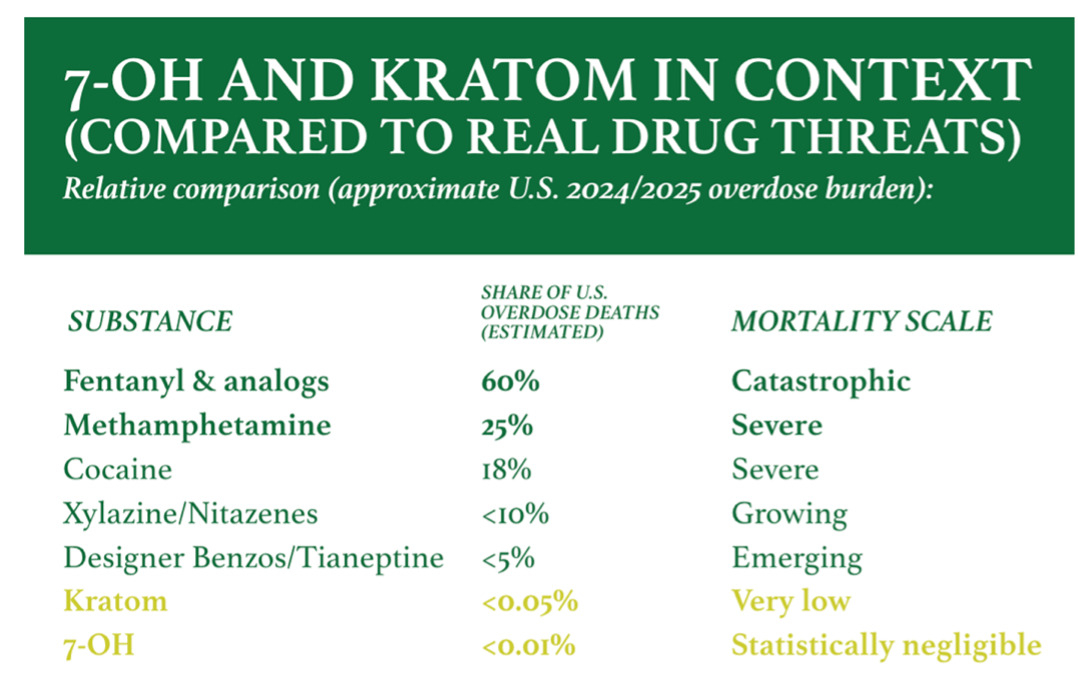
Let’s be clear: 7-OH is not a public health crisis. According to the Food and Drug Administration’s (FDA) own Adverse Event Reporting System (FAERS), and shown in the Marwood Report, there have been under 75 adverse events ever reported, despite well over a billion doses consumed nationwide.”
According to Smith, the real public-health danger is coming from unregulated products like Feel Free, which combines kratom and kava into an addictive cocktail that has caused severe physical and emotional harm to consumers, including intense withdrawal, depression, skin deterioration, and emotional instability.
The FDA abandoned its case against Feel Free but continues to pursue 7-OH, despite no FDA-reported deaths, fueling concerns that politics and powerful relationships, including ties to Robert F. Kennedy Jr., are outweighing real consumer protection.
“The fixation on 7-OH is a deliberate distraction from these far more dangerous products flooding the market, many of them marketed without clear warnings and readily available in convenience stores,” Smith said. “Instead of pursuing a misguided ban, regulators should focus on consumer protection through consistent, science-based standards applied equally across all kratom products.”
Smith added that HART continues to call for evidence-based policymaking and open scientific review before any action is taken that could harm consumers, researchers, and small businesses operating within the legal botanical products industry.
“The American people deserve transparency, scientific integrity, and consumer choice,” Smith continued. “The scheduling of 7-OH is a dangerous precedent. It tells consumers their health takes a back seat to corporate lobbying. It tells researchers their work will be evaluated in the policymaking sphere based on politics, not evidence. And it tells patients seeking safer alternatives that Washington would rather push them into the shadows than allow regulated, legal access.”
About Holistic Alternative Recovery Trust (HART)
The Holistic Alternative Recovery Trust (HART) is a nonprofit policy organization dedicated to advancing safe, evidence-based access to natural alternatives for recovery and wellness. HART advocates for scientific transparency, consumer safety, and regulatory accountability in emerging health and wellness industries. Learn more at hartsupporter.com.
Media Contact
HART Media
media@hartsupporter.com

KP Public Affairs Celebrates 30-Year Anniversary with Third Generation Leadership
KP Public Affairs is excited to celebrate its 30-year anniversary and announce its third generation leadership with a new management team.
As one of the longest standing and consistently effective advocacy and public affairs firms in California, KP’s work continues to expand in all practice areas including legislative and regulatory advocacy, policy consulting, public relations, and procurement.
The firm’s new management team will be led by Alison MacLeod, John Doherty, and Brian White, and will oversee day to day operations alongside partners Jon Ross, Ed Manning, Mike Burns, Jeff Sickenger, Jenny Dudikoff, Vanessa Cajina, Patrick Geoge, and Pat Joyce.
KP began in the mid-1990’s by combining two firms to create the largest lobbying firm in the state with clients that represented every major industry and local government sector in California. KP has evolved over the last three decades to become a full-service, integrated public affairs firm with a comprehensive public relations and regulatory consulting practice. Throughout this growth, the company has maintained a boutique feel with the highest level of service and dedication to client success.
“We are focused on delivering client successes today, while positioning the firm for future growth with continuous expansion of our expertise and capabilities. KP has a strong foundation of clients across industry sectors and interest areas, and we have a highly talented team of professionals that are working every day to meet our clients’ goals,” said Alison MacLeod, John Doherty, and Brian White.
In 2022, KP joined Public Policy Holding Company (PPHC), a group of leading national and international lobbying and public affairs firms. As California is increasingly recognized as a global leader in setting public policy, there is interest far beyond the state’s borders in California policy and political affairs. By joining PPHC, KP has expanded its network of client connections, and positioned the firm for collaboration across national and international interests.
With the recent expansion of the firm’s leadership to include seasoned professionals in both the advocacy and public relations spaces, KP has enhanced the services offered to clients and expanded those services into new issue areas. KP has strengthened its commitment to strategic advocacy and public affairs consulting, utilizing a wide variety of products and services, to assist our clients in achieving their business objectives. Our multidimensional approach remains strong and unmatched, setting us apart from our competition.
“After 30 successful years, we remain focused on providing leadership and strategy as a trusted advisor on California policy issues, offering superior services and comprehensive public affairs programs to deliver client wins, big and small, for years to come,” said Mike Burns, partner.
With more than 30 employees, including 14 lobbyists and 12 public relations professionals, KP’s bench of talent brings a multifaceted skillset that is deep and diverse, spans several industries and issue areas, with various backgrounds and professional expertise.
About KP Public Affairs
KP Public Affairs’ multi-dimensional expertise spans across four service offerings, public affairs, legislative advocacy, regulatory consulting, and public relations, to assist our clients in navigating the complexities of California government. In 2022, KP Public Affairs became part of the Public Policy Holding Company, which is comprised of Crossroads Strategies, Forbes Tate Partners, Seven Letter, O'Neill and Associates, Alpine Group, MultiState Associates, Concordant Advisory, Lucas Public Affairs, Pagefield, TrailRunner International and Pine Cove Strategies. For more information, www.kppublicaffairs.com.
Media Contact
Jenny Dudikoff
jdudikoff@ka-pow.com

POUCH Drinkable IV Formula™ Introduces The First-of-its-Kind Ready-to-Drink Supplement Built for High-Performers
POUCH today announced the launch of it's new nationwide supplement brand designed to deliver IV-inspired nutritional formulations in a portable, ready-to-drink format. The product line is intended for individuals seeking targeted, nutrient-dense supplementation without the time commitment or clinical setting required for traditional IV therapy. The initial launch includes four premium blends formulated to support daily nutrition without needles, appointments, or downtime:
- Hydration+: Powered by marine minerals to help replenish minerals lost through sweat and support lasting performance
- Immunity+: Powered by a blend of polyphenols, vitamin C, zinc, and more to support immune health
- SkinRevive+: Delivers 2x the antioxidant power of standard skin drinks to support overall healthy, radiant-looking skin
- WellDrip+: Inspired by the Myers’ Cocktail, this blend combines vitamins, minerals, and antioxidants to support energy and total wellness.
Each formula is proprietary, built around a clear outcome so users can choose the support that fits their needs.
Miami-based founder Annie Kurnick, who built her career in luxury media and brand development, relied on IV therapy during periods of intense travel and high-pressure work. While effective, the format never fit her on-the-go lifestyle.
“IV therapy worked for me, but sitting still for an hour never made sense,” says Kurnick. “I wanted something targeted, portable, and real, something that could actually keep up.”
That insight became POUCH. The formulas are inspired by well-known IV therapy blends, including the Myers’ Cocktail, using highly bioavailable vitamins, minerals, and antioxidants for efficient absorption. Across the collection, standout ingredients include:
- Aquamin™, a multi-mineral complex derived from red algae harvested off the coast of Iceland that carries over 72 trace minerals to support superior hydration and absorption.
- NutriGlo® Glutathione, often called the body’s “master antioxidant,” defends against oxidative stress and supports detoxification.
- VitAlign™, a blend of 7 plant-based polyphenols that helps reduce oxidative stress, protect cells from free radicals and support a healthy immune response.
Design is central to POUCH’s identity. Each product comes in a flexible, lightweight pouch with a sport nozzle spout, subtly referencing an IV bag while remaining sleek, discreet, and travel-ready. Packaging incorporates post-consumer recycled materials where feasible, signaling an early commitment to sustainability.
“This is about premium fluids that carry meaningful nutrition into real life,” Kurnick adds. “Our customers operate at a high pace, and their nutrition can slip to the margins of the day. What they’re missing isn’t discipline, it’s time. POUCH was built to solve for that.”
Formulation rigor was non-negotiable from day one. All products are produced in cGMP-certified facilities, with ingredients sourced from validated suppliers, and formulas third-party tested to ensure quality, label accuracy, and reliability.
“From a formulation standpoint, the goal with POUCH was efficiency,” says Rachel Dannemeyer, POUCH’s lead consulting chemist. “We selected nutrient forms that are known to be highly bioavailable orally and built each blend around purposeful dosing rather than excess. Every ingredient is there to support a specific function, and the delivery format was designed to make daily use realistic, not clinical.”
POUCH is rewriting the rules of advanced nutrition: proprietary, IV-level fluids delivered in a sleek package, engineered for lives in constant motion. For consumers, this means high-performance hydration, immunity, total body wellness, and skin support in a format that keeps up, anywhere, anytime.
About POUCH
POUCH is an IV-inspired, ready-to-drink supplement brand delivering targeted solutions for hydration, immunity, total body wellness, and skin support in a portable, modern format. Using IV-inspired formulation logic and bioavailable ingredients, POUCH offers premium, performance-focused fluids designed for high performers who need reliable nutrition that fits the pace of real life. To learn more, visit drinkpouch.com or connect on Instagram or LinkedIn.
Aquamin™ is a registered trademark of Marigot Ltd. of Cork Ireland. NutriGlo® is a registered trademark of NutriScience Innovations, LLC. VitAlign™ is a trademark of VDF FutureCeuticals, Inc., used under license. POUCH™ and Drinkable IV Formula™ are trademarks of Ivy Products, LLC.
Media Contact
Tanya Doggwiler
ONDA Marketing + PR
tanya@ondamarketingco.com
+1 631-702-5734

Pushly and The Arena Group Extend Strategic Partnership Through 2027 to Accelerate Audience Growth and Engagement
Pushly, the leading AI-driven audience engagement and push notification platform for publishers and e-commerce brands, today announced a two-year extension of its strategic partnership with The Arena Group, continuing their collaboration through 2027. The renewed agreement reinforces both companies’ shared commitment to driving measurable audience growth, deeper reader relationships, and incremental revenue across The Arena Group’s portfolio of premium media brands.
Since partnering, Pushly has helped power The Arena Group’s direct-to-consumer engagement strategy by delivering high-performance web push experiences that increase return visits, subscriber acquisition, and monetizable sessions — providing a reliable channel for reaching audiences beyond search and social platforms.
Together, the companies will expand their focus on AI-powered personalization, first-party data activation, and performance optimization to help The Arena Group strengthen owned audience channels and future-proof its growth strategy.
“Publishers can’t afford to rent their audiences anymore — they have to own the relationship,” said Brendan Ripp, CEO of Pushly. “The Arena Group understands that direct engagement is now a core growth lever, not a nice-to-have. We’re proud to extend this partnership through 2027 and continue delivering incremental pageviews, stronger loyalty, and meaningful revenue impact across their portfolio.”
“The ability to directly connect with our audiences in real time is critical to our content and commerce strategy,” said Paul Edmondson, CEO of The Arena Group. “Pushly has proven to be a trusted partner that consistently delivers measurable results. Extending this relationship allows us to further scale personalized engagement and drive sustainable growth across our brands.”
The extended partnership will include continued deployment of Pushly’s full web push suite, advanced segmentation and automation capabilities, and new AI-driven tools designed to maximize performance across breaking news, evergreen content, and commerce initiatives.
As publishers face ongoing disruption from algorithmic platforms and AI-powered search, owned channels like push notifications are becoming essential infrastructure — enabling brands to reach audiences directly, instantly, and profitably.
About Pushly
Pushly is an AI-powered audience engagement platform that helps publishers and e-retailers drive incremental traffic, increase conversions, and grow first-party relationships through intelligent web and in-app push notifications. Leading media brands rely on Pushly to turn attention into action and revenue. For more information, visit pushly.com.
About About The Arena Group
The Arena Group Holdings, Inc (NYSE: AREN) is a brand, data and IP company that builds, acquires, and scales high-performing digital assets. We combine technology, storytelling, and entrepreneurship to create deep content verticals that engage passionate audiences across sports and leisure, lifestyle, and finance. Through our portfolio of owned and operated brands including TheStreet, Parade, Men's Journal, Athlon Sports, the Adventure Network (Surfer, Powder, Bike, etc), ShopHQ and others, we deliver trusted content and meaningful experiences to millions of users each month. Learn more at thearenagroup.net.
Media Contact
Pushly Marketing
marketing@pushly.com
Sanford Heisler Sharp McKnight Releases 2026 Worker Misclassification Guide: Navigating New Wage Thresholds and Legal Risks
Beginning in 2026, new state laws, particularly in California, will raise the minimum salary for exempt employees to over $70,000 annually, a change that places millions of workers at risk of misclassification. This shift exposes employers to severe legal and financial consequences, including liability for back pay and significant penalties. The new regulatory environment is prompting calls from legal experts and regulators for immediate employer compliance audits across the nation to mitigate a wave of potential litigation and enforcement actions.
The New Regulatory Landscape of 2026
The updated wage and hour regulations taking effect in 2026 represent a significant challenge for businesses, especially those that have not recently reviewed their employee classifications. Higher salary thresholds combined with a renewed focus on enforcement from both federal and state agencies create a high-stakes compliance environment where errors can be exceptionally costly.
1. Understanding the Salary Threshold Increase
A key driver of this change is California's new exempt salary threshold, which will rise to $70,304 annually effective January 1, 2026. This is part of a broader national trend, with 18 states adjusting their minimum wages and exemption thresholds for 2026. Any salaried employee earning less than the new threshold in their respective state must be reclassified as non-exempt, making them eligible for overtime pay. Concurrently, the U.S. Department of Labor has finalized a new rule to clarify the distinction between employees and independent contractors, signaling a heightened federal focus on reducing misclassification risk.
2. Who is Most Affected by Reclassification?
Job roles most vulnerable to reclassification often include junior managers, administrative staff, sales representatives, and other professionals in industries like retail, hospitality, and technology. A job title alone, such as manager, is not sufficient to determine exempt status; the employee's actual day-to-day duties are the deciding factor. Employers in high-cost-of-living areas like Long Island and California face particularly heightened risks and are being advised to conduct proactive audits before employee complaints or government enforcement actions arise.
Defining Exempt vs. Non-Exempt Status
Determining whether an employee is legally exempt from overtime pay involves a two-part test that considers both their salary and their specific job responsibilities. While the new salary thresholds are a clear-cut benchmark, the duties test is more subjective and a common source of employer error and subsequent litigation.
1. The 'Duties Test': Beyond the Paycheck
For an employee to be legally classified as exempt, their compensation must exceed the new salary threshold, and their job responsibilities must primarily involve executive, administrative, or professional duties as defined by the Fair Labor Standards Act (FLSA). The executive exemption requires that an employee's main duty is managing the business, that they direct the work of at least two other employees, and that they have the authority to hire or fire. The administrative exemption applies to employees whose primary duty is office work directly related to business operations and who exercise discretion and independent judgment. The professional exemption covers employees whose work requires advanced knowledge in a field of science or learning, or is original and creative in an artistic field.
2. Common Misclassification Scenarios
Frequent employer mistakes can lead to costly class-action lawsuits and regulatory penalties. These errors often stem from a misunderstanding of the law or a failure to adapt to changes in an employee's actual job functions over time. Key errors include:
- Relying on Job Titles: Classifying all managers or supervisors as exempt without a detailed analysis of their daily tasks and decision-making authority.
- Ignoring 'Off-the-Clock' Work: Failing to pay non-exempt employees for work performed before or after shifts, during meal breaks, or at home. Data shows nearly one-third of U.S. employees who record their hours report that they sometimes work without logging that time.
- Improper Independent Contractor Classification: Misclassifying workers as independent contractors to avoid paying minimum wage, overtime, and payroll taxes. This practice is a major focus for the IRS and state labor departments, particularly in the gig economy, where high-profile enforcement actions are becoming common.
- Incorrect Overtime Calculation: Paying straight time for overtime hours or failing to include commissions and non-discretionary bonuses in the regular rate of pay when calculating overtime premiums.
3. Expert Insight on Escalating Compliance Risks
The shifting legal landscape for 2026 requires employers to be more vigilant than ever, according to legal experts. The new salary thresholds are a tripwire for businesses that have been passive about compliance.
David Sanford, Chairman of Sanford Heisler Sharp McKnight, noted, "Wage theft enforcement in 2026 is focusing on two areas: timekeeping integrity and worker misclassification. The mechanisms are often quiet—minutes shaved through clock rounding, off-the-clock prep work, edited timecards—but they add up at scale. State attorneys general are actively litigating these issues, California just strengthened wage recovery tools effective January 1st, and the DOL has made independent contractor misclassification a priority. Employers need systems that capture compensable time accurately, not aspirationally."
A proactive audit guided by an experienced wage theft lawyer is no longer optional—it is an essential risk management strategy.
The High Cost of Non-Compliance
The financial and reputational damage from a misclassification finding can be severe. Penalties extend beyond unpaid wages and can include damages, fines, and legal fees that can threaten a company's financial stability.
1. Financial Penalties and Back Pay Liability
Misclassified employees can sue for up to three years of unpaid overtime, liquidated damages that can double the amount owed, and attorney's fees. The scale of the problem is substantial; between 2021 and 2023, government enforcement and class-action lawsuits recovered over $1.5 billion in stolen wages for workers. For an individual, the losses can be significant; a misclassified construction worker could lose over $16,700 annually in income and benefits. Major companies have faced staggering penalties, such as ride-share company Lyft's $19.4 million settlement in New Jersey for misclassifying over 100,000 drivers.
2. Federal vs. State Enforcement Mechanisms
Employers must comply with both federal and state laws, and they are required to follow the law that provides greater protection to the worker. Many states, such as California, have stricter requirements for overtime, meal breaks, and penalties than federal law.
Primary enforcement
- Federal law (FLSA): U.S. Department of Labor (DOL)
- California law: Labor Commissioner’s Office; Private Attorneys General Act (PAGA)
Overtime pay
- Federal law (FLSA): 1.5× pay for hours worked over 40 in a workweek
- California law: 1.5× pay for hours worked over 8 in a day or over 40 in a week; 2× pay for hours worked over 12 in a day
Meal and rest breaks
- Federal law (FLSA): Not federally mandated
- California law: Mandated paid 10-minute rest breaks and unpaid 30-minute meal breaks
Unique penalties
- Federal law (FLSA): Liquidated damages equal to double back pay
- California law: PAGA allows employees to sue on behalf of the state to recover civil penalties; the Labor Commissioner may investigate and remedy tip theft directly
A Proactive Approach to a New Era of Wage Law
As the 2026 deadlines approach, the convergence of higher salary thresholds and aggressive enforcement actions creates a critical juncture for U.S. employers. The financial and reputational risks associated with worker misclassification have never been higher. For employees, the new regulations offer a powerful tool to claim rightfully earned wages. Legal experts anticipate a significant increase in wage and hour litigation, making compliance audits and classification reviews a fundamental business necessity in the coming years.
About Sanford Heisler Sharp McKnight, LLP
Sanford Heisler Sharp McKnight is a premier national civil rights and public interest law firm with offices in New York, Washington, D.C., San Francisco, Palo Alto, San Diego, and Nashville. The firm specializes in high-stakes litigation against powerful interests, having recovered more than $15 billion for its clients. Core practice areas include:
- Employment & Executive Representation: Discrimination, harassment, wrongful termination, and wage theft.
- Institutional Accountability: Sexual violence, Title IX, and victims' rights.
- Financial Integrity: Whistleblower/qui tam, False Claims Act, and ERISA class actions.
The firm is consistently ranked Tier 1 by Best Law Firms® and has been named Civil Rights Firm of the Year by The National Law Journal. In 2024 and 2025, Chairman David Sanford was recognized by Forbes as one of America’s and New York’s top attorneys. For more information, visit sanfordheisler.com.
Media Contact
Jamie Moss
Jamie@newspros.com


California Department of Public Health Updates Kava Guidance, Clarifying the Status of Traditional Preparation
Today, the Kava Coalition welcomed an important update from the California Department of Public Health (CDPH), which revised its Consumer Fact Sheet for Kava to clearly recognize traditionally prepared kava as a lawful single ingredient conventional food when steeped in water.
Following input by the Kava Coalition and ongoing dialogue with state regulators, CDPH updated its guidance to explicitly state that kava steeped solely in water and prepared as a single ingredient beverage is not regulated as a food additive. The updated Consumer Facts Kava 2026 document now reads: “Kava would generally not be regulated as a food additive if kava is steeped in only water to brew tea and consumed as a single ingredient conventional food.”
In addition to this clarification, CDPH materially revised the summary section of the fact sheet. While the earlier version referenced only the absence of regulatory limitations for kava as a dietary supplement, the updated document now states that “there are currently no regulatory limitations regarding the use of kava as a single ingredient conventional food or dietary supplement.” This change explicitly expands lawful use beyond supplements and directly affirms the legitimacy of traditional water-based kava preparation.
“This update provides long-needed clarity for consumers, businesses, and regulators alike,” said Douglas La Rose, Executive Director of the Kava Coalition. “For more than a year, the Kava Coalition has worked closely with kava bars across California to petition for clear guidance, and the state has now provided that clarity. We also consulted extensively with Pacific Islander communities who were deeply concerned about California’s position on kava as a conventional food. Traditional kava preparation has profound cultural significance and a long history of safe use, and we are encouraged to see California’s guidance now clearly reflect that reality.”
California is home to one of the largest Pacific Islander populations in the continental United States, including communities from Fiji, Tonga, Samoa, and other kava-producing cultures. For these communities, kava is not only a social beverage but a cornerstone of cultural practice, ceremony, and identity. The updated CDPH guidance provides meaningful cultural recognition while also supporting small businesses and community spaces that contribute to local economies throughout the state.
The Kava Coalition views this update as a significant step forward for public understanding, regulatory consistency, and cultural recognition in California. After a period of uncertainty, the revised guidance offers a more stable and accurate framework for how kava is prepared and consumed across the state.
The Coalition expressed appreciation for the engagement of CDPH staff and acknowledged the persistence and collaborative efforts of its members and partners who contributed to this outcome.
Copies of the prior and updated fact sheets are available upon request from CDPH.
About Kava Coalition
The Kava Coalition is an alliance of noble kava consumers, experts, and industry leaders committed to advancing kava education, advocacy, and choice. By promoting responsible consumption, market transparency, and cultural respect, the Coalition works to ensure that noble kava is widely recognized, accessible, and valued as a safe, pro-social beverage. For more information, visit www.kavacoalition.org.
Media Contact
Douglas La Rose
info@kavacoalition.org
GCS Fibers Announces the Relocation of Its Breakthrough Coal Industry Operations to the U.S. Market
GCS Fibers LLC recently announced that its first factory in the United States will be operational by October 2026, furthering its plans to relocate operations to the U.S. market this year. Over the next five years, GCS Fibers plans to build at least 25 U.S. factories, with the potential to create up to 12,500 direct jobs and 62,500 indirect jobs.
Ambition for American Energy Independence and Job Creation Through Innovation
Amid an ongoing push for American energy independence, manufacturing sector revitalization, and job creation, GCS Fibers’ market entry is notable. The mineral fibers and pulp produced by the company can be used to manufacture end-products such as automobiles, airplanes, textiles, construction and building materials, rubber, plastics, and carbon fiber precursors, just to name a few. To implement its U.S. market operations, the company says it is seeking partnerships with federal and state governments, industry stakeholders, trade associations, and investors as it begins construction of its factories.
Two Core Technologies
Led by CEO Ato Andoh, GCS Fibers specializes in innovations that empower the U.S. energy and manufacturing sectors. The company’s core technologies encompass its coal ash-to-mineral fiber and pulp production and its complementary coal power plant emissions capture technology, which captures 96% of coal power plant emissions, including CO2. According to the company, these two areas of development are intended to contribute to broader efforts to strengthen domestic manufacturing and industrial sustainability in the United States, in addition to facilitating America’s quest for sustained energy independence, job creation, and reduced energy costs for American consumers while mitigating any adverse environmental impact from coal energy generation.
Safe and High-Quality Mineral Fiber and Pulp Products
GCS Fibers has made strides in mineral fiber and pulp manufacturing innovation through the high-volume recycling of coal ash. According to company data, these developments have led to lower reported No Significant Risk Values (NSRLs) for carcinogenic compounds in the company’s mineral fibers. When combined with its complementary coal power plant emissions-capture innovation, GCS Fibers states that its approach is designed to introduce safe, highly applicable, and sought-after mineral fiber and pulp raw materials to America’s industrial base, spurring the next American industrial revolution.
“Worst-case estimates of exposure to trace metals in the mineral fiber insulation are 11- to 167,504-fold below their respective NSRL values,” Canadian third-party risk-assessment firm Intertek Assuris reported of GCS Fibers. “Risks of adverse effects attributable to the trace metals from use of the mineral fiber are negligible.”
Carbon Emissions Reduction Technology
Complimenting its high-volume coal ash-to-mineral fiber and pulp recycling innovation, GCS Fibers claims that its associated coal power plant greenhouse gas emissions capture technology can capture up to 96% of CO2 emissions. Perhaps more importantly, the company’s emissions capture systems are designed to be adaptable for use in recently closed, existing, and new coal power plants, allowing for potential retrofitting across multiple facility types. While these innovations have deployed abroad, the company is exploring their potential in the U.S. market.
Cryptocurrency Innovations
To date, GCS Fibers has been funded by its members and a cryptocurrency ecosystem developed by a separate team, also led by Ato Andoh. The ASH DAO | Ash Token uses its transaction fees to provide grants to companies with proven innovations, measurable job creation, and environmental goals. According to the organization, the cryptocurrency is intended to support breakthrough real-world projects focused on job creation, economic development, and sustainability rather than speculative investment.
Plans for the Future
As GCS Fibers pursues federal and state funding opportunities, the company maintains that its planned U.S. operations could contribute to domestic manufacturing, increased energy generation, job creation, and environmental efficiency. GCS Fibers representatives state that these efforts are aimed at supporting long-term economic and industrial development.
About GCS Fibers
Through innovative energy generation, manufacturing, economic development, and environmental solutions, GCS Fibers aims to lead the next generation of American mineral fiber pulp manufacturing. By transforming billions of tons of domestic coal ash waste into valuable industrial materials while capturing up to 96% of coal power plant emissions, GCS Fibers says it is working toward creating long-term jobs that revitalize communities and reduce reliance on imports. For more information, visit www.gcsfibers.com.
Media Contact
Daniel Perez
contact@gcsfibers.com
Author Steve Munkeby Announces New Book About the Bible
Steve Munkeby, founder of NextGen Publications LLC and author of multiple books, has announced that a new project is in the works. He plans to research the Bible to write a book for both believers and non-believers that addresses biblical topics. This will be his first written work focusing on the Bible.
“Let me explain what I mean. Right now, I’m working on the topic of parenting, and the way I approach it is pretty simple. I start with the biblical references themselves and then look at what those passages say when you put them side by side. It’s less about arguing a doctrine and more about exploring how Scripture actually talks about parenting across different contexts, and what that might mean for real life. That same approach shows up in other topics, too; things like shame, speech and waiting. It’s a different perspective, one that’s meant to be practical and reflective rather than theological or argumentative,” says Dr. Munkeby.
Dr. Munkeby’s Career Background
As an author and educator, Dr. Munkeby has built a unique career in technology and systems development. With four decades of professional experience, his passion for his work has led him to notable success in his field. Amid the rise of artificial intelligence, he continues to bridge the divide between emerging technology and its practical application.
Before his current role as an author and educator, Dr. Munkeby completed a Bachelor of Science in computer science at the University of Montana in 1977. He then enlisted in the U.S. Army as a second lieutenant and infantry officer. As he rose to the rank of first lieutenant in 1979, then captain in 1981, his role as a leader was quickly solidified. Dr. Munkeby transitioned to the U.S. Army Ready Reserve later in 1981, serving as an infantry officer until 1983.
During his service in the U.S. Army Ready Reserve, Dr. Munkeby furthered his education. Upon leaving his position as an infantry officer, he completed a Master of Science in systems management at the University of Southern California. In 2007, he earned a Doctor of Management in organizational leadership from the University of Phoenix.
During his service in the U.S. Army Reserve, Dr. Munkeby entered the aerospace industry. In this role, he served as a software engineer, program manager and assistant vice president until 2013. From 2007 until his retirement in 2024, he also took on part-time faculty roles at five universities. In 2024, Dr. Munkeby founded NextGen Publications LLC.
Advocating for Artificial Intelligence
Having served in the military, aerospace and education, Dr. Munkeby has been uniquely positioned to comment on artificial intelligence innovation. He recognizes, whether from direct conversations or on social platforms, that there is a lack of trust surrounding this new technology. This issue is one that Dr. Munkeby has been exploring across all 16 of his books published through NextGen Publications LLC.
Some of Dr. Munkeby’s most recent works focus on faculty responses to artificial intelligence, as the technology demands adaptation in teaching. His book, written with Dr. Barb Turner, “Faculty in the AI Era — Rethinking Teaching, Supervision, and Academic Integrity,” is especially focused on this matter. With its publication, Dr. Munkeby positions himself at the forefront of this divisive topic. He aims to make the technology feel simple, practical and useful in everyday life by teaching others to leverage it in meaningful ways.
Plans for the Future
Dr. Munkeby’s current focus remains on writing and publishing his next book on the Bible. However, within the next few years, he has ambitions to expand his company and increase his publications. He also hopes to assist others in publishing their own work, ever dedicated to helping people find their way.
About NextGen Publications
Dr. Steve Munkeby is an author, educator and founder of NextGen Publications LLC. With experience in the aerospace industry and the military, he has written 15 publications, including a series of 10 handbooks titled “AI Made Simple.” Dr. Munkeby was previously featured on Apple News, USA Today, and the Wall Street Journal. For more information, visit stevemunkeby.com.
Media Contact
Dr. Steve Munkeby
drstevemunkeby@gmail.com

Black Banx Group Reports Record Full-Year 2025 Results, Strong Year-on-Year Growth and Quantified Outlook for 2026
Black Banx Group today announced its full-year financial and operational results for the year ended 31 December 2025, highlighting record revenue and profitability, continued operational efficiency gains, and a year-end customer base just short of 100 million clients.
Financial Performance Overview — Key Financial Metrics
- Revenue: $14.2 billion in FY 2024; $17.1 billion in FY 2025 (+20.4% YoY)
- Profit before tax (PBT): $4.9 billion in FY 2024; $6.5 billion in FY 2025 (+32.6% YoY)
- Cost-to-income ratio: 65.5% in FY 2024; 62.0% in FY 2025 (down 350 basis points)
- Year-end clients: 78.1 million in FY 2024; 99.9 million in FY 2025 (+28% YoY)
- Employees: 8,212 in FY 2024; 10,081 in FY 2025 (+23% YoY)
The improvement in the cost/income ratio reflects operating leverage, automation, and disciplined cost management, with profit growth materially outpacing revenue growth.
Full-Year 2025 Highlights
- Revenue: USD 17.1 billion
- Profit before tax: USD 6.5 billion
- Global client base: 99,998,982 customers
- Employees: more than 10,000 globally
- Client reach: services provided in over 180 countries
While the Group narrowly missed its internal target of reaching 100 million customers by year-end — falling short by 1,018 clients — Black Banx significantly exceeded expectations on revenue and profitability, reinforcing the scalability and resilience of its digital banking platform.
Quarterly Momentum in 2025
- Q1 2025: Revenue USD 4.3 billion, PBT USD 1.6 billion
- Q1–Q3 2025: Revenue USD 12.7 billion, PBT USD 4.7 billion
- Q4 2025: Revenue USD 4.4 billion, PBT USD 1.8 billion
The consistent quarterly performance underpinned full-year revenue of USD 17.1 billion and profit before tax of USD 6.5 billion.
Management Commentary
“The comparison with 2024 clearly demonstrates the transformation underway at Black Banx,” said Michael Gastauer, Group CEO. “In just one year, we increased revenues by over 20%, profits by over 32%, and reduced our cost/ income ratio by more than three percentage points — all while scaling our client base to almost 100 million globally.”
“Our 2025 results confirm the financial strength and scalability of the Black Banx platform,” said Daniel Dumitrascu, Group CFO. “With USD 17.1 billion in revenue and USD 6.5 billion in profit before tax, we enter 2026 from a position of strength. Our focus remains on disciplined growth, further margin expansion, and sustaining a low cost/income ratio as we continue to scale globally.”
Quantified Outlook for 2026
Based on its current run-rate, operational scale, and expansion plans, Black Banx provides the following management outlook for 2026:
- Clients: 125–130 million by year-end
- Revenue: USD 20–22 billion
- Profit before tax: USD 8.0–8.5 billion
- Cost / Income Ratio: low 60% range
Growth is expected to be driven by continued client acquisition, increased transaction volumes, higher monetisation per customer, and further efficiency gains from automation and technology investments.
About Black Banx Group
Black Banx Group is a leading global fintech, serving over 78 million customers across more than 180 countries. With over 8,700 employees and offices on four continents, we deliver secure and all-inclusive digital banking services to individuals, businesses, and institutions worldwide. Black Banx is committed to innovation, financial accessibility, and seamless cross border financial solutions. For more information, visit www.blackbanx.com.
Media Contact
Black Banx Media Relations
mediateam@blackbanx.com

B57+ Business Leaders Initiative Establishes Asia-Pacific Headquarters at Indonesia Economic Summit 2026
At the Indonesia Economic Summit 2026 the summit, the announcement of the establishment of the B57+ Asia-Pacific Regional Headquarters was made, marking a significant milestone in the B57+ Business Leaders Initiative.
Launched under the auspices of the Islamic Chamber of Commerce and Development (ICCD), the initiative is a leading private sector-led strategic program aimed at promoting economic integration among Islamic countries and strengthening their connection to the global economy.
Abdullah Saleh Kamel, President of the Islamic Chamber of Commerce and Development (ICCD) and President of the Federation of Saudi Chambers, underscored the strategic importance of the new Asia-Pacific branch. He described it as a pivotal step in expanding the initiative and transforming economic partnerships from coordination frameworks into actionable projects with direct developmental impact.
Kamel explained that the B57+ initiative was created to address a longstanding gap in trade and investment among member states of the Organization of Islamic Cooperation (OIC). Despite a combined population exceeding two billion and vast natural and financial resources, intra-OIC trade currently accounts for only 20-22% of total trade.
He attributed this gap to structural challenges, including divergent regulatory frameworks, fragmented private sector representation, and limited sustainable channels for communication between policymakers and business communities. B57+ seeks to overcome these challenges by establishing a structured and enduring platform for public-private partnerships.
Kamel emphasized that the initiative serves as a bridge between government policies and the practical investment and operational needs of the private sector, translating economic cooperation frameworks into tangible results such as expanded trade, increased cross-border investment, job creation, and shared prosperity.
The B57+ initiative is an inclusive global economic platform extending beyond OIC member states to encompass countries with significant Muslim populations, international centers for Islamic finance and trade, and global institutions aligned with the principles of Islamic economics. The “+” symbol reflects this comprehensive vision, emphasizing the creation of an interconnected economic network that fosters integration among emerging markets while moving beyond short-term interests and geopolitical polarization.
He noted that the initiative marks a qualitative shift in the private sector’s role in the Islamic world, transitioning from mere capitalization on opportunities to actively shaping impact, thereby reinforcing the Islamic economy’s position as a major driver of global growth.
Looking ahead, B57+ is expected to provide a practical framework for harmonizing common economic policies, encouraging cross-border investment, and converting economic agreements into tangible projects, ultimately enhancing the Islamic economy’s presence and influence within the global economic system.
The world is standing at a decisive economic and moral crossroads, as rapid geopolitical and economic shifts reveal deep vulnerabilities in the prevailing global economic order, said Kamel.
Addressing the opening session of the summit, Kamel added that increasing fragmentation of the international system and the dominance of power-based interests have undermined justice, development, and human values, creating an urgent need for a more balanced and inclusive economic model.
He noted that the current global economic framework has proven incapable of delivering sustainable growth or ensuring equitable access to opportunities, attributing this failure to the growing separation between economic policies and ethical principles.
Kamel observed that the global economic discourse prevailing in major international forums no longer inspires confidence, instead reflecting a harsh reality marked by weakened regulatory frameworks, erosion of justice, and the dominance of profit-maximization and hegemonic logic over considerations of humanity, society, and environmental sustainability.
He stressed that these challenges impose a dual responsibility on business leaders in the Global South and developing economies to take the initiative in shaping a new economic framework founded on the principle of rights and obligations, rather than short-term profit-and-loss calculations.
Kamel emphasized that sustainable economic systems cannot exist without a clear moral framework, noting that investment, trade, and finance should function as tools to advance societal welfare. He warned that detaching economics from values has contributed to the erosion of trust, the fragmentation of communities, and increasing environmental harm.
He pointed out that the Islamic world possesses a longstanding civilizational legacy founded on strong ethical and value-based economic principles, which historically enabled it to contribute to the development of resilient and human-centered economic models. He said the opportunity remains for the Islamic world to reclaim this role and actively participate in shaping a more stable and just global economic future.
Highlighting the role of the private sector, Kamel said, it is capable of leading development pathways through effective partnerships with the public sector, provided there is political commitment, enabling legislation, and institutional frameworks capable of translating strategic visions into measurable outcomes.
In this regard, he commended the economic reforms being implemented in several countries, particularly the Kingdom of Saudi Arabia, noting that Saudi Vision 2030 has offered a practical and forward-looking model for redefining the relationship between the state and the economy. Kamel said the Vision has strengthened the private sector’s role through comprehensive regulatory reforms, major infrastructure investments, and accelerated digital transformation.
Kamel added that the Kingdom’s continued economic liberalization and institutional modernization reflect a broader international shift toward empowering the private sector as a key driver of sustainable growth, employment generation, and economic resilience.
The Indonesia Economic Summit 2026 is being held at a critical juncture for the global economy, underscoring the importance of dialogue platforms that bring together policymakers, private sector leaders, and research institutions to reexamine growth models, enhance cross-border cooperation, align public policy with market dynamics, and reinforce the private sector’s role in advancing development.

SoulGen 2.0 Redefines Image-to-Video AI with Unprecedented Technical Breakthroughs
SoulGen today announces that its groundbreaking 2.0 platform has established new industry benchmarks for image-to-video AI generation. By combining revolutionary facial consistency technology with industry-leading motion accuracy and color reproduction, SoulGen 2.0 positions itself as the definitive solution for professional content creators across entertainment, marketing, social media, and digital storytelling.
Why Image-to-Video AI Matters Now
The digital content creation industry is undergoing a significant transformation driven by artificial intelligence advances. Recent studies indicate that 41.7% of AI content platforms now enable video generation capabilities — yet most struggle with fundamental technical challenges:
- Facial distortions during movement
- Color inconsistencies across frames
- Unnatural, robotic motion
SoulGen 2.0 directly addresses these industry-wide limitations through comprehensive technical innovations that deliver professional-grade results.
Who benefits from SoulGen 2.0?
SoulGen 2.0 serves diverse creative applications across multiple industries:
Film and Animation
- Pre-visualization
- Character studies
- Concept development
Digital Marketing
- Dynamic social media content
- Product demonstrations
- Brand storytelling
Gaming
- Character animation references
- Cutscene prototyping
Education
- Interactive learning materials
- Historical recreations
Social Media
- Engaging video content
- Content creation for influencers and creators
Core Technology Breakthroughs
1. Unmatched Facial Identity Consistency
The challenge: Facial consistency is the most critical quality metric for character-driven content generation. Traditional AI video generators struggle to maintain facial features when subjects move or change angles.
The solution: SoulGen 2.0 achieves an industry-leading ID consistency score of 0.96, dramatically outperforming competing solutions:
- SoulGen 2.0: ID Consistency Score of 0.96
- Hunyuan: ID Consistency Score of 0.73
- PixVerse: ID Consistency Score of 0.71
This achievement stems from two proprietary technologies working in concert:
- Dynamic Feature Disentanglement (DFD): Separates identity features from pose and motion features
- Deep Facial Fusion (DFF): Ensures facial characteristics remain stable across all camera angles
The result: Videos where subjects maintain perfect facial recognition across the entire sequence — regardless of movement complexity.
2. Revolutionary Human Motion Precision
The challenge: Body distortions and unnatural movements have plagued earlier image-to-video AI generators, requiring costly retakes and manual corrections.
The solution: SoulGen 2.0 delivers transformative improvements in human motion accuracy:
- MPJPE (Mean Per Joint Position Error): 42.3 mm, representing a 38.2% reduction
- PCK@150mm (Keypoint Accuracy): 96.8%, indicating anatomically correct movements
- Precision Gain: Each joint positioned with 2.6 cm or greater accuracy
The result: Natural, accurate body movements without awkward distortions — enabling creators to generate professional content directly without extensive post-processing.
3. Industry-Leading Color Reproduction
The challenge: Color shifts between reference images and generated videos previously required extensive post-processing corrections.
The solution: SoulGen 2.0 delivers a ΔE2000 score of 1.27 — a 73.7% improvement from previous generation technology.
Why this matters: A ΔE2000 score below 2.0 means color differences are imperceptible to the human eye. Content creators can now rely on generated videos to maintain faithful color matching to reference images, ensuring:
- Consistent skin tones
- Accurate lighting reproduction
- Stable environmental details throughout video sequences
4. Superior Texture and Detail Preservation
The challenge: AI-generated content often suffers from smoothing and detail loss, requiring additional polishing for commercial use.
The solution: SoulGen 2.0 approaches the excellence benchmark across all texture quality metrics:
- SSIM (Structural Similarity Index): 0.947, approaching the 0.95 excellence benchmark
- LPIPS (Perceptual Similarity): 0.096, reflecting a 56% improvement
- PSNR (Peak Signal-to-Noise Ratio): 41.8 dB, showing a 28.2% increase
The result: Professional-grade outputs suitable for commercial deployment — without additional polishing.
5. Enhanced Motion Naturalness
The challenge: Robotic, jittery movements break viewer immersion and reduce content quality.
The solution: The Fréchet Inception Distance (FID) score decreases from 8.45 to 2.73 — a 67.7% reduction that positions SoulGen 2.0 among industry-leading AI video generation solutions.
What FID measures: How closely generated content resembles real-world video distributions. Lower scores = more natural, fluid movements.
6. Advanced Semantic Understanding
The challenge: Misalignment between text prompts and visual outputs leads to time-consuming iterative refinement.
The solution: CLIP Score rises 18.5% to 0.891, reflecting significantly stronger alignment between text prompts and visual outputs.
The result: More intuitive creative control — the AI accurately interprets text prompts and reference images on first attempts, reducing iteration cycles.
Comprehensive Generation Capabilities
SoulGen 2.0 provides multiple pathways for content creation:
- Image-to-video: Upload any image to generate a fully animated 6-second video with perfect identity consistency (23% performance gain)
- Text-to-video: Create complete videos from descriptive text prompts (17% performance gain)
- Video extension: Extend existing sequences while maintaining quality consistency (19% performance gain)
Production-Ready Performance at a Glance
- Visual quality (FVD): 0.96–0.98, delivering broadcast-grade visual fidelity
- Cross-modal identity consistency: 0.88, ensuring character identity is maintained across generation modes
- Scene generation quality: 0.92, producing coherent and realistic environments
- Generation speed: ~1 minute per video, approximately 4× faster than competing platforms
Complete Technical Comparison: SoulGen 1.0 vs 2.0
- MPJPE (mm): Improved from 68.5 to 42.3 (38.2% reduction), resulting in natural body movements without distortions
- PCK@150mm (%): Increased from 87.3 to 96.8 (10.9% gain), meaning nearly all body parts are positioned correctly
- ΔE2000: Reduced from 4.82 to 1.27 (73.7% reduction), delivering near-perfect color accuracy
- SSIM: Improved from 0.823 to 0.947 (15.1% increase), ensuring fine details remain sharp and clear
- PSNR (dB): Increased from 32.6 to 41.8 (28.2% gain), achieving broadcast-quality sharpness
- LPIPS: Reduced from 0.218 to 0.096 (56.0% reduction), producing visuals that feel realistic and perceptually authentic
- FID: Improved from 8.45 to 2.73 (67.7% reduction), resulting in natural, smooth motion
- CLIP score: Increased from 0.752 to 0.891 (18.5% gain), enabling more accurate text prompt interpretation
What Content Creators Are Saying
Professional users have validated SoulGen 2.0's technical capabilities through real-world applications:
"The motion quality of the video generator is quite impressive. The frames move so fluidly that it will make you feel like you are viewing a real-life situation." — Marcus Lopez, digital content creator
"SoulGen's AI video maker has me hooked! I began with a simple video to photo AI project and the results that I got were astounding — zero distortion in the video and cinema quality for AI-generated movies. As an AI video creator, this was easily one of the most impressive tools I've encountered." — Kayla Ray, content creator
How SoulGen 2.0 Solves Industry-Wide Challenges
The content AI generation industry faces persistent technical challenges that limit quality and productivity. Facial consistency problems remain particularly problematic — many image-to-video systems experience significant drops in facial resemblance when subjects move or change perspectives.
SoulGen 2.0's Architectural Advantage:
While competing solutions often rely on single images for output — leading to consistency challenges as videos progress — SoulGen 2.0's advanced identity encoding separates identity features from motion features, maintaining perfect facial consistency throughout entire sequences.
Pricing: Professional-Grade Technology Made Accessible
- Annual subscription: $7.58 per month
- Monthly plan: $12.99 per month
This pricing structure enables both individual creators and production teams to leverage professional-grade capabilities without prohibitive investment.
The Future of Digital Content Creation
As the entertainment and digital media industries undergo AI-driven transformation, SoulGen 2.0 establishes the technical foundation for next-generation content creation.
What SoulGen 2.0 Delivers:
- Unprecedented facial consistency (0.96 ID score)
- Revolutionary motion accuracy (38.2% improvement)
- Industry-leading color reproduction (ΔE2000: 1.27)
- Superior texture preservation (SSIM: 0.947)
- 4x faster generation speed
For content creators seeking cutting-edge image-to-video AI capabilities across film, marketing, social media, gaming, and educational applications, SoulGen 2.0 represents not merely current state-of-the-art technology — but a glimpse into the future of professional digital content creation.
Availability
SoulGen 2.0 is now available to all users at SoulGen.net.
About SoulGen AI
SoulGen AI is an industrial AI company specializing in AI character image and video generation technology. Founded with the mission to make cutting-edge AI accessible to everyone, SoulGen AI has served over 300 million users worldwide, establishing itself as a leader in the AI-driven content creation space. Headquartered in Hong Kong, the company is dedicated to developing innovative solutions that empower creators and entertainment professionals to produce high-quality, realistic content with unprecedented speed and precision. Through continuous technological innovation and proprietary algorithms, SoulGen AI is redefining what's possible in AI-powered content generation. For more information, visit SoulGen.net.
Media Contact
Shawn Banks
Marketing Manager, Wave Dance Intellengic
business_shawnbanks@soulgen.ai

Moreira Team | MortgageRight Launches Upfront Approval Guarantee
Moreira Team | MortgageRight, a leading Georgia-based mortgage lender, announces the launch of its innovative Upfront Approval Guarantee, a new program designed to provide homebuyers with a fully underwritten loan commitment before they even make an offer on a property. This groundbreaking guarantee aims to eliminate uncertainty in the mortgage process, making offers as strong as cash bids and helping clients navigate competitive real estate markets with confidence.
The Upfront Approval Guarantee goes beyond traditional pre-approvals by verifying all financial details — including income, assets, debts, and creditworthiness — through a comprehensive underwriting review. This results in a rock-solid commitment that assures sellers of the buyer's financing viability, subject only to property-specific conditions such as appraisals, inspections, and title work. Eligible buyers can waive financing contingencies, close in as little as 10 days, and enjoy extended validity of up to 120 days, far surpassing the typical 60-day window for standard approvals.
Streamlining the Path to Homeownership
In today's fast-paced housing market, where multiple offers are common, the Upfront Approval Guarantee gives clients a decisive advantage. The process begins with a secure online application and submission of documentation like bank statements, tax returns, and proof of income. A dedicated underwriting team then conducts a full review to identify and resolve any potential issues upfront, delivering a formal guarantee that outlines exact purchasing power, including affordable price ranges, closing costs, and monthly payments. This not only boosts the competitiveness of the offer, but also ensures a smoother, faster closing by handling the bulk of the work before the home search intensifies.
"Buyers deserve a mortgage experience that's transparent, efficient, and free from last-minute surprises," said Alvaro Moreira, founder and leader of Moreira Team | MortgageRight. "Our Upfront Approval Guarantee is a game-changer, putting clients in the driver's seat with the assurance they need to compete like cash buyers and secure their dream homes without delays."
The program is ideal for buyers in high-demand areas, those seeking quick closings, or anyone looking to stand out without the resources for all-cash offers. Interested clients can get started with a free quote — no credit check or commitments required — via the company's website or by scheduling an appointment.
About Moreira Team | MortgageRight
Moreira Team | MortgageRight is a Georgia-based mortgage lender with over 20 years of experience, specializing in home purchase loans and refinance solutions across Atlanta, the Southeast, and nationwide. Led by Alvaro Moreira, the team offers a range of programs including Conventional, FHA, VA, USDA, Jumbo, and Renovation (203,000) loans, leveraging technology for automated verifications, competitive rates from over 28 lenders, and faster closings. Committed to transparency, expert guidance, and client-focused service, Moreira Team | MortgageRight has helped thousands achieve homeownership with lower rates, no hidden fees, and a personalized approach that treats every client like family. For more information, visit moreirateam.com.
Media Contact
Alvaro Moreira
Moreira Team | MortgageRight
al@moreirateam.com
+1 404-238-7888
Moreira Team | MortgageRight Unveils Groundbreaking 'Upfront Approval Guarantee' to Empower Homebuyers in a Competitive Market
Moreira Team | MortgageRight, a leading mortgage brokerage committed to making homeownership more accessible and competitive, is announcing the launch of its innovative Upfront Approval Guarantee program — a game-changing financing solution designed to give homebuyers a significant edge in today’s fast-paced real estate market.
In an environment where housing inventory remains tight and multiple competing offers are the norm, buyers frequently face the challenge of proving their financing strength to sellers. The Upfront Approval Guarantee rises above the traditional pre-approval model by providing a fully underwritten loan commitment before buyers make an offer — giving sellers the confidence traditionally reserved for all-cash offers.
“Our market demands more than surface-level pre-approvals,” said Alvaro Moreira, founder and licensed mortgage advisor of Moreira Team | MortgageRight. “With the Upfront Approval Guarantee, we’re verifying income, assets, credit, and debt upfront so our clients walk into negotiations with unparalleled confidence and credibility. This isn’t just an advantage — it’s a strategic game changer for buyers looking to compete with the strongest offers on the market.”
Program Highlights and Benefits
The Upfront Approval Guarantee offers homebuyers several key advantages that distinguish it from traditional pre-approval processes:
- Verified financing strength: Unlike standard pre-approvals, which are often based on preliminary data, the Guarantee involves a comprehensive underwriting review of financials, giving sellers assurance that financing is solid and reliable.
- Comparable to cash offers: Buyers can make offers that carry near-cash credibility, and in many cases waive financing contingencies, making their bids more attractive to sellers.
- Faster, smoother closings: With most underwriting steps completed in advance, qualified buyers can often close in as little as 10 days, significantly faster than the industry standard.
- Extended validity: The Guarantee typically remains valid for up to 120 days, giving buyers extended runway to find their ideal home without needing new approvals.
- Greater buyer confidence: Knowing exactly what financing is available — including price range, closing costs, and payments — enables buyers to shop and negotiate more assertively.
This enhanced approval process addresses the common pain points that derail home purchases and equips buyers with verified documentation that resonates with sellers and listing agents alike.
Industry Praise: Why This Matters to Agents and Buyers
“When our buyers come to the table with a fully underwritten approval in hand, it changes everything,” said Ryan Lewis, owner/realtor of Ryan Lewis & Associates. “Sellers and listing agents instantly see strength in their offer, and we’ve seen firsthand how that makes securing homes in competitive situations not just possible — but probable.”
As homebuyers strive to stand out in bidding wars and multiple-offer scenarios, the Upfront Approval Guarantee arms them with credibility typically reserved for all-cash purchasers — leveling the playing field.
About Moreira Team | MortgageRight
Moreira Team | MortgageRight is a trusted mortgage brokerage based in Atlanta, Georgia, dedicated to delivering transparent, client-focused financing solutions and exceptional customer service. With over a decade of experience helping homebuyers navigate the mortgage process, the team offers tailored loan options, streamlined systems, and strategic financial tools designed to simplify homeownership. Known for innovation in the mortgage space and commitment to client success, Moreira Team continues to lead with forward-thinking products like the Upfront Approval Guarantee. For more information or to begin your eligibility process with the Upfront Approval Guarantee, visit moreirateam.com or contact Moreira Team | MortgageRight directly at moreirateam.com/press.
Media Contact
Alvaro Moreira
Moreira Team | MortgageRight
al@moreirateam.com
+1 404-238-7888

Dr. Serkan Aygin Launches 2026 Hair Restoration Protocol Ahead of ‘Spring Surge’ in Global Medical Tourism
As Turkey’s medical tourism sector prepares for a record-breaking 2026, the hair restoration sector braces for the “spring surge,” a strategic biological window for international patients.
Industry-awarded Dr. Serkan Aygin has announced available clinical slots for April and May, as Turkey is projected to host over two million health tourists by the end of 2026. Central to this demand spike is the formal launch of the 2026 Hair Restoration Protocol by the Dr. Serkan Aygin Clinic.
The Spring Surge: Biological, Behavioral, and Climatic Alignment
The traditional spring surge is increasingly driven by sophisticated data regarding graft survival and recovery climates. Medical research indicates that April and May offer an optimal "Goldilocks zone" for follicular recovery. For international patients, this timing is about maximizing the metabolic success of the procedure:
- Temperate Recovery Climate: With average Istanbul temperatures between 13°C and 20°C, patients avoid the extreme perspiration of summer, which can elevate infection risks (folliculitis) and compromise graft anchor rates.
- Reduced UV Exposure: Lower UV intensity during these months protects sensitive newly-transplanted follicles from sunburn and tissue damage, which are primary causes of delayed healing in summer months.
- Hormonal Upswing: Biological studies suggest that spring aligns with a regenerative phase in the human hair cycle, where elevated levels of growth factors like IGF-1 can promote healthier follicular metabolism and faster onset of visible growth.
- Social and Aesthetic Timing: A procedure in April or May allows for the critical three-month "shock loss" phase to pass before the summer social season, ensuring early-stage growth is visible by July or August.
Strategic Capacity in a Maturing Market
As Turkey evolves from a budget destination into what analysts call the "Silicon Valley of Hair Restoration," the availability of slots at elite clinics during high season is becoming increasingly rare. In this environment, the Dr. Serkan Aygin Clinic — backed by 30 years of clinical authority — has announced limited availability for the peak spring period, positioning itself to meet global demand for its newly formalized 2026 Hair Restoration Protocol.
"High-Yield" Outcomes: Dr. Serkan Aygin’s 2026 Protocol
The Dr. Serkan Aygin Clinic, led by the recipient of Best Hair Transplant Surgeon award at the European Awards in Medicine 2019, is utilizing this peak season to deploy its most advanced clinical framework to date. Following a multi-year audit of 2,500 cases, the clinic reported graft survival rates reaching up to 98% in specific cohorts — a significant departure from industry averages which typically fluctuate between 75% and 95%.
The protocol integrates a suite of bio-integrated surgical steps:
- Integrated 3D Robotic Mapping: Utilizing German-engineered ARTAS systems to evaluate donor hair caliber and bulb depth, reportedly reducing follicular damage by 15% compared to manual methods.
- Sapphire FUE and DHI Hybrid Systems: The clinic combines the precision of Sapphire blades for micro-channels with DHI (Direct Hair Implantation) using specialized Choi pens. This dual approach allows for millimetre-perfect control over the angle, direction, and depth of each graft.
- Ischemic Time Reduction: The exclusive use of Sapphire FUE and DHI (Direct Hair Implantation) also minimizes "out-of-body" time for follicles.
- Regenerative Signaling: The inclusion of Exosome Therapy and Stem Cell Hair Transplants as standard procedural steps. These treatments provide biological "instructions" to the scalp, stimulating mitochondrial energy and reducing the downtime typically associated with surgical trauma.
- Metabolic Support: The use of Low-Level Laser Therapy (LLLT) to stimulate mitochondrial energy, helping grafts overcome "surgical shock."
About Dr. Serkan Aygin Clinic
Founded by Dr. Serkan Aygin, a global authority with 30 years of experience and an estimated 100,000 successful procedures, the clinic serves as a center of excellence in Istanbul. Attracting patients from over 140 countries, the clinic is a pioneer in FUE Sapphire, DHI, and bio-technological hair treatments. For more information, visit www.drserkanaygin.com.
Media Contact
Yunus Marangoz
yunus.marangoz@dokuclinic.com


Chalice AI and PubMatic Advance Agentic Interoperability Across the Open Internet
Advertisers are under pressure to deliver more with less. Agentic workflows promise efficiency, but buyers need proof that AI-driven decisioning improves measurable performance in live programmatic transactions. This collaboration makes that connection real.
Chalice AI, the platform-independent AI media decisioning company, and PubMatic (Nasdaq: PUBM), the leading AI-powered ad tech company delivering digital advertising performance, are working together to advance interoperability across emerging agentic frameworks.
PubMatic is the first independent ad tech company to connect Model Context Protocol (MCP) infrastructure with a custom bidding agent developed within the IAB Tech Lab’s Agentic Real Time Framework (ARTF), demonstrating how agent-driven decisioning and programmatic execution work together. The integration creates a standards-based bridge between agent-driven decision systems and transaction-level programmatic execution, enabling AI agents to operate directly within real-time media workflows.
The integration is powered by PubMatic’s AgenticOS, its operating system for agentic execution embedded directly into programmatic infrastructure. AgenticOS coordinates native PubMatic agents across discovery, activation, optimization, and troubleshooting, while providing an open environment where external intelligence, like Chalice’s AI decisioning, can operate with the exact same workflows. Human operators define objectives and guardrails, while AgenticOS continuously executes and optimizes across live programmatic transactions.
“Agentic systems cannot scale in isolation,” said Adam Heimlich, CEO of Chalice AI. “Interoperability between decision layers and execution infrastructure is what turns automation into accountable performance. This work with PubMatic reflects a shared commitment to building infrastructure that can support agent-driven execution at scale.”
As advertisers and agencies move from AI experimentation to operational deployment, seamless interaction between planning, optimization, and live supply becomes essential. By linking MCP and ARTF, the Chalice AI and PubMatic integration enables buyers to apply coordinated decisioning directly to live programmatic inventory and transactions with greater transparency and stronger performance alignment across the ecosystem.
“Buyers want more control over how decisions are made programmatically, without adding complexity or slowing execution,” said Kyle Dozeman, Chief Revenue Officer of PubMatic. This partnership with Chalice allows buyers and agencies to apply custom AI decisioning directly within PubMatic’s agentic workflows, combining Chalice’s intelligence with our native agents to drive faster activation, more precise optimization, and better outcomes across the open internet.”
As the industry shifts from automation to autonomy, standards-based interoperability will define which systems scale responsibly across the open internet.
About Chalice AI
Chalice AI is the leading AI platform for advertising growth. Advertisers’ custom models can be deployed in all major DSPs/SSPs, as well as Meta and YouTube. In 2024, Chalice pioneered the first containerized bidding agent in an SSP, enabling advertisers to optimize supply around their goals — bringing quality, context, and performance together in a single buying strategy. For more information, visit www.chalice.ai.
About PubMatic
PubMatic (Nasdaq: PUBM) is the leading AI-powered ad tech company delivering digital advertising performance. Through an intelligent, unified platform that connects buyers, publishers, data partners, and commerce media networks, PubMatic delivers superior performance with greater transparency, control, and efficiency.
Since 2006, PubMatic has pioneered every major advance in programmatic advertising, from enabling the first OpenRTB transactions to embedding AI-driven optimization and privacy-focused innovation across its platform. With omnichannel scale, proven reliability, and a track record of continuous innovation, PubMatic is building a more intelligent, profitable, and sustainable open internet. Built to Connect. Powered to Perform.
To learn more, visit pubmatic.com.
Media Contact
Hollis Guerra
hollis@purposenorthamerica.com
Inventor Thomas H. Hillery Awarded Patent for EV Battery Management System
Inventor Thomas H. Hillery has been awarded a patent for an electric vehicle battery power monitoring and management system. This announcement coincides with recognition from Marquis Who’s Who, acknowledging Hillery’s work in developing products focused on safety, comfort and efficiency. Across his inventions, his work emphasizes practical design and usability.
Rethinking How Electric Vehicles Are Powered
Most recently, Hillery has developed and patented a practical power monitoring and management system for electric vehicles (U.S. Patents 11,962,028 B2 and 12,394,851 B2). Rather than attempting to accelerate charging time, which can place additional strain on battery systems, Hillery took a different approach.
“The fastest I’ve ever heard anybody pull into a charging station and get enough charge is 20 minutes,” said Hillery. “I figured that what we have to do is find a quick and efficient way to replace the batteries — pop out depleted batteries and put in newly charged batteries.”
Hillery introduced a modular battery-power design to facilitate sequential battery usage, allowing for individual battery modules to be replaced as needed. Rather than defaulting to the large, heavy batteries favored by current designs, Hillery’s patents use several smaller batteries. This reduces the size and weight of each module, making replacement more manageable.
From Everyday Comfort to Life-Saving Design
Before pivoting to electric vehicles, Hillery focused on everyday comfort. One project in this space involved mobile phones, after he recognized that a modern smartphone’s hard, rectangular shape was uncomfortable in the back pocket. His solution was a flexible telephone that conformed to the body’s contours rather than opposing them. Hillery’s concept earned recognition from notable technology leaders, including Apple cofounder Steve Wozniak on video-sharing website Cameo.
As a member of the National Fire Protection Association, Hillery also has a unique perspective on fire safety. Observing that ceiling-mounted smoke detectors can be difficult to monitor and maintain, especially at the recommended monthly intervals, he saw the need for change. Hillery introduced patents for devices that place controls and power access points at Americans with Disabilities Act-compliant heights, intended to improve accessibility and maintenance of home safety systems.
A Commitment to Collaboration and Impact
Hillery attributes his work to a disciplined approach to problem-solving and an interest in applying established principles to modern design challenges. This perspective has allowed him to develop patented solutions across multiple fields, from electric vehicles to fire safety.
Progress, Hillery said, is supported through collaboration. As such, his focus remains on developing technology designed for practical use and broader applicability.
“I’m trying to get useful products out into the marketplace so that people can use them and benefit from their designs," said Hillery.
In addition to his work as an inventor, Hillery recognizes academic achievement by presenting the Paul F. Hillery Scholar Athlete Award (Hillery Award®) to the top student in the Rindge School of Technical Arts at the Cambridge Rindge and Latin School each year.
About Thomas H. Hillery
Thomas H. Hillery is an inventor with more than 20 years of experience creating patented technologies across electric vehicles, consumer electronics and fire safety systems. His work centers on practical design solutions that prioritize usability, accessibility and system maintenance.
Media Contact
Thomas Hillery
tom.hillery@yahoo.com

ATOM Group Brings Platform-Led Distribution Model to the United States
ATOM Group has formalized its entry into the United States entertainment and digital content market through a strategic joint venture with Rogelio Archilla, professionally known as Don Perry.
The parties have signed a term sheet to establish ATOM Distribution, a U.S.-incorporated business unit designed to promote, commercialize, and distribute talent-driven content and media assets. The venture represents a significant milestone in ATOM Group’s broader international growth strategy.
ATOM Distribution will be formed as a Delaware entity, with ATOM Group holding majority ownership and operational control. Governance will be overseen by a four-member Board of Directors, providing structured oversight while enabling efficient execution. A management incentive pool has also been established to support future leadership hires and long-term growth.
The new entity has been designed to address the increasing convergence between talent, digital platforms, and monetization. Rather than replicating traditional agency or studio models, ATOM Distribution will operate as a focused commercial channel that aligns curated talent networks with scalable distribution infrastructure.
ATOM Group will contribute its platform infrastructure, technology, and operational execution through its ecosystems, including JGGL and Arteki. These platforms integrate content creation, management, distribution, and monetization within a single framework.
Don Perry will provide exclusive access to his talent roster, creative projects, and international business network, supporting deal origination and commercial development. With decades of experience across the U.S. and global entertainment industries, Perry brings a reputation for discretion and long-standing relationships at senior levels of the industry.
According to Dmitry Saksonov, founding partner at ATOM Group, ATOM Distribution represents a wide range of the group’s media and content production initiatives. He emphasized that the combination of platform technology and an established talent network is designed to create long-term value in the U.S. market.
Perry described the partnership as a structured alignment built on transparency and execution. He noted that ATOM Group’s operational depth and platform capabilities provide the foundation needed to bring talent-driven projects to market efficiently.
Initial operations will focus on the United States, with the framework allowing for potential expansion into additional international markets. The final structure and operations of the joint venture remain subject to definitive agreements.
Jordan Budd, who supports Don Perry across strategic initiatives and deal execution, contributed to the successful facilitation of the partnership and will continue to provide operational coordination.
The launch of ATOM Distribution underscores ATOM Group’s intention to build durable, platform-driven businesses that integrate talent, technology, and governance as core components of long-term growth.
About JIGGL
JIGGL is a next-generation social networking company built to make real-world connections easier, smarter, and more intentional. Designed for a mobile-first generation, JIGGL bridges the gap between digital discovery and real human interaction by helping people connect based on proximity, context, and shared intent. At its core, JIGGL is focused on authentic connection. Whether users are looking to expand their social circle, meet like-minded individuals, or discover people nearby in real time, the platform removes friction from the way people meet and interact in modern life. Unlike traditional social networks that prioritise vanity metrics and passive scrolling, JIGGL is built around presence, relevance, and timing. The platform emphasises meaningful interactions over noise, encouraging users to engage when it actually matters, not endlessly consume content. JIGGL is positioned at the intersection of social technology, location intelligence, and community building, offering a fresh alternative to outdated social models. Its design philosophy centres on simplicity, privacy, and user control, ensuring that connections feel natural rather than forced. As social behaviour continues to evolve, JIGGL aims to become the go-to infrastructure for real-world social discovery — powering a new era where technology enhances human connection instead of replacing it. For more information, visit jggl.ai.
Media Contact
Valeriya Maslova
valeriiamslv@gmail.com

George Alifragis, SVP and Head of Operating Network and Ecosystem at Metropolitan Partners Group Joins Inc. Leadership Forum
George Alifragis, senior vice president and head of Operating Network and Ecosystem at Metropolitan Partners Group, is joining the Inc. Leadership Forum, a distinguished and invitation-only community curated by Inc., the leading business media brand and playbook for entrepreneurs and business leaders shaping our economy. The exclusive group is reserved for founders, CEOs, and the C-suite of companies that have earned recognition in Inc. award programs, such as the Inc. 5000, Inc. Female Founders, Inc. Regionals, and Inc. Best Workplaces, along with other select high-profile executives.
Inc. Leadership Forum brings together a collective of the most dynamic visionaries in business. Members gain access to invitation-only live events, experiences, high-level masterminds, and information-packed virtual sessions and networking designed to facilitate growth, collaboration, and personal development. Through its platform, Inc. amplifies members’ voices across industries by publishing their thought-leadership expertise on Inc.com.
"Joining Inc. Leadership Forum represents an incredible opportunity to connect with fellow operators and innovators who are reshaping American business," said Alifragis. "Throughout my career, I've built on the principle that high-growth businesses drive the most meaningful innovation and economic impact when empowered by intentionally designed ecosystems. This community embodies that entrepreneurial spirit, and I look forward to contributing to and learning from this exceptional group of leaders.”
Alifragis brings nearly two decades of experience in business transformation, strategic partnerships, and innovation-driven leadership across high tech, telecommunications, and financial services. He has held senior and C-suite leadership roles at Bell/BCE Inc., Altima Telecom, and Sryas. At Metropolitan Partners Group, a New York-based private investment firm, George serves as senior vice president and head of Operating Network and Ecosystem (ONE). In this role, he is transforming how growth capital is approached by integrating operational expertise and ecosystem development across the investment lifecycle. ONE is a curated, purpose-built ecosystem designed to convert industry knowledge into competitive advantage. By combining sector expertise with operational excellence, ONE enables the firm and its portfolio companies to navigate challenges, capitalize on opportunities, and accelerate sustainable growth.
“We’re thrilled to bring together this exclusive group of executives who deeply understand the rewards and challenges of running some of the fastest-growing companies in America. By staying connected to their peers and to Inc. — the only publication wholly devoted to their success — they can jointly prosper,” said Mike Hofman, editor-in-chief of Inc.
For more information on Inc. Leadership Forum, please visit inc.com/LeadershipForum.
About Metropolitan Partners Group
Founded in 2008, Metropolitan Partners Group is a New York-based private investment firm. Metropolitan provides non-controlling growth capital to non-sponsored, entrepreneur-led businesses predominantly across the U.S., designed to preserve ownership, honor the management team's vision, and accelerate scale, while delivering value and downside protection to its investors. To learn more, visit www.metpg.com.
About Inc.
Inc. is the leading media brand and playbook for the entrepreneurs and business leaders shaping our future. Through its journalism, Inc. aims to inform, educate, and elevate the profile of our community: the risk-takers, the innovators, and the ultra-driven go-getters who are creating our future. Inc.'s award-winning work achieves a monthly brand footprint of more than 40 million across a variety of channels, including events, digital, print, video, podcasts, newsletters, and social media. Its proprietary Inc. 5000 list, produced every year since its launch as the Inc. 100 in 1982, analyzes company data to rank the fastest-growing privately held businesses in the United States. The recognition that comes with inclusion on this and other prestigious Inc. lists, such as Female Founders and Power Partners, gives the founders of top businesses the opportunity to engage with an exclusive community of their peers, and credibility that helps them drive sales and recruit talent. For more information, visit www.inc.com.


RepeatMD’s AI Treatment Advisors Adonis and Aria Drive Over $5 Million in Sales for Practices in 30 Days
RepeatMD announced that its newly launched AI agents, Adonis and Aria, generated more than $5 million in treatment sales for aesthetic and wellness practices within a 30-day period, highlighting the growing role of AI-driven commerce in the industry.
Adonis and Aria are agentic AI solutions embedded directly within the RepeatMD platform. Trained on each practice’s specific treatments, packages, and products, the AI agents engage with patients in real time, answer questions, recommend services, and complete purchases without staff involvement. Operating around the clock, the agents enable practices to capture revenue opportunities beyond traditional business hours.
“We recently launched Adonis and Aria as fully trained AI agents inside our app, and in their first 30 days they generated about $5 million in sales for practices,” said Phil Sitter, founder and CEO of RepeatMD.
Since launch, the AI agents have driven a wide range of transaction sizes across RepeatMD’s client base, from smaller individual purchases to higher-value treatment sales. This performance demonstrates the agents’ ability to support diverse practice models and patient needs.
“Adonis and Aria are completing transactions at every level, from a few hundred dollars to tens of thousands of dollars, by guiding patients through aesthetic and wellness treatments in real time,” Sitter said.
Beyond revenue growth, the AI agents are designed to reduce operational burden for practice owners and staff by managing patient inquiries and sales conversations autonomously. Patients are engaging with the agents at all hours, often outside of normal business operations, allowing practices to convert interest into purchases without additional staffing.
“What makes this different is that practices are reclaiming time while patients are having meaningful, one-on-one conversations about treatments whenever it’s convenient for them, whether that’s late at night or early in the morning,” Sitter said.
RepeatMD currently supports more than 4,000 aesthetic and wellness practices with technology focused on patient engagement, automated commerce, and revenue optimization. The launch of Adonis and Aria represents the company’s continued expansion into AI-powered solutions designed to help practices scale efficiently while meeting modern consumer expectations.
In addition to its AI-driven product releases, RepeatMD will host a virtual membership masterclass on January 28 at 3:00 p.m. ET featuring Dr. Gabrielle Lyon. The event is designed for aesthetic and wellness practices selling memberships who may be feeling stuck or seeking new strategies to grow recurring revenue. Register for the membership masterclass at: info.repeatmd.com/2026-membership-masterclass
About RepeatMD
RepeatMD is a Medcommerce™ platform transforming how aesthetic and wellness practices grow revenue through automated patient engagement, ecommerce, loyalty tools, and AI-driven sales solutions. Serving thousands of practices and millions of patients, RepeatMD empowers providers with tools that increase revenue while reducing operational burden. For more information, visit repeatmd.com.
Media Contact
RepeatMD Press Inquiries
info@repeatmd.com



Turn your news into performance
EZ Newswire is the only news platform connecting the most influential organizations with the most trusted media outlets.