Newsroom
View news releases and announcements distributed by EZ Newswire, the trusted source for business news.
American Kratom Association Opposes Michigan House Move to Replace Regulatory Framework with Kratom Ban
The American Kratom Association (AKA) today expressed formal opposition to Michigan House Speaker Matt Hall’s procedural move to transition the bipartisan Kratom Consumer Protection Act into a total ban on kratom. The AKA asserts this action bypassed standard committee review and limited the opportunity for public testimony from Michigan consumers.
In a rare procedural sequence, Speaker Hall moved the legislation to the House floor for an immediate vote on a full kratom ban. This move replaces a previously proposed regulatory framework intended to oversee the sale and manufacturing of kratom products in the state.
“We believe this process overlooked essential scientific testimony,” said Mac Haddow, Senior Fellow on Public Policy for the American Kratom Association. “Michigan residents were not afforded a full hearing on a regulatory approach that has been adopted in more than 20 other states.”
The original Kratom Consumer Protection Act (KCPA) aimed to establish several safeguards, including:
- Prohibiting the sale of adulterated or chemically altered products.
- Requiring clear labeling of alkaloid content.
- Establishing a minimum purchase age.
- Setting manufacturing purity standards.
The AKA argues that a total ban may lead consumers toward unregulated markets. This legislative shift follows a public campaign by Patti Wheeler, whose documentary attributes her son’s death to kratom — a claim the AKA maintains is not supported by conclusive toxicological data.
“It is concerning to see policy shaped by personal narratives rather than broader public health data,” Haddow added. “Many Michigan residents utilize kratom for personal wellness and harm reduction.”
Advocates like Michigan resident Melody Woolf have highlighted the distinction between natural kratom and synthetic compounds. Woolf previously represented consumers at a federal briefing where health officials, including HHS Secretary Robert F. Kennedy Jr., recommended scheduling chemically manipulated 7-hydroxymitragynine (7-OH) products, rather than natural kratom leaf.
“The distinction is vital,” Haddow emphasized. “The AKA believes the primary public health risk stems from synthetic compounds marketed as kratom. A total ban on the natural leaf does not address the availability of these synthetic alternatives.”
The AKA cited the National Institute on Drug Abuse (NIDA) regarding kratom’s potential role in harm reduction. The organization concludes that the most effective path forward is a regulated market that removes dangerous synthetics while ensuring consumer access to labeled, natural products.
About American Kratom Association (AKA)
American Kratom Association (AKA) is a consumer-based, nonprofit organization, focused on furthering the latest science as guidance for kratom public policy. AKA works to give a voice to millions of Americans by fighting to protect their rights to access safe and natural kratom. For more information, visit americankratom.org and learn more at kratomanswers.org.
Media Contact
Mac Haddow
press@americankratom.org
+1 571-294-5978

Unibank Lists Armenia’s First-Ever Perpetual Bonds in Landmark Market Debut
Unibank has listed Armenia’s first-ever perpetual bonds on the Armenia Securities Exchange (AMX) following a $26 million issuance that was fully placed within days, highlighting strong investor demand for strategic capital instruments.
The December 2025 offering comprised three tranches of perpetual bonds and was completed ahead of schedule as demand significantly exceeded supply. The securities are now available for manual and repo trading on AMX, adding liquidity to a product previously unavailable in Armenia.
Perpetual bonds — instruments with no fixed maturity date — are widely used by banks to create robust capital buffer and diversify funding sources. Their introduction marks a structural step forward for Armenia’s domestic capital market.
Unibank’s AMD-denominated bonds offer a fixed coupon of 13.75% per annum for the first three years, resetting thereafter to the three-month Armenian government bond yield curve plus 6.5%. The USD-denominated bonds offer a fixed coupon of 8.3% during the initial three-year period, following which the coupon will reset on a quarterly basis to the 90-day SOFR plus 4%. The bonds got an option for the bank to call them for early repayment after the fifth year. The Deposit Guarantee Fund of Armenia insures investments in perpetual bonds in the same way as bank deposits.
Commenting on the issuance, Mesrop Hakobyan, chairman of the management board of Unibank, stated that the successful placement demonstrates growing market sophistication: “The introduction of perpetual bonds reflects both regulatory progress and investor readiness for more advanced capital instruments. The success of this issuance reflects growing confidence among domestic and international investors in the banking sector and in the overall development of Armenia’s capital market."
Unibank has placed 30 bond issues to date, with total bonds listed on AMX exceeding $120 million. The bank is among the most active issuers on the exchange and has consistently broadened Armenia’s capital market toolkit. At the AMX Awards, it was named “Best Equity Issuer on the Exchange” and “Best in Secondary Equity Market.”
“We are seeing increasing interest in the country's financial instruments, supported by macroeconomic stability, prudent fiscal policy and ongoing market reforms. The introduction of more sophisticated instruments such as perpetual bonds demonstrates that the investment environment is maturing and aligning with international standards. We believe Armenia offers compelling opportunities for investors and see substantial potential for further enhancing the attractiveness of the local capital market,” said Mesrop Hakobyan.
Armenia’s macroeconomic backdrop has further supported investor sentiment. According to preliminary data, Armenia’s GDP reached 7.2% in 2025, while annual inflation stood at 3.3%, providing relative stability for investors. The strongest growth was recorded in construction (21%), information and communications (18.6%), and finance and insurance (14.7%), while industrial production increased by 4.7% year-on-year.
Fitch Ratings has revised the Outlook on Armenia's Long-Term Foreign-Currency (LTFC) Issuer Default Rating (IDR) to Positive from Stable and affirmed the IDR at BB-. The Outlook revision reflects Armenia's higher international reserves and continued solid growth that will support fiscal consolidation consistent with debt stabilization over the medium term.
Unibank became the first bank in Armenia to conduct an IPO, listing its shares in 2015. Since then, the bank has raised about $70 million in equity capital. The bank has around 400 minority shareholders. The free float of its preferred shares exceeds the requirements for the Main (highest) Listing category of the AMX. Specifically, the free float of Class B preferred shares exceeds 17%, while the free float of Class C preferred shares stands at 86%.
Unibank has demonstrated steady growth in dividend distributions in recent years. The bank paid $11 million in dividends for 2023. The payout nearly doubled to $21 million for 2024, while the dividend distribution for 2025 is projected to increase by a further 20%.
Under the bank’s dividend policy, the target payout ratio is set at no less than 25% of the previous year’s net profit. In practice, this reflects the Bank’s strong commitment to shareholder returns while preserving sufficient capital to support sustainable growth and long-term strategic development.
For 2025, Unibank reported net profit of $30 million, up 38% year-on-year. Return on assets stood at 2.9%, while return on equity reached 21.6%, positioning the bank among the higher-return institutions in the domestic market.
Moody’s upgraded Unibank’s long-term deposit rating to B1 with a stable outlook, citing improved asset quality, profitability, and capital efficiency.
The bank serves more than 350,000 clients through 50 branches and 400 sales points. Key growth drivers include card products, residential mortgages, POS financing, supported by AI-based credit scoring technologies, and micro, and SME lending.
International money transfers remain a core business line. In 2024, Unibank launched UBPay, an Armenian payment and settlement system focused on instant cross-border transfers. Today, UBPay holds a significant share of Armenia’s money transfer market, handling about one-third of all transactions in the country. The system provides an intuitive API, allowing banks and money transfer companies to easily integrate transfer services and ensure smooth and reliable transactions.
Digital banking plays a central role in Unibank’s long-term strategy. Over the past two years, the number of digital clients has grown more than threefold.
The bank is actively implementing new technologies such as biometric identification services for mobile app onboarding and online lending, including POS loans within the digital ecosystem. Looking ahead, Unibank plans to further enhance the mobile app by integrating artificial intelligence–driven features and personalized financial insights.
Unibank’s trading platform, Unibank Invest, provides clients with access to major international exchanges, including NYSE, NASDAQ, LSE and XETRA, as well as OTC instruments. Clients can execute trades through the mobile app and the web-based terminal, which offers a customizable workspace for managing investments.
Unibank Invest also provides personalized advisory services, offering investment recommendations and helping clients build portfolios tailored to their financial goals and prevailing market conditions.
Unibank operates in full compliance with international regulatory standards and best practices in corporate governance, risk management, and financial transparency. Unibank’s majority shareholder is UniHolding GG Limited, a Cyprus-based company operating under European corporate and regulatory frameworks.
About Unibank
Unibank is one of Armenia’s leading technology-driven banks, committed to delivering innovative financial services that meet the evolving needs of its customers. It offers comprehensive retail and business banking services, along with Private Banking solutions tailored to high-value clients. To learn more, please visit www.unibank.am.
Media Contact
Lusine Khachatryan
lusine.khachatryan@unibank.am
+374 10 712222
.jpeg)

CHNR Announces Non-Binding Letter of Intent to Acquire Majority Stake in HooRii Technology, Marking Strategic Shift to Physical AI
China Natural Resources, Inc. (NASDAQ: CHNR) ("CHNR" or the "Company"), a holding company that operates in exploration and mining business, today announced that it has signed a non-binding Letter of Intent ("LOI") with Feishang Group Limited, its principal shareholder ("Feishang"), to acquire 100% shares of a wholly owned subsidiary of Feishang that will own, directly or indirectly, 59.79% of the equity interest of HooRii Technology (HK) Limited ("HooRii"), a limited liability company incorporated in Hong Kong specializing in physical AI development, through the combination of IOT and artificial intelligence, to bring AI into the physical world (the "Acquisition"). The Company has established a special committee consisting of all of the independent directors to evaluate the Acquisition.
Pursuant to the LOI, the Acquisition's total consideration is estimated to range between US$37 million to US$40 million through a combination of cash and stock issuance. The Acquisition is subject to the negotiation and execution of definitive documentation, completion of due diligence, receipt of regulatory approvals, and necessary corporate approval, alongside other customary closing conditions.
This proposed Acquisition represents a pivotal strategic evolution for CHNR, advancing the Company's dual mandate to strengthen its core mining operations through AI and to build a scalable growth platform in cutting-edge AI and IoT technologies. CHNR plans to deploy HooRii's AI and IoT expertise to optimize mining workflows, enhance safety, and improve cost efficiency across CHNR's global assets, while leveraging HooRii's market-leading technology to expand into the high-growth physical AI market, diversifying beyond traditional resources.
Since its founding in 2021, HooRii has been at the forefront of IoT technology. Supported by Feishang, HooRii is a world-leading company at the intersection of AI and IoT, determined to become a key force in connecting artificial intelligence with the physical world, driven by the mission to "Bring your AI to the real world." HooRii initially focused on advancing the development and commercialization of the Thread protocol, successfully launching a series of hardware and software products and solutions that provided robust technical support for millions of IoT devices and thousands of developers worldwide.
In 2026, as OpenClaw became the most popular project in GitHub's history, a wave of personal AI assistants swept the globe. HooRii seized this momentum to launch ClawStage, the first embodied personal AI built on the OpenClaw architecture. This landmark product received widespread acclaim within a month of its launch, gaining over 10 million impressions and attracting more than 10,000 seed users. Since its inception, HooRii has secured multiple rounds of investment from renowned funds, including Plum Ventures, Eminence Ventures, and PreAngel, with total financing exceeding $7 million USD.
"Today's announcement marks a watershed moment for CHNR," said Wong Wah On Edward, chief executive officer of CHNR. "As an experienced company in the traditional industries, we recognize that embracing AI is not merely an opportunity — it is a necessity. This proposed acquisition would accelerate our transformation, enabling us to apply HooRii's innovative technology to our core mining business while unlocking new revenue potential in the fast-growing physical AI ecosystem. We are committed to balancing the strength of our heritage with the agility of a tech-enabled future."
"HooRii's journey from a start-up to a leader in physical AI is a testament to our team's innovation and vision," said Albert Licheng Zhu, chief executive officer of HooRii Technology. "Teaming up with CHNR will provide us with the financial strength, global reach, and operational scale to accelerate product development and market expansion. We are delighted to partner with CHNR to redefine the future of both AI and IOT and the resources industry."
Important Disclosure Regarding the LOI
The foregoing description of the LOI does not purport to be complete and are qualified in its entirety by reference to the full text of the agreement, which the Company plans to furnish as an exhibit on its current report on Form 6-K.
Investors are cautioned that the LOI is non-binding and serves only as a preliminary expression of intent. The Company provides no assurance that a definitive agreement will be executed or that the proposed acquisition will be consummated on the terms described, or at all. Furthermore, the Company can offer no guarantee regarding the timing of the potential closing, which remains subject to the satisfaction of various closing conditions.
About HooRii Technology Limited
HooRii is a Hong Kong-based physical AI innovator specializing embodied personal AI built on the OpenClaw architecture. Supported by Feishang and many other venture capital funds, HooRii is dedicated to making AI accessible and intuitive for consumers and businesses worldwide.
About China Natural Resources, Inc.
China Natural Resources, Inc. (NASDAQ: CHNR) is currently a holding company that operates in exploration and mining business. The Company is engaged in the acquisition and exploitation of mining rights in Inner Mongolia, including exploring for lead, silver and other nonferrous metal, and is actively exploring business opportunities in the healthcare and other non-natural resource sectors. Committed to operational excellence, sustainability, and shareholder value, CHNR is advancing a strategic transformation to integrate AI and technology across its business.
Forward-Looking Statements
This press release contains certain statements that may include "forward-looking statements." All statements other than statements of historical fact included herein are "forward-looking statements." These forward-looking statements are often identified by the use of forward-looking terminology such as "believes," "expects" or similar expressions, involving known and unknown risks and uncertainties. Although the Company believes that the expectations reflected in these forward-looking statements are reasonable, they do involve assumptions, risks and uncertainties, and these expectations may prove to be incorrect. You should not place undue reliance on these forward-looking statements, which speak only as of the date of this press release. The Company's actual results could differ materially from those anticipated in these forward-looking statements as a result of a variety of factors, including the risk factors discussed in the Company's periodic reports that are filed with the Securities and Exchange Commission and available on the SEC's website (www.sec.gov). All forward-looking statements attributable to the Company or persons acting on its behalf are expressly qualified in their entirety by these risk factors. Other than as required under the applicable securities laws, the Company does not assume a duty to update these forward-looking statements.
Media Contact
Yicong Liu
contact@hoorii.io


Plains Cotton Growers: Buying American Cotton Act Seeks to Weave U.S. Cotton Back in American Closets
U.S. farmers produced roughly 14 million bales of cotton last year. American shoppers and industries consumed in finished textile products an estimated 17.5 million bales of cotton in the same year, yet only three million of the bales were American.
In today’s ‘America First’ movement, Congress is taking back control of our domestic cotton product demand by introducing the Buying American Cotton Act (BACA).
“Lawmakers must do more to give producers a fair shot and provide real, tangible demand-based solutions to the challenges they face — that’s why I introduced the BACA bill,” said Sen. Cindy Hyde-Smith (R-MS).
Hyde-Smith was joined in introducing the Buying American Cotton Act of 2025 (S. 1919) by Senators Katie Britt (R-AL), Roger Marshall (R-KS) and John Boozman (R-AR), respectively, in May 2025.
Eight months later, BACA found a home in the House of Representatives, introduced by Rep. Greg Murphy (R-NC) and Rep. Terri Sewell (D-AL) and boasting 56 congressional cosponsors. For more information on the mechanics of the bill, download the one-pager prepared by the American Cotton Shippers Association (ACSA).
Plains Cotton Growers and the American Cotton Shippers Association are teaming up to take on The Hill March 24–26 to promote and prioritize BACA legislation to Congressional Members.
“The best way to make American farmers competitive is to create demand by leveraging the power of the U.S. economy. Currently, our competitors have better access to the U.S. consumer than our producers do. The President challenged U.S. agriculture to cultivate domestic demand while his trade agenda created export market access. That is what the Buying American Cotton Act does,” said Buddy Allen, ACSA president and CEO.
The legislation, if passed, would achieve the following:
- Increase demand for U.S. cotton, thereby increasing market revenue for U.S. cotton farmers;
- Incentivize investment in the domestic textile milling industry to increase the capacity of U.S. cotton processing;
- Incentivize relocation of labor-intensive cotton apparel production activities to countries closer to the U.S., reducing costs and improving supply chain efficiencies;
- Retain and create U.S. jobs in ginning, warehousing, manufacturing, logistics, supply chain management, and other affiliated services;
- Level the playing field for U.S. farmers who must compete against foreign cotton and manmade fiber competitors;
- Lower the cost of existing farm programs; and,
- Support existing industry initiatives that address country-of-origin concerns.
What if a single policy change could create purchasing habits that redirect millions of dollars in textile demand toward cotton grown by U.S. farmers?
Plains Cotton Growers Inc. is the nonprofit certified producer organization for cotton producers across the High Plains, covering 42 counties in the state of Texas. Our mission is to promote and protect the interests of our producers through legislative advocacy, research funding, product promotion and service. Our producers plant roughly 4 million acres annually and are responsible for 60% of the state’s cotton production and 34% of the nation’s cotton production.
The American Cotton Shippers Association is a trade association primarily made up of cotton merchants founded in 1924. Collectively, ACSA members handle the vast majority of U.S. cotton production and foreign growths traded globally. Our services consist of merchandising, delivery logistics, and risk management.
Expert List:
Buddy Allen, President and CEO of American Cotton Shippers Association
William H. “Buddy” Allen became the president and CEO of American Cotton Shippers Association on January 1, 2019. Allen serves on the Agricultural Advisory Board of the Commodity Futures Trading Commission and is a contributor to Delta Strategy Group, a Washington, D.C.-based government affairs firm. Allen formerly served as the chairman of the Committee for International Co-operation Between Cotton Associations and was recognized in 2015 as a “Champion of Change for Sustainable Agriculture” by the White House.
After earning his degree from the University of Mississippi, Allen gained Capitol Hill experience from both the Office of United States Senator Thad Cochran and his involvement in The Macon Edwards Company, where he provided service to ACSA. He is a partner in A&J Planting Company, a vertically integrated agribusiness in Tunica, Mississippi.
Kody Bessent, CEO of Plains Cotton Growers
Kody Bessent, a native of Acuff, Texas, currently serves as the chief executive officer for Plains Cotton Growers, Inc. (PCG), a regional certified cotton producer organization covering 42 counties in the High Plains of Texas. The PCG territory annually plants an average of 3.75 million acres of cotton representing approximately 65% of Texas cotton production and 35% of the nation’s production. Bessent, in conjunction with PCG’s board of directors, oversees the organization’s legislative agenda on state and federal matters. He also supervises a staff of five professionals in carrying out the mission of proactive representation of the region’s cotton producers on policy initiatives, cotton research and market development at a local, state, and national level. Bessent also administers and works to enhance the PCG Political Action Committee, which was established in 2015.
Shea Ishee, Vice President of American Cotton Shippers Association
Shea Ishee joined the American Cotton Shippers Association in June of 2020, where she currently serves as vice president. In the role, she oversees membership engagement, manages ACSA’s political action committee, and supports the development and implementation of the association’s strategic plan. Additionally, Ishee serves on the Agricultural Technical Advisory Committee for Tobacco, Cotton, Peanuts, and Hemp to the United States Department of Agriculture and U.S. Trade Representative.
Steve Olson, Cotton Producer in Plainview, Texas
Steve Olson never planned to be a farmer — he wanted to be an engineer designing and maintaining combines. After working as a hired hand during the last years of college, he fell completely in love with farming. “I didn't come from a farm family, so no one told me that I couldn't start farming on my own and make it,” he added. “It has been an incredible struggle at times but through perseverance we have been more successful than I ever imagined we would. My wife, Cindy, has been right beside me through the worst and the best times.” Steve started farming in 1989 and has incorporated diverse crop rotation and regenerative agriculture practices into his operation.
Cotton is his main cash crop with about 1,100 acres. Yields range between 1,100–1,800 pounds, usually around 1,300 pounds. Steve is focused on learning how to build amazing root systems that help mitigate the risk we face trying to grow crops in this arid and hot region of Texas. Strip-till has played an important role in being able to maintain yield while placing fertility at varying depths with the precision that comes with using RTK guidance to precisely place seed to sub inch accuracy. His leadership in strip-tell led Orthman to invite him to be a part of their Precision Tillage team where they teach other producers how to farm more sustainably.
Brady Raindl, ECOM USA U.S. Purchasing Manager
Brady Raindl has been a cotton trader with ECOM USA, LLC for 20 years and is the U.S. purchasing manager overseeing sourcing operations across the Cotton Belt. He is a past president of the Texas Cotton Association, Lubbock Cotton Exchange, and serves as a director of the American Cotton Shippers Association and National Cotton Council of America.
About Plains Cotton Growers (PCG)
Plains Cotton Growers Inc. is the nonprofit certified producer organization for cotton producers across the High Plains, covering 42 counties in the state of Texas. Our mission is to promote and protect the interests of our producers through legislative advocacy, research funding, product promotion and service. Our producers plant roughly four million acres annually and are responsible for 60% of the state’s cotton production and 34% of the nation’s cotton production. For more information, visit www.plainscotton.org.
Media Contact
Kara Bishop
Director of Communications and Public Affairs, Plains Cotton Growers
kara@plainscotton.org
+1 806-792-4904
Deadline for King Faisal Prize 2027 Nominations Set for March 31
The King Faisal Prize has set March 31 as the final deadline for submitting nominations for its 49th edition (2027) across five categories, marking the start of the evaluation process by international selection and judging committees.
Secretary General Dr. Abdulaziz Alsebail said nominations are open to universities, institutions, and research centers across the Prize’s five categories: Islamic Studies (focused on “Contemporary Applied Jurisprudential Studies”); Arabic Language and Literature (focused on “Institutional Efforts in Arabic Language Processing”); Medicine (focused on “Artificial Intelligence in Clinical Medicine”); and Science (focused on “Chemistry”).
Alsebail added that King Faisal Prize for Service to Islam is awarded to individuals and institutions with distinguished contributions to serving Islam and Muslims intellectually, scientifically, and socially through impactful initiatives and programs.
The General Secretariat stated that nominations may be submitted via email at nominations@kingfaisalprize.org or through the official portal at www.kingfaisalprize.org/nominations, where full guidelines and eligibility criteria are available.
Since its establishment nearly five decades ago, the Prize has honored 308 laureates from 45 nationalities.
Each category award includes a certificate featuring Arabic calligraphy summarizing the laureate’s achievements, a 200-gram 24-karat gold medal, and a cash prize of SAR 750,000 (approximately $200,000).


MOONTON Games Shines at Hong Kong FILMART, Unveiling Three Original Film-Game IPs and Forging a New Film-Game Integration Ecosystem for the Future
On the opening day of Hong Kong FILMART, global leading game enterprise, MOONTON Games, hosted a film-game intellectual property (IP) launch conference under the theme "From Spark to Spotlight," officially announcing its cross-border upgrade from the game industry to full ecological incubation of film-game IPs. At the event, MOONTON Games unveiled three flagship original IPs — "You Ming Zhi," "Cetus," and "Project: Lovania" — spanning Eastern fantasy, sci-fi adventure, and cozy genres, with diversified formats including feature films, animated series, and video games. An industry forum was held to explore the new-era development of film-game integration.
Distinguished guests attended the conference, including Cloud Zhang, Head of ByteDance's Game Business and CEO of MOONTON Games; Yaguang Ma, also known as Link Ma, Head of MOONTON Games' Lighthouse Studio; renowned screenwriter Ran Ping; celebrated author Jiang Nan; acclaimed animation director Shen Youbafang; Wang Shanshan (Film and Television Director of "Science Fiction World"); as well as leaders from the National Radio and Television Administration; the Hong Kong Trade Development Council; numerous media representatives; and industry peers.
Founded in 2014, MOONTON Games has crafted a portfolio of classic game IPs loved by gamers worldwide. Its debut at Hong Kong FILMART marks the launch of MOONTON Games' global incubation journey for premium IPs with a brand-new vision, completing a cross-dimensional creative leap from a digital game kingdom to a cinematic light and shadow realm, and empowering Chinese culture-rooted original content to shine on the international stage. MOONTON Games' Lighthouse Studio, the core vehicle for its film-game IP development, made its official debut at the conference, and its unwavering commitment to long-term creative philosophy has become the cornerstone of Moonton's film-game integration layout. The three distinctive original IPs form MOONTON Games' first film-game IP matrix; all anchored in high-quality content, they pose profound emotional inquiries around "What it means to be human, what it means to live," with unique themes and expressive formats.
You Ming Zhi: Rooted in Chinese Folk Customs, Forging a Benchmark for Eastern Fantasy Theatrical Animated Films
As MOONTON Games' maiden cross-border film and television project, the Eastern fantasy IP "You Ming Zhi" — deeply rooted in Chinese folk culture — officially kicked off at the conference. The IP builds a distinctive worldview where the world is governed by animal Spirits of Light, and humans embark on a quest to uncover their own history and the meaning of survival. Breaking free from the clichés of traditional immortal and chivalric fantasy, it returns to a narrative core rooted in mortal life and journey experiences. The growth story of protagonist Zhou Chu mirrors the self-discovery and identity exploration of contemporary young people, embodying both profound Chinese cultural heritage and universal emotional resonance.
The IP's first concept short film made a stunning debut at the conference. Wanzhou Yu, the IP producer, shared that creative inspiration stemmed from personal emotional resonance, aiming to create a humanistic Eastern fantasy work where the protagonist achieves inner growth through witnessing rather than conquering. Cloud stated that this IP was chosen as the starting point of MOONTON Games' cross-border endeavor for its compelling narrative rooted in Chinese folk customs that transcends media boundaries; it reflects and MOONTON Games' aspirations to set an aesthetic and narrative benchmark for it with the ceremonial essence of film. Yaguang Ma highlighted the IP's pure creative team, original worldview and systematic aesthetic system, believing it to be an IP seed with sustainable growth potential for a decade. A landmark announcement was made: national first-class screenwriter Ran Ping officially joined the project as the animated film's screenwriter. Ran Ping noted that the IP's allure lies in exploring profound propositions of civilization, loneliness and coexistence through a fantasy lens, integrating the traditional heritage of ancient supernatural tales with modern narrative consciousness, and a great fantasy work ultimately reflects reality. The MOONTON Games team presented Ran Ping with a framed original art poster of the IP, marking his official joining in a highly ceremonial way.
Cetus: Debut of a Dieselpunk Sci-Fi IP, Launching a Global Co-creation Plan
Following "You Ming Zhi," MOONTON Games released the high-concept sci-fi IP "Cetus," with the first concept short film of its diesel-punk post-apocalyptic adventure animated series also unveiled at the event. The IP constructs a post-apocalyptic world shrouded in a sea of clouds, where humans have built a unique civilization based on whaling in an isolated island setting, and cling to hope and resolve amid ruins and steel.
Cetus boasts celebrated author, Jiang Nan, as co-creator and acclaimed sci-fi animation director, Shen Youbafang, as director — two core creative forces with profound expertise in building grand worldviews and crafting sci-fi animations. Yaguang Ma commented that Jiang Nan has endowed "Cetus" with a profound textual foundation and epic grandeur, while Shen Youbafang masterfully captures and presents the distinctive texture of this sea of clouds world to audiences. Jiang Nan explained that the core of "Cetus" is to depict the essence of humanity in desperate situations: even if only one tower remains in the world, there will still be stories, warmth, and dignity. Shen Youbafang frankly shared that the challenge and joy of creation both lie in building a dieselpunk visual system that blends industrial ruggedness with the warmth of life, making every gear and rust mark an integral part of the narrative. Moonton also announced the official launch of the "Cetus" global co-creation plan at the conference, opening up the IP's worldview setting to global sci-fi writers, illustrators, animators and game designers, and inviting creators worldwide to jointly build this magnificent sea of clouds universe. The plan is jointly promoted by MOONTON Games and "Science Fiction World," the benchmark platform for Chinese sci-fi literature. Cloud, Wang Shanshan and three other distinguished guests launched the plan with a jigsaw puzzle ceremony, marking "Cetus" as the first Chinese diesel-punk sci-fi IP nurtured by global creators.
Project: Lovania: A Cozy Game Surprise Debuts, Creating a Spiritual Haven
As a delightful surprise at the conference, MOONTON Games launched the original cozy game, "Project: Lovania," whose promotional short film brought a warm and heartfelt experience to the audience. The game builds a fairy-tale wonderland named the "Hometown Never Forgotten," where players take on the role of a little puppet and embark on a magical adventure following a long-eared star. In the game, players can build exclusive homes, customize their avatars, and pursue the starlight and the moon hidden in fascinating stories. In an era driven by efficiency, "Project: Lovania" centers on the core of healing, serving as a warm emotional complement to MOONTON Games' IP matrix and adding greater diversity to the company's film-game IP layout.
For The Future: MOONTON Games Releases the Core Strategy for Film-Game Integration
At the conference, MOONTON Games showcased the creative aspirations and team spirit of Lighthouse Studio through a corporate short film, with original aspiration and unwavering faith as the studio's core tenets. On behalf of the studio, Yaguang Ma released MOONTON Games' core strategy for film-game integration, stating that the establishment of Lighthouse Studio stems from MOONTON Games' persistent commitment to long-term content creation. The studio rejects rushed content production, focuses on returning to the essence of creation itself, and builds a tailored creative ecosystem for the sustainable growth of premium IPs.
MOONTON Games' film-game integration layout is not a simple cross-media expansion, but is centered on building a living, evolving world. Each IP is enabled to naturally evolve into diverse formats including games, films and animations, based on a complete worldview and a profound emotional core. Cloud emphasized that MOONTON Games has always believed that a good story transcends media and time, and the core of film-game integration is to take high-quality original content as the foundation, allowing IPs to realize value amplification and enduring vitality across different media. The three IPs released at the event represent the first implementation of this core strategy, and Moonton will continue to deepen its focus on original content creation, fueling the incubation and growth of more film-game IPs in the future.
Industry Elites Gather at the Forum to Explore the Key to Success for the Future of Film-Game Integration
After the IP release session, MOONTON Games hosted an industry forum themed "What is the Decisive Factor for the Future of IP-Based Film-Game Integration," moderated by Li Xingwen, a famous cultural critic and Chief Editor of "Film and Television Critic." Cloud, Ran Ping, Jiang Nan, and Huang Haibo, Director of Phoenix TV Movie Channel, engaged in an in-depth discussion from diverse professional perspectives.
The forum delved into core topics including the key factors for translating film-game integration concepts into practical execution, the essential traits of IPs with sustainable cross-media vitality, the creative differences between animation and traditional film and television production, the creative adaptation of literary IPs for film and game cross-border development, the new forces urgently needed in the film and television industry, as well as the opportunities and challenges for game enterprises venturing into the film and television sector. Combining their rich practical experience and insightful industry observations, the guests offered multi-dimensional insights and ideas for the industrial development of film-game integration, helping the on-site audience gain a clearer and more in-depth understanding of its future development trends.
MOONTON Games' film-game IP launch conference at Hong Kong FILMART marks the official launch of the company's global film-game IP layout, emerging as a pivotal practice for game enterprises in cross-border film-game integration. From deepening its roots in the game industry to incubating film-game IPs, MOONTON Games takes these three original IPs as its starting point, integrating the essence of Chinese culture with modern creative expression. With its long-term creative philosophy and open co-creation operation model, Moonton sets a new paradigm for the development of the global film-game integration industry. As the conference theme "From Spark to Spotlight" implies, this launch is not the end of MOONTON Games' cross-border film and game journey, but the beginning of a new chapter. In the future, Moonton's Lighthouse Studio will continue to polish high-quality original content, drive the in-depth integration and global development of film-game IPs, and let Chinese original film-game IPs shine brightly on the world stage.
About MOONTON Games
Established in 2014, MOONTON Games is a global video game company dedicated to gaming development, publication, and esports. With more than 2,000 employees worldwide, the company operates offices in Indonesia, Malaysia, Singapore, the Philippines, Latin America, and China. It has successfully launched several high-profile mobile games globally and has built long-term relationships with governments and esports organizations in more than 30 countries around the world. "Mobile Legends: Bang Bang" is its current star game and the leading mobile multiplayer online battle arena (MOBA) game worldwide. For more information, visit en.moonton.com.
About Lighthouse Studio
Lighthouse Studio is a studio under MOONTON Games that creates original content. It currently owns three IPs: "You Ming Zhi," "Cetus," and "Project: Lovania." The studio adheres to the principle of "Innovation as the Core, Content Is King," deeply exploring the integration of storytelling and artistic expression in its commitment to building an immersive art world that combines emotional resonance and visual tension. With its relentless pursuit of quality, Lighthouse Studio leverages its cutting-edge aesthetic vision and technical capabilities to continuously push the boundaries of creativity, establish a complete chain from the core settings of IP, aesthetic innovation to multi-form content development, and create benchmark IPs with global recognition and cultural influence — whether it's games, film and television, or animation.
Media Contact
Peter Ping
peterping@moonton.com

Enrollment Opens for Virtual Preparatory Academy of Oklahoma Serving Students Statewide
Enrollment is now open for the 2026–2027 school year at Virtual Preparatory Academy of Oklahoma, a tuition-free online public charter school serving students in grades K-12 across the state.
Virtual Preparatory Academy of Oklahoma offers families a flexible online learning option that combines rigorous academics with the structure of live instruction from certified teachers. In addition to core coursework, students can explore expanded opportunities in STEM and aerospace pathways, connecting classroom learning with future careers.
A Rigorous Online Learning Experience
Students at Virtual Preparatory Academy of Oklahoma participate in structured online classes designed to support academic success while allowing families flexibility in their daily schedules.
Students benefit from:
- Prep-school expectations with public school access. Students receive rigorous academics in a tuition-free online environment.
- Live instruction from certified teachers. Students participate in structured classes rather than self-paced worksheets.
- Flexible learning without sacrificing quality. Families get the benefits of online education with strong academic accountability.
- Expanded STEM and aerospace opportunities. Students can explore aviation, engineering, robotics, and other STEM pathways through a specialized aerospace program.
- Career-connected learning for the future. The program introduces pathways such as drone operation, aircraft maintenance, and other aviation-related careers.
Enrollment Information
Enrollment is open for students in grades K-12 who reside in the state of Oklahoma.
Families can learn more or apply at oklahoma.virtualpreparatoryacademy.com/admissions or contact (405) 666-5177.
Frequently Asked Questions About Online School
In what ways is online learning different from classroom learning?
Students follow the same academic standards, curriculum, and graduation requirements as they would in a traditional public school. The difference is that instruction happens online, offering flexibility in where and when students learn.
Why do some families choose online school?
Online learning can provide flexibility, personalized support, and a safe learning environment. It may be especially helpful for students who thrive at a different pace or who need a schedule that fits their family’s needs.
How can parents support their child’s success?
Supporting routines, celebrating effort, monitoring progress through the learning platform, and maintaining communication with teachers can all help students build independence and confidence.
How do students stay engaged in an online environment?
Students benefit from consistent routines, regular check-ins, clear expectations, and encouragement. Feeling supported and seeing their progress can help maintain motivation.
What technology or supplies are needed?
Students generally need a computer, a reliable internet connection, and a quiet learning space. Some schools may offer laptops for families who qualify—families can contact the school for more details.
Are there opportunities for students to socialize?
Yes. Online schools offer live instruction, group projects, student clubs, and other activities that encourage connection and social interaction.
Can students move to another school if needed later?
Online schools follow state academic standards so students stay academically aligned. If your family’s needs change, the school team can assist with next steps.
About ACCEL Schools
ACCEL Schools is an educational service provider to more than 100 public charter schools serving K-12 students across the United States. The organization directly manages or supports brick-and-mortar, online, and hybrid schools tailored to the needs of the communities they serve. ACCEL Schools supports a range of innovative educational models, including college prep, career and technical, classical, dropout prevention, and other specialized academic pathways. For more information, visit accelschools.com.
About Virtual Preparatory Academy
Virtual Preparatory Academy is a tuition-free online public charter school that brings college-preparatory learning to families across the country. Students learn through live instruction with certified teachers, high academic expectations, and personalized support. In Oklahoma, students can also access a specialized Aerospace and STEM program that introduces career pathways in aviation, engineering, robotics, and related fields. By combining flexible online learning with rigorous coursework and career-focused opportunities, Virtual Prep prepares students for success in college and beyond. For more information, visit oklahoma.virtualpreparatoryacademy.com.
Media Contact
Warren Cohn
warren@rocketshippr.com
Brains Bioceutical Achieves CEP Certification for Pharmaceutical-Grade Cannabidiol
Brains Bioceutical Corp. (“Brains Bio” or the “Company”), a global leader in natural, GMP-compliant cannabinoid pharmaceutical ingredients, today announced it has been granted a Certificate of Suitability (CEP) for its Cannabidiol (CBD) pharmaceutical ingredient by the European Directorate for the Quality of Medicines & Healthcare (EDQM). The CEP, which will be listed under BSPG Laboratories, its wholly owned subsidiary, on the EDQM CBD CEP register, confirms that Brains Bio’s naturally-derived CBD fully meets European Pharmacopoeia (Ph. Eur.) character, specification, and methodology requirements for use in pharmaceutical development and commercial drug products.
This milestone follows the Company's previously announced CEP application pathway initiated in August 2024, and represents a significant advancement in the regulatory standardisation of cannabinoid-based pharmaceutical ingredients.
What the CEP Means for Drug Development Partners
For pharmaceutical manufacturers advancing cannabinoid-based programs, the CEP functions as a consolidated regulatory anchor. Drug developers may reference it directly within European marketing authorisation applications, materially reducing duplicative ingredient assessments across multiple jurisdictions, simplifying lifecycle management, and accelerating timelines from clinical development through to commercialisation.
The certification centralises regulatory oversight through EDQM, replacing the need for parallel submissions to individual national authorities and delivering the consistency and predictability that serious pharmaceutical programs demand.
This matters most for companies operating in EU-regulated markets where CEP status is frequently a prerequisite in tender and procurement policies. Brains Bio’s naturally-derived ingredient now carries the highest available regulatory certification in the category.
A Platform Built for What Comes Next
The CEP arrives as Brains Bio advances one of the most operationally active cannabinoid drug development platforms in the world. The Company's expanding drug portfolio spans late-stage development programs across glaucoma, opioid use disorder, and epilepsy in the United States, early market access programs targeting Australia and Brazil, and discovery-stage programs exploring next-generation molecular entities. Clinical programs are progressing across multiple jurisdictions, with regulatory submissions and anticipated approvals expected across several assets.
Each of these programs is supported by Brains Bio’s pharmaceutical-grade ingredient supply. The CEP establishes that ingredient as a regulatory-ready reference point across the full scope of EU and Ph. Eur.-aligned markets globally, including the UK, Germany, Latin America, and the MENA region where the Company is actively pursuing registration and early access strategies. For US-aligned programs, Brains Bio’s active FDA Drug Master File provides the equivalent regulatory foundation.
For pharmaceutical and biotech companies building cannabinoid-based drug programs, the practical implication is straightforward: sourcing from Brains Bio means sourcing from the premier naturally-derived CBD supplier whose ingredient is backed by this level of global regulatory standing.
The Industry's Most Complete Credential Portfolio
The CEP adds to what is now the most comprehensive regulatory credential portfolio for a naturally-derived cannabidiol pharmaceutical ingredient: ICH Q7 compliance, an active FDA Drug Master File, EU ASMF, NSF certification, Kosher and Halal certification, MHRA GMP, over 500 commercial batches, and 36-month stability data. These capabilities position Brains Bio to support pharmaceutical partners across the full drug development lifecycle, from early-stage research and clinical programs through to commercial supply at scale.
For manufacturers evaluating sourcing options in EU-regulated and EU-aligned markets, Brains Bio’s naturally-derived ingredient now carries the highest available regulatory certification in the category. The depth and breadth of the Company’s credential stack reduces regulatory execution risk for drug developers and reflects a manufacturing platform built for the long-term demands of global pharmaceutical supply.
"This is what years of building the right way looks like," said Ricky Brar, CEO and chairman of Brains Bioceutical Corp. "Every certification we have earned, and now the CEP, exists because we refused to cut corners when others did. The companies building serious drug portfolios need a partner whose quality credentials are beyond question. That is Brains Bio."
About Brains Bioceutical
Brains Bioceutical (“Brains Bio” or “Brains”) is a diversified cannabinoid life sciences company with a late-stage portfolio spanning pharmaceutical assets targeting central nervous system (CNS) disorders with high unmet needs, proprietary therapies, and advanced technologies. Headquartered in Vancouver with manufacturing operations in the UK, Brains operates one of the world’s only EU-GMP certified facilities capable of producing pharmaceutical-grade cannabinoids — including cannabidiol (CBD), tetrahydrocannabinol (THC), cannabinol (CBN), and cannabigerol (CBG) — at scale. With the recent completion of its state-of-the-art Phase 2 manufacturing facility, Brains Bio is well positioned to meet growing demand as customers advance through clinical development to commercialization. The company serves pharmaceutical, nutraceutical, and veterinary partners worldwide. For more information, visit brainsbioceutical.com.
Media Contact
Calvin Rasode
calvin@brainsbio.com


Geely Expands Strategic Partnership with NVIDIA Across Physical, Enterprise, and Industrial AI
Geely Auto Group today announced it is expanding its strategic partnership with NVIDIA. Moving beyond traditional hardware supply, the companies are collaborating across three core dimensions: physical AI for the continuous evolution of smart vehicle capabilities, enterprise AI for cloud computing and platform synergy, and industrial AI for the digital transformation of manufacturing and R&D.
Highlights
- Geely Auto Group is expanding its strategic partnership with NVIDIA across physical AI, enterprise AI, and industrial AI to build a full-chain intelligent mobility ecosystem.
- In autonomous driving, Geely's G-ASD system will integrate with Alpamayo, Cosmos, and NuRec technologies. In addition, Geely, along with ecosystem partners, will develop and commercialize Robotaxis using the NVIDIA DRIVE Hyperion platform
- Geely will leverage the NVIDIA AI supercomputing platform, Nemotron models, NeMo software, and the NVIDIA AI Enterprise suite to advance its AI technologies and agentic AI capabilities, while upgrading its cloud and enterprise infrastructure.
- Geely will leverage NVIDIA Omniverse and Vision AI agents to accelerate industrial automation.
- Geely will leverage NVIDIA edge computing and AI models to deliver agentic in-vehicle experiences, with Dimensity Auto Cockpit C-X1 debuting as a next-generation platform for infotainment and in-vehicle AI.
Geely and Afari Technology's G-ASD system, which utilizes a Smart AI Agent architecture and the WAM (World Action Model) is deepening its cooperation with NVIDIA. The G-ASD system will integrate NVIDIA Alpamayo, NVIDIA Cosmos, and NVIDIA NuRec technologies to improve development, simulation, and validation efficiency.
In addition, Geely, along with ecosystem partners, will develop and commercialize Robotaxis using the NVIDIA DRIVE AGX Hyperion autonomous vehicle architecture to enhance generalization capabilities and safety redundancies in complex driving scenarios.
For cloud and AI infrastructure, Geely will utilize the NVIDIA AI supercomputing platform, combined with the NVIDIA Nemotron open-source model, NVIDIA NeMo software, and the NVIDIA AI Enterprise suite. This integration is designed to accelerate enterprise-level AI evolution, upgrading capabilities from R&D data processing to intelligent business decision-making, and driving Geely's operational transition into an "AI organization."
For in-vehicle experiences, Geely will be the first in the industry to deploy the Dimensity Auto Cockpit C-X1, jointly developed by NVIDIA and MediaTek (MTK). Featuring NVIDIA’s Blackwell GPU with second generation Transformer engine and nvFP4 support, the C-X1 is specifically optimized for LLM and VLM inference performance, with unmatched token processing throughput and memory bandwidth efficiency. Additionally, Geely will utilize the NVIDIA DRIVE AGX platform and a breadth of optimized AI models for AI Box differentiated in-vehicle applications driving continued innovation inside the car.
The partnership also extends to industrial AI, encompassing the application of Vision AI agents, factory automation based on NVIDIA Omniverse libraries, and AI-driven industrial design and CAE (computer-aided engineering) workflows. Through these AI interventions, Geely aims to significantly shorten R&D cycles and achieve highly flexible and automated manufacturing processes.
With the launch of more all-new car models such as the Zeekr 8X, Geely is accelerating the application of AI capabilities from the laboratory to real-world scenarios, ushering in a brand-new era of smart mobility.

Geely Auto Reports Record 2025 Revenue of CNY 345.2 Billion and 3.02 Million Vehicle Deliveries
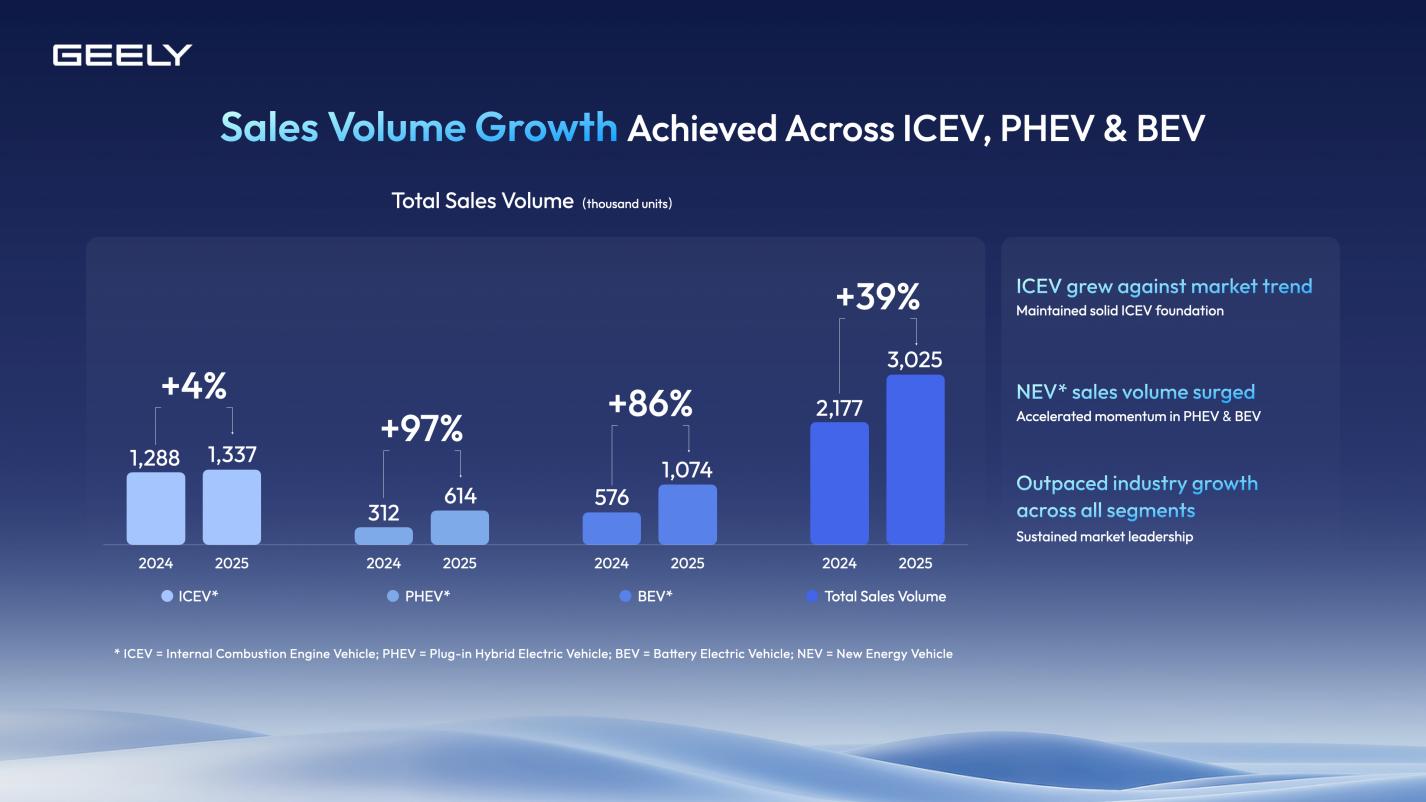
Geely Automobile Holdings Limited today announced its financial and operational results for the full year of 2025. Driven by a 90% year-on-year increase in New Energy Vehicle (NEV) sales, the company achieved record revenue of CNY 345.2 billion and a core net profit of CNY 14.41 billion. Total global deliveries reached 3.02 million vehicles.
Highlights
- Revenue reached an all-time high of CNY 345.2 billion (up 25% YoY), with core net profit rising 36% to CNY 14.41 billion.
- Total global deliveries hit 3.02 million vehicles. New Energy Vehicle (NEV) sales surged 90% YoY to 1.68 million units.
- Under the "One Geely" strategy, Geely Galaxy sales grew 150% to 1.24 million units, becoming the fastest NEV brand to reach one million annual sales.
- Geely’s G-ASD became the first Chinese ADAS to receive EU certification. The company also expanded its export volume to 420,000 units across 88 countries.
Following the "One Geely" strategy, Geely Galaxy led the NEV expansion with 1.24 million units sold. Zeekr delivered 224,000 units, maintaining top market positions in the luxury MPV and large SUV segments. Lynk & Co recorded a 23% sales increase, reaching 350,000 units. Concurrently, the internal combustion engine segment remained stable, with the China Star series selling 1.21 million units.
Geely launched a full-stack AI architecture featuring the World Action Model (WAM). In autonomous driving, Geely’s G-ASD system became the first Chinese Advanced Driver Assistance System (ADAS) to receive European Union certification. The company also established a strategic partnership with NVIDIA for next-generation intelligent mobility.
Geely’s global footprint expanded significantly, with total export sales reaching 420,000 units. The Geely brand entered 13 new markets, including the UK, Italy, and Brazil, bringing its total network to over 1,200 outlets across 88 countries. Zeekr expanded its operations to over 50 countries, while Lynk & Co grew its global retail presence to over 860 stores. To support international volume, Geely operationalized new localized production facilities in Egypt and Indonesia.
In corporate governance and sustainability, Geely achieved an MSCI ESG AA rating and reported a 25.5% reduction in per-vehicle lifecycle carbon emissions compared to its 2020 baseline.
Author Nina M. Kelly Plans Revised Edition of “Grace Has a Silent Voice” Focused on Literacy
Author Nina M. Kelly, PhD, is developing a new edition of her nonfiction book, “Grace Has a Silent Voice,” titled “Life in the Key of G,” with an expanded emphasis on resilience in times of tragedy. The updated edition will further examine themes of perseverance in the face of loss. She is also continuing her work through her children’s books, supporting her ongoing work promoting literacy initiatives for children.
Dr. Kelly is the proprietor of HoneyBee TreeHouse LLC. She holds a doctorate in mythological studies and depth psychology from Pacifica Graduate Institute and completed postdoctoral certifications through Assisi International Institute. Her professional background spans medicine, executive film production, literature and arts leadership.
Storytelling in Medical Recovery Research
“Grace Has a Silent Voice” acknowledges silent heroes and examines resilience in the face of tragedy. Dr. Kelly is currently rewriting the new edition while also drafting her fourth children's book. Her publishing efforts reflect her focus on supporting children's literacy and the use of storytelling to increase personal development.
Throughout her career, Dr. Kelly has emphasized the role of story and imagery in times of tragedy to help the healing process. Her doctoral dissertation, “Myth Making and Modern Medicine: A Case of Kidney Transplantation,” was a significant milestone in her career. Through her research at Louisiana State Medical School in New Orleans, she used stories and images to reduce the incidence of post-operative rejection episodes among kidney transplant patients. This pilot study resulted in 50% fewer rejection episodes. She observed that the patients, who once feared they would not survive, not only recovered quicker but also later wanted to give back to the community and share their recovery success.
Dr. Kelly cited her dissertation as the highlight of her career. She noted the importance of observing patients regain stability and a renewed sense of direction following transplantation.
A Career in Arts, Film and Service
In addition to her literary work, Dr. Kelly is an Emmy Award-winning film executive producer. She served as executive producer of the documentary “A New Lease On Life: K9 for Warriors,” which received four Emmy Awards. She also executive-produced “Folds of Honor,” recipient of the Humanitarian Award; “The Voice of a Generation: The Life of Larry King;" and the short film “Dandelion,” which earned the Judges’ Award.
Dr. Kelly's published works include three Mother’s Choice Award-recognized children's books, “Honeybee Treehouse," “Athena the Brave,” and “Athena, Tudor and the Eagle.” She has collaborated with programs and figures, including Larry King and Jack Canfield, on books such as “The Big Question," “Success Mastery,” “Success Breakthrough,” and “Leo Learns a Lesson.”
Dr. Kelly has held leadership roles as president and chief executive officer of the Children's Bureau and the New Orleans Opera, visiting committee chair for Loyola University Music School, the vice president of Shreveport Opera and president and chief executive officer of the Southern Repertory Theater. Her civic involvement has included service on numerous nonprofit boards. She received the Atticus Award and the Most Outstanding Dedication to Volunteering Award for her work with the Juvenile Justice Organization in Lafayette, Louisiana.
Maternal Values, Integrity and Faith
Dr. Kelly attributes her success to her life and the values instilled in her from her mother, who died when she was seven, her father, Irvin J. Kelly II, and her great aunt, Rosalie Kelly. “If the community is good to you, it is imperative that you are also good to your community” is a guiding principle she was taught and lives by. Her inspiration to serve others also stems from her great aunt, one of The ARC’s founders. She also dedicates her work to her mother and father’s teachings of integrity, humanitarian efforts and religious philosophies.
Dr. Kelly intends to complete a book based on her dissertation research and to prepare the next edition of “Grace Has a Silent Voice” for publication. Through her continued work in literature, film and humanitarian service, she remains focused on sharing stories that encourage empathy, cultural awareness and literacy among young readers.
About HoneyBee TreeHouse
Nina M. Kelly, PhD, is a mythologist, humanitarian, bestselling author and executive film producer. She is the proprietor of HoneyBee TreeHouse, LLC and earned a doctorate from Pacific Graduate Institute. Dr. Kelly produced an award-winning documentary, “A New Leash on Life: K9 for Warriors,” and wrote several award-winning children's books. She's preparing the next edition of “Grace Has a Silent Voice” while supporting children's literacy initiatives. For more information, visit ninamkelly.com.
About Marquis Who’s Who
Since 1899, when A. N. Marquis printed the First Edition of Who’s Who in America®, Marquis Who’s Who® has chronicled the lives of the most accomplished individuals and innovators from every significant field, including politics, business, medicine, law, education,
art, religion and entertainment. Who’s Who in America remains an essential biographical source for thousands of researchers, journalists, librarians and executive search firms worldwide. The suite of Marquis® publications can be viewed at the official Marquis Who’s Who® website, www.marquiswhoswho.com.
Media Contact
Nina M. Kelly
HoneyBee TreeHouse LLC
nina@honeybeetreehouse.com


Hermest Hair Clinic Recognized at the European Awards in Medicine 2025
Hermest Hair Clinic has been recognized in the category of Hair Transplant Surgery at the European Awards in Medicine 2025, an international ceremony honoring healthcare providers for excellence in patient care, safety protocols and clinical innovation. The award ceremony took place Nov. 27, 2025, in Rome, Italy, bringing together medical professionals and healthcare organizations from across Europe and global healthcare networks.
The recognition highlights Hermest Hair Clinic’s approach to surgical precision, structured treatment planning and post-operative care in hair restoration procedures. Organizers of the European Awards in Medicine state that recipients are selected based on factors including treatment safety standards, patient satisfaction, and the use of established medical protocols.
The award comes amid rising global demand for hair transplantation procedures, particularly in Turkey. According to the International Society of Hair Restoration Surgery (ISHRS), demand for hair transplant procedures continues to grow worldwide as techniques such as FUE-based methods advance and success rates improve through structured post-operative care.
Turkey has emerged as one of the leading destinations for medical tourism in hair restoration, with thousands of international patients traveling each year for treatments addressing male pattern baldness, female hair loss and other hair restoration needs.
Clinical Leadership and Surgical Approach
Hermest Hair Clinic is led by Dr. Ahmet Murat, a physician specializing in hair restoration surgery with experience in advanced FUE, Sapphire FUE and Direct Hair Implantation (DHI) procedures.
Dr. Murat’s work focuses on natural hairline design, long-term graft survival planning and individualized donor area management. The clinic’s surgical team emphasizes evidence-based practices aligned with ISHRS guidance, particularly in donor preservation, graft handling and post-operative care.
Patients considering hair restoration procedures often prioritize factors such as density design, graft angulation and natural growth direction — areas that Hermest incorporates into its surgical planning.
Turkey’s Role in Global Hair Transplantation
Turkey has become a central hub for hair restoration procedures, with clinics in Istanbul and Ankara performing a high volume of treatments each year. This procedural frequency allows surgeons to refine techniques and treat a wide range of hair types and conditions.
Many clinics serving international patients provide integrated treatment packages that may include accommodation, airport transfers, medication and aftercare kits, interpreter services and digital follow-up monitoring. These services are designed to simplify the treatment process for patients traveling internationally.
According to ISHRS reports, the high number of procedures performed in the region has contributed to improvements in graft survival optimization, graft placement patterns and long-term density planning.
Treatment Techniques and Planning
Most modern hair transplant procedures rely on follicular unit extraction (FUE) and related variations. Common techniques include:
- Follicular unit extraction (FUE): Individual graft extraction from donor areas with minimal visible scarring.
- Sapphire FUE: Use of sapphire blades to create smaller channels for graft placement, supporting precise implantation and healing.
- Direct hair implantation (DHI): Direct graft implantation using implanter pens, allowing detailed control of angle and direction.
Clinics frequently use digital planning tools such as graft calculators, density mapping and simulation software to help patients understand expected results.
Methodology
Hermest Hair Clinic applies a structured surgical system that combines technique with safety planning. These methods are intended to support graft survival and reduce potential complications during recovery.
- UNIQUE FUE® Method: This approach focuses on controlled graft extraction and placement designed to support natural hairline transitions and minimize donor area trauma. It integrates customized graft angulation, density planning per square centimeter and multi-zone implantation strategies.
- AIS Protocol (All-In Safety Protocol): Hermest’s internal protocol standardizes surgical safety and aftercare procedures, including sterile surgical environment controls, graft hydration and handling standards, staged implantation procedures and a structured recovery timeline.
Patient Experience and Recovery
Patients traveling internationally for hair transplantation procedures in Turkey typically remain in the country for three to four days, allowing time for surgery, the first washing session and early healing checks.
After returning home, many clinics continue monitoring recovery through digital follow-up systems, which may include scalp care guidance, medication schedules, monthly growth updates and long-term progress tracking over six to 12 months.
About Hermest Hair Clinic
Hermest Hair Clinic is a medical practice specializing in advanced hair restoration procedures, including FUE, Sapphire FUE and Direct Hair Implantation (DHI). Led by Dr. Ahmet Murat, the clinic focuses on evidence-based surgical techniques, natural hairline design and structured post-operative care to support long-term patient outcomes. Hermest serves an international patient base and incorporates digital planning tools and safety protocols to guide treatment and recovery. For more information, visit www.hermestclinic.com.
Disclaimer
This content is provided for informational purposes only and does not constitute medical advice. Individuals should consult with a qualified dermatologist or licensed medical professional before undergoing any medical or surgical procedure.

PDF Guru Launches Net Price Calculator for Low-Income Students
PDF Guru has launched its free Net Price Calculator that ranks more than 1,500 U.S. affordable universities and colleges by what students actually pay after financial aid.
What colleges advertise for tuition and what students actually pay are often very different, and that gap is especially hard on low-income students. PDF Guru’s Head of Product, Dmytro Kanievskyi, says the team created the Net Price Calculator after studying data from over 1,500 schools to help close that information gap.
“Our goal was to show families the true net price after Pell Grants, federal aid, and scholarships, so they can compare colleges by the amount they will really pay instead of the sticker price on a website,” said Kanievskyi.
How the Calculator Works
At its core, the tool is built on IPEDS data from the U.S. Department of Education, updated annually, with the latest figures covering 2023–2024. It spans 1,582 institutions — everything from cheap colleges with low tuition to higher-priced schools that award big scholarships to offset their sticker price.
Users can filter by state, school type and size, graduation rate, tuition range, acceptance rate, income, residency, and living situation, including in-state and out-of-state tuition. Each school is ranked by net price, and schools with income-based tuition models are included in the results.
Once filters are set, users can place two colleges for low-income students side by side and compare net price, tuition, total cost, financial aid, and admissions metrics — all updating in real time. Worth noting: The calculator doesn't replace the FAFSA or school-specific aid estimates, but it's built on the same data colleges file with the federal government each year.
How Sticker Prices Mislead Low‑Income Students
In 2024–25, public four‑year colleges listed an average in‑state tuition of $11,610, and private nonprofit four‑year colleges listed $43,350, based on College Board data analyzed by the National Association of Student Financial Aid Administrators (NASFAA). For example, Stanford's annual cost of attendance is $87,800–$92,900 per year, yet the average net price for first-year students receiving grant aid is only about $23,410.
California State University, Long Beach, offers a good contrast. For 2025–26, CSULB's total cost of attendance is $27,722 for California residents living at home, with 2024–25 costs slightly lower. Even with that lower price, some CSULB students with aid may still pay more out of pocket than students at private universities with generous aid. That is because grants and eligibility vary widely by school. For methodology and school-level net price data from federal IPEDS figures, see PDF Guru's top U.S. universities analysis.
PDF Guru Highlights the Most Affordable Colleges in the U.S.
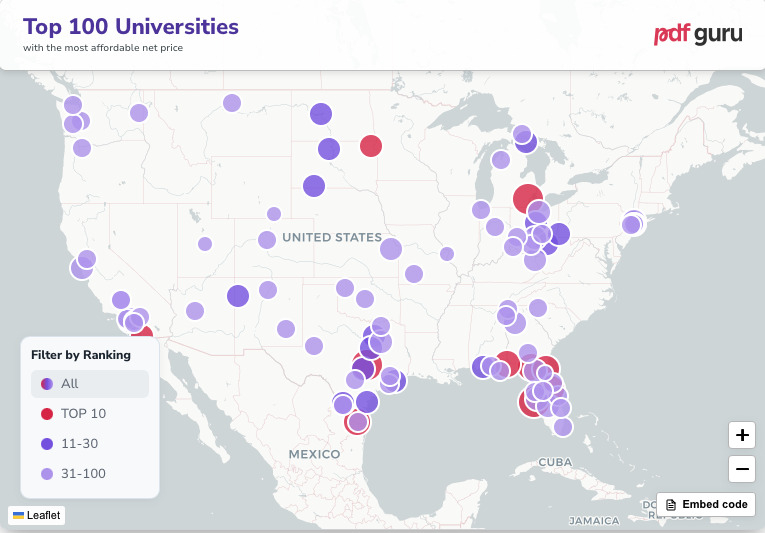
PDF Guru ranks 100 of America's most affordable colleges by net price after aid. Six of the top ten are in Florida, two in Texas — states with low tuition. Florida leads with $6,360 average in-state tuition for public four-year schools.
The report also includes an interactive map of all 100 schools, giving readers an easy way to see where the most affordable options are. Users can filter by ranking range, hover to view each school’s name, rank, and net price, and quickly spot clusters in places like Florida’s Gulf Coast and Texas’s Rio Grande Valley.
What Students Should Keep in Mind
The PDF Guru team recommends using its Net Price Calculator as the first step when comparing college costs. From there, students can keep these tips in mind:
- Check all deadlines; aid, scholarship, and admission may have different dates.
- Consider lesser-known schools; they often give stronger aid.
- Ask how your aid could change if your family income changes.
- If you plan to work, check whether your offer includes work‑study.
- Contact the financial aid office if anything is unclear.
About PDF Guru
Founded to make PDF work simpler and faster, PDF Guru provides an all-in-one document management platform used by 15 million people in 180 countries. The web-based tool enables users to edit text in PDFs, convert between formats, including Word, Excel, and image files, add electronic signatures, and process scanned documents with OCR — all without downloading software. PDF Guru prioritizes security and privacy through GDPR compliance, SSL and AES encryption, and verification by industry leaders. Available in over 20 languages with subscription plans for both individuals and teams, the platform combines powerful functionality with an interface designed for immediate usability. For more information, visit pdfguru.com.
Media Contact
Marta Synelnyk
Content Writer, PDF Guru
marta.synelnyk@uni.tech

Charleston Real Estate Agent Crabtree Launches AI-Powered Home Search to Give Buyers and Sellers a Competitive Edge
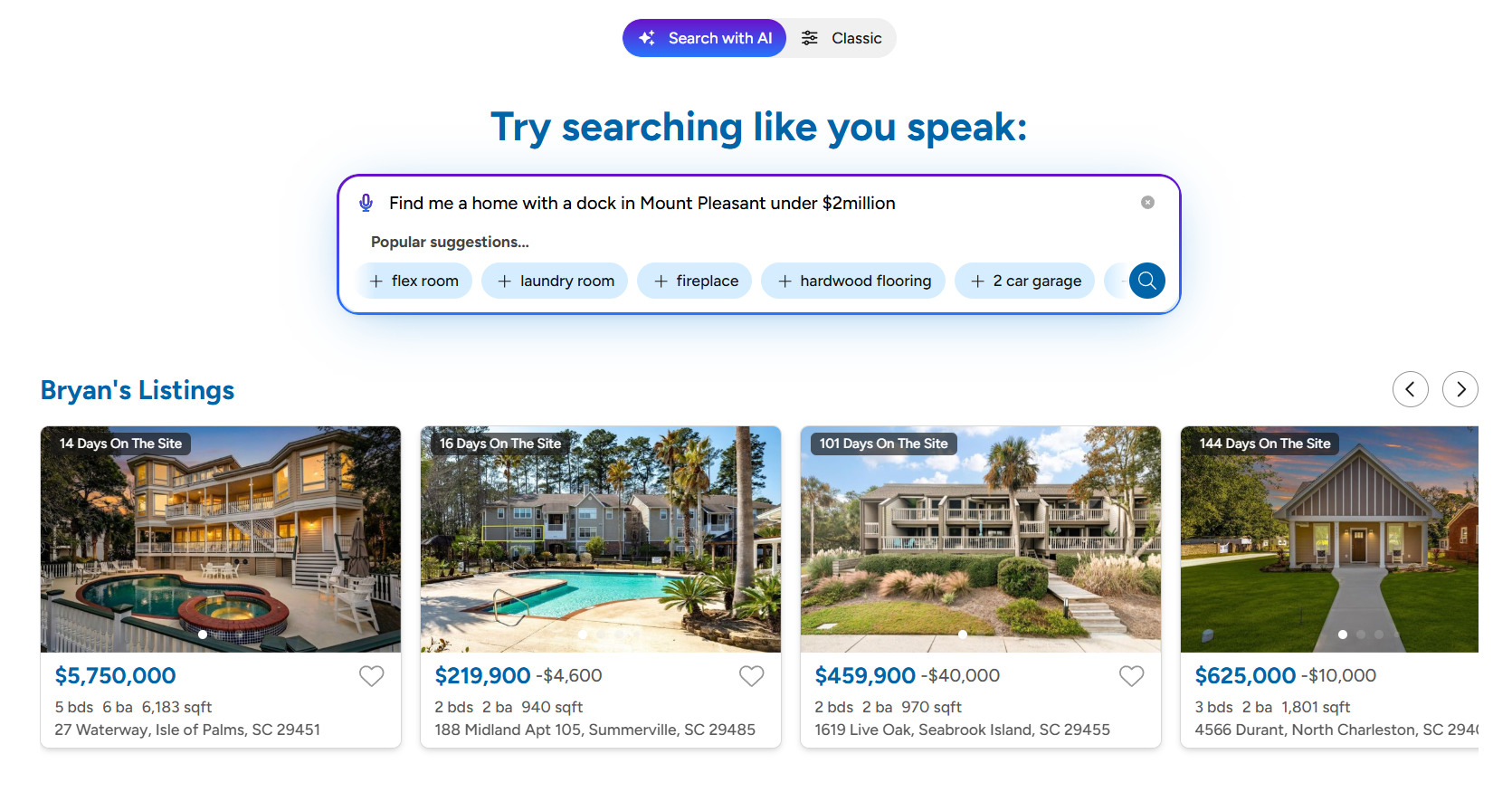
A new artificial intelligence-powered home search platform is changing how buyers find homes in the Charleston market — and how sellers gain exposure — as local real estate broker Bryan Crabtree announces the rollout of conversational AI search on his website.
The technology allows users to search for homes by simply asking questions in plain language, mirroring how consumers increasingly interact with platforms like ChatGPT and other AI tools. Instead of filtering through dropdown menus and preset criteria, buyers can now input highly specific requests such as lifestyle preferences, architectural styles, location nuances, and even investment goals.
“I realized that people are now simply asking AI chatbots to find the home they want,” said Crabtree. “They are asking very specific questions, but virtually all of the major search sites, companies and agents haven't launched this technology yet. My buyer customers find it of great value and it significantly enhances the exposure for my seller clients to give them a clear market advantage. Given my operational background combined with the global power of the Christie’s International Real Estate brand, my goal is to offer a clear advantage to my sellers and home buyers.”
The launch comes at a time when the real estate industry is undergoing rapid change, particularly around how listings are marketed and accessed. With the growing trend of “exclusive previews” and private listing networks, many buyers are finding it increasingly difficult to view the full scope of available inventory in one place.
Crabtree says the AI-driven platform addresses that challenge directly.
“This is one of the few ways buyers can still see and search across the full spectrum of live inventory in a single experience,” he said. “It removes friction from the process and gives buyers a more intuitive way to discover properties that actually match what they’re looking for — not just what fits into a standard search box.”
Beyond convenience, the platform is designed to improve outcomes for both sides of the transaction. Buyers benefit from more precise and efficient discovery, while sellers gain increased visibility as their properties are surfaced through more nuanced and intent-driven searches.
The technology is now live and available to the public through Crabtree’s website, www.bryancrabtreerealestate.com — marking one of the first implementations of conversational AI home search in the Charleston region.
As artificial intelligence continues to reshape industries, Crabtree believes early adoption will be key in real estate.
“Consumers are already there,” he said. “The platforms just haven’t caught up yet.”
About Bryan Crabtree Real Estate
Bryan Crabtree is a Charleston, South Carolina real estate broker and Realtor® with Indigo Oak | Christie’s International Real Estate, serving Charleston and Mount Pleasant. He specializes in luxury homes, historic properties, golf communities, and waterfront real estate across the Lowcountry. Crabtree works with both local and relocating buyers and sellers. For more information, visit www.therealestateexperts.com.
Media Contact
Bryan Crabtree
Real Estate Broker, IndigoOak | Christie's International Real Estate
bcrabtreeiphone@gmail.com
+1 843-343-4141
Clip Collective Meets Peak Wedding Season Demand for Authentic Wedding Content
As couples look for more authentic and shareable ways to capture their wedding day, Memphis-based Clip Collective is gaining traction ahead of peak wedding season for its modern, guest-powered approach to wedding memories. Instead of relying on a single videographer, the platform turns the moments friends and family are already capturing on their phones into one professionally edited wedding video, preserving candid moments, behind-the-scenes clips, and the kind of real memories couples actually want to watch back.
But Clip Collective goes well beyond the video itself. With thoughtful features like a Private Wedding Feed that brings every moment together in one place, couples can collect, organize, and relive their wedding day through a seamless digital experience. The result is a wedding video and memory hub designed for how modern couples celebrate, share, and revisit their big day, all at a fraction of the cost of traditional videography.
How It Works
Clip Collective is designed to be simple and stress-free, so couples can focus on enjoying their wedding day while friends and family capture the moments that make it unforgettable.
- Select Your Date: Couples book their wedding date through Clip Collective and receive a personalized wedding profile where everything for their event lives in one place.
- Invite Your Family and Friends: Guests join using a simple link or QR code, making it easy for everyone attending to share the photos and videos they capture.
- Upload Videos and Photos: Guests upload their clips throughout the celebration, which are automatically organized and used to create the final wedding video.
What’s Included
Beyond the final wedding video, Clip Collective offers a suite of features to help couples capture, share, and relive every moment of their wedding day.
- Professionally Edited Wedding Video: Guest footage is transformed into one polished, ready-to-share wedding video that captures the energy and candid moments of the day.
- Private Wedding Feed: A private feed lets couples and guests view, share, and relive moments from the celebration as photos and videos are uploaded.
- Video and Photo Gallery: All guest-submitted photos and videos are organized into a clean, easy-to-browse gallery that preserves every angle of the day.
- Guestlist: Couples can easily invite guests, manage participation, and track who has joined the wedding feed.
- Wedding Hub: Everything lives in one simple hub, making it easy to access memories, share the final video, and revisit the celebration anytime.
Book While You Can
With dates filling quickly ahead of peak wedding season, couples interested in Clip Collective are encouraged to reserve their date before it’s taken. By combining guest-captured moments with professional editing and modern sharing tools, the platform is quickly becoming a go-to option for couples who want wedding memories that feel real, personal, and easy to relive. Couples can learn more and secure their date at clipcollective.com.
About Clip Collective
Clip Collective is the guest-powered wedding video platform for modern couples who want an authentic, beautifully edited wedding film without traditional videography prices or pressure. Guests capture the day from every angle while professional editors transform those moments into a polished, social-ready wedding video delivered in just 10 business days. Couples also receive a private wedding feed, an organized gallery, and a simple hub where friends and family can relive the celebration. Real moments, captured naturally and crafted professionally. For more information, visit clipcollective.com.

Corridor Raises $25 Million Series A to Secure AI Coding at the Source
Corridor, the security platform built for AI-native software development, has raised a $25 million Series A at a $200 million valuation, led by Felicis, with participation from Conviction, Timeless, Artisanal Ventures, Lux Capital, Sunflower Capital, Datadog, SV Angel, and leading angels from Anthropic, OpenAI, Cursor, Cognition, Factory, Lovable, and more. The company will use the capital to expand its Agentic Coding Security Management (ACSM) platform and deepen integrations across modern developer tools.
As AI coding tools dramatically increase the volume and speed of software production, security teams are struggling to keep up with approaches designed for a pre-AI world. Corridor was founded on the belief that security must move into the flow of development, not operate after code is written.
“Secure by design can’t just be a slogan, it has to be how software actually gets built,” said Jack Cable, CEO and co-founder of Corridor. “As AI revolutionizes coding, security has to be embedded at the moment code is created, not bolted on later.”
Corridor’s Agentic Coding Security Management (ACSM) platform embeds real-time security controls directly into AI coding workflows, helping prevent vulnerabilities as code is generated.
“AI code generation is only as powerful as the ecosystem around it,” said Ashwin Ramaswami, CTO and co-founder of Corridor. “Our platform natively integrates with coding agents to embed security at the source, and we're assembling a world-class team to do it."
Aside from the velocity of code, new tools expand who is creating code. Corridor secures use cases ranging from expert developers overseeing teams of autonomous agents, to sales and marketing teams using AI to create internal apps. “Corridor is building the missing layer for this new era: a security and management system designed specifically for code generation” said Jake Storm, general partner at Felicis. “And they're doing it in a way that fundamentally reimagines where in the development process security actually lives.”
That philosophy is reflected in Corridor’s partnership with code generation leaders like Cursor and Factory, where Corridor runs natively inside the agents developers use. These integrations provide real-time security feedback during development and code review without disrupting developer velocity.
“Corridor meets developers where they already work,” said Mike Vernal, partner at Conviction. “That’s why adoption happens naturally and why this approach to application security is so compelling.”
Early customers report strong results.
Sublime Security, the leader in next-gen email security, uses Corridor to secure their AI development pipelines. Their founder and CEO, Josh Kamdjou, says, “AI code generation has the potential to dramatically accelerate engineering teams, but for a security company like Sublime, speed can never come at the expense of safety. With Corridor, we’re able to empower our developers with the latest AI tools while ensuring the code that reaches production is secure, compliant, and worthy of our customers’ trust. Just as importantly, it allows us to capture the real ROI of AI-assisted development - faster delivery, higher developer productivity, and less friction between engineering and security.”
Pylon, the AI-native B2B customer support platform, uses Corridor to secure its development workflows. “Corridor has been essential in adding security to our software development life cycle at all stages, ensuring that we can continue to ship quickly and securely,” said Aashish Kapur, security lead at Pylon.
"Most security tooling was designed for a world where humans write every line. Corridor is different — it's an actual agentic security solution built for agentic coding," said Gil Spencer, founder and CTO of WitnessAI. "It gives agents the security context and guardrails they need at the prompt level, in real time, before a single vulnerable line gets written. It's an approach built from the ground up for how modern development actually works."
Corridor plans to use the funding to advance its ACSM capabilities, expand AI development integrations, and support growing customer demand. Corridor continues to grow its strong team of engineers, researchers, and cybersecurity experts.
“I’m bullish on what the Corridor team is building. As AI coding agents become part of the default SDLC, the question is not whether teams move faster, it is whether they can trust what gets shipped,” per Nancy Wang, the CTO of 1Password. “What stands out to me is Corridor’s proactive model: guardrails at code generation time, real PR feedback. If we are going to let agents write meaningful portions of our codebase, we need security that operates at the same layer and velocity.”
“I’m excited that Corridor is building a product that gives every CISO the assurance they need while giving engineers rocket fuel to move fast but also to break nothing,” said Alex Stamos, CPO of Corridor.
About Corridor
Corridor builds security infrastructure for AI-native software development. Its Agentic Coding Security Management (ACSM) platform helps teams prevent vulnerabilities as code is generated, enabling secure development at modern engineering speeds. The Corridor team brings deep expertise across both cybersecurity and AI. CEO Jack Cable is a top-ranked bug bounty hunter who helped start CISA’s Secure by Design initiative. CTO Ashwin Ramaswami has built large-scale systems and published research on AI and foundation models at Stanford. CPO Alex Stamos brings decades of security leadership experience, including serving as CSO at Facebook, Yahoo, and SentinelOne. Across the company, the team draws on experience from leading organizations including Applied Intuition, Vanta, Amazon, and others. For more information, visit www.corridor.dev.
Media Contact
Jack Cable
contact@corridor.dev


Engineered Silkworms Spin Spider Silk as Kraig Labs Targets Commercial Scale
Kraig Biocraft Laboratories (OTCQB: KBLB) announced that it has deployed one million genetically engineered silkworm eggs across multiple production facilities in Vietnam as part of a spring scale-up effort that could eventually produce approximately 10 metric tons of recombinant spider-silk cocoons per month.
Spider silk has attracted scientific interest, due to its impressive mechanical properties, for decades. By weight, the fiber can be stronger than steel and tougher than many high-performance synthetic materials. The challenge has been viable mass production, since spiders cannot be farmed easily due to their territorial behavior.
The company’s approach modifies domesticated silkworms so they spin fibers incorporating the desired spider-silk proteins. The insects retain their natural spinning process, allowing the fiber to be produced using traditional sericulture methods rather than industrial reactors.
Kraig Labs says it is preparing initial shipments of the biodegradable recombinant Spider Silk material to several unannounced global brands as part of pilot development programs and first commercial deliveries.
From Lab Research to Industrial Production
Kraig Labs first reported integrating spider-silk genes into silkworms more than a decade ago. The work was later described in a peer-reviewed study in the Proceedings of the National Academy of Sciences, which reported that composite fibers produced by transgenic silkworms were tougher than conventional silkworm silk and approached the toughness of natural dragline spider silk.
The research drew widespread attention at the time, including coverage in science publications and mainstream media following a press conference at the University of Notre Dame announcing the breakthrough.
The technology is still attracting interest from the leading authorities, as the March issue of National Geographic examines efforts to commercialize spider silk and highlights genetically engineered silkworms as a potential pathway to scalable production.
Rare Precedent for Engineered Animal Products
Commercial products derived from genetically engineered animals remain uncommon.
One example is ATryn®, a therapeutic antithrombin protein produced in the milk of genetically modified goats. The drug was approved in Europe in 2006 and by the U.S. Food and Drug Administration in 2009 after more than two decades of development.
Kraig’s platform differs from pharmaceutical production because the silkworm directly produces a structural fiber rather than a purified biological compound.
If the company succeeds in maintaining industrial-scale production, it would represent one of the few examples of a transgenic animal system used for commercial manufacturing outside pharmaceuticals.
Hybrid Fibers Today, Purer Silk Tomorrow
Current production fibers are hybrid composites combining traditional silkworm silk proteins with spider-silk proteins. Kraig Labs stated that laboratory testing of the material has shown tensile strengths for some samples approaching 1.8 gigapascals and elasticity above 38%.
The company is also exploring a more ambitious genetic design using sequences from the Darwin’s bark spider, known for producing some of the toughest natural silk fibers measured. That research aims to replace the silkworm’s native silk genes with spider-silk genes, potentially allowing the insects to produce fibers composed largely of spider silk proteins. Results from that work have not yet been announced.
Ancient Industry Meets Modern Genetics
Sericulture is the cultivation of silkworms for silk production, which dates back more than a thousand years and remains a major industry in Asia.
By combining that historical production system with modern gene-editing techniques, Kraig Labs is attempting to turn spider silk from a laboratory material into a commercially manufactured fiber.
For more information about Kraig Labs’ spider silk technology and partnership opportunities, visit www.kraiglabs.com.
About 24/7 Market News
In today’s fast-moving markets, visibility is critical. 24/7 Market News (24/7) provides a comprehensive suite of investor relations and public relations solutions designed to enhance corporate awareness efficiently and effectively. Whether supporting established companies seeking broader exposure or emerging issuers looking to expand their reach, 24/7 delivers targeted coverage through news distribution, analyst reports, featured editorial content, and multi-channel amplification across financial platforms, social media, and investor communities.
Our services are designed to increase visibility, support investor engagement, and strengthen long-term shareholder confidence, while maintaining a commitment to transparency and compliance with applicable regulations.
For analyst report coverage, customized investor relations campaigns, press release distribution, or other tailored communications solutions, contact sales@247marketnews.com to learn more.
About Kraig Biocraft Laboratories
Kraig Biocraft Laboratories, Inc. (OTCQB: KBLB) (“Kraig Labs”) is a biotechnology company focused on the development and commercialization of advanced biomaterials through genetic engineering. The company is best known for its work in producing recombinant spider silk using genetically engineered silkworms, an approach designed to overcome the long-standing challenges of harvesting spider silk at scale.
With growing interest in sustainable and high-performance materials, Kraig Labs is positioning itself at the intersection of biotechnology and advanced materials science, seeking to deliver novel fiber solutions to global markets.
Kraig Labs was featured on the cover of the March 2026 issue of National Geographic. Read the National Geographic cover story.
For more information, visit www.kraiglabs.com.
Disclaimer
This is a paid editorial communication provided for informational purposes only. 24/7 is a third-party media provider that currently owns shares of Kraig Biocraft Laboratories, Inc. (OTCQB: KBLB). These shares are held in inventory and may be sold at the editor’s discretion. 24/7 has been compensated for providing ongoing market awareness, outreach, and related services on behalf of KBLB.
This communication may include technical analysis and forward-looking statements and should not be construed as financial or investment advice. Investing in securities involves risk, including the potential loss of principal. Readers are strongly encouraged to conduct their own due diligence and consult with a qualified financial advisor before making any investment decisions.
For further information, visit 247marketnews.com or go.247marketnews.com/kblb-
disclosure/.
Cautionary Note Regarding Forward-Looking Statements
This press release contains forward-looking statements within the meaning of applicable securities laws. These statements are subject to various risks and uncertainties and include, but are not limited to, statements regarding the Company’s ability to grow its business and other statements that are not historical facts. Forward-looking statements are often identified by words such as “intends,” “may,” “will,” “plans,” “expects,” “anticipates,” “projects,” “predicts,” “estimates,” “aims,” “believes,” “hopes,” “potential,” or similar expressions.
Actual results may differ materially from those expressed or implied in these forward-looking statements due to a variety of factors, including, without limitation, the Company’s ability to continue as a going concern, general economic conditions, and other risks and uncertainties described in the Company’s filings with the U.S. Securities and Exchange Commission (SEC).
Forward-looking statements speak only as of the date of this press release, and the Company undertakes no obligation to update or revise these statements, except as required by applicable law.
Media Contact
24/7 Market News
editor@247marketnews.com


ShapeShift Earn Launches with Morpho Vaults on Katana, Powered by Yield.xyz
ShapeShift, a non-custodial, multichain platform for digital assets with millions of users across its open-source ecosystem, announced the launch of ShapeShift Earn, a fully integrated yield experience powered by Yield.xyz. The launch includes native access to Morpho Vaults deployed on Katana. Morpho is one of DeFi's most trusted lending protocols with billions of dollars in deposited capital. The integration gives ShapeShift users the ability to deploy capital into curated, high-quality lending positions on Katana, directly within the ShapeShift interface.
ShapeShift Earn represents a new standard for how consumer crypto platforms should approach yield. Rather than building and maintaining individual protocol integrations, a process that typically requires months of engineering work and ongoing maintenance across each new yield opportunity, ShapeShift integrated the Yield.xyz API and instantly unlocked access to staking, lending, and DeFi yield opportunities spanning multiple networks. Morpho Vaults on Katana are among the first available at launch, bringing ShapeShift's broad user base direct access to one of the most battle-tested lending protocols in DeFi.
"Yield.xyz exists to make onchain yield accessible to everyone, and partnerships like this one show what that means in practice. ShapeShift users can now earn yield on some of the best lending markets in DeFi, directly from an interface they already trust, without any of the complexity that has historically made that difficult,” said Serafin Lion Engel, co-founder at Yield.xyz
The announcement brings together three distinct pieces of DeFi infrastructure: Katana as the yield-optimized network layer, Morpho as the lending protocol, and Yield.xyz as the API that makes onchain yields accessible to ShapeShift users through a single integration.
Yield.xyz Integration
Onchain yield is fragmented. Opportunities exist across hundreds of protocols, dozens of networks, and thousands of individual markets, each with its own integration requirements, smart contract interfaces, and risk profiles. For a platform like ShapeShift, building direct integrations with each protocol is not a sustainable path. The engineering cost is high, the maintenance burden is ongoing, and coverage will always lag behind the pace of DeFi.
Yield.xyz was built to solve this problem at the infrastructure level. By abstracting yield discovery, routing, and execution into a single API, Yield.xyz allows any platform to offer comprehensive yield access without protocol-by-protocol integration work. The API covers over 2,800 yield opportunities across more than 80 networks, including staking, lending, liquidity provision, and vault strategies. Built-in support for auto-compounding, reward conversion, and secure transaction verification means platforms can launch production-grade yield products with minimal overhead.
How It Works
When ShapeShift users access the Earn section of the platform, Yield.xyz surfaces available opportunities in real time, handles yield routing, and manages the underlying complexity of cross-protocol interactions. Morpho's lending architecture sits on top of that foundation, enabling access to permissionless, immutable lending vaults with transparent risk parameters and competitive rates driven by supply and demand.
"ShapeShift has always believed users deserve access to the best DeFi opportunities without giving up control of their assets. Integrating Yield.xyz gave us a path to launch a complete yield product without rebuilding infrastructure from scratch. Morpho Vaults on Katana are a natural fit for our users: transparent, non-custodial, and built on a network specifically designed for yield. ShapeShift Earn is what we think accessing the frontier of DeFi should look and feel like," said Tim Black, product lead at ShapeShift.
Why Morpho on Katana
Katana's architecture is designed to attract and retain liquidity by directing protocol revenue back to the network, creating a compounding yield environment that benefits its users. Deploying Morpho Vaults on Katana concentrates that yield-generating potential into one of DeFi's most trusted lending frameworks.
“Morpho Vaults were built to be integrable with any application. Through them, we're excited to support Yield.xyz in bringing that infrastructure to an entirely new universe of developers, making it simple for any app to connect their users' balances to onchain lending markets and put idle capital to work at scale,” said Paul Frambot, CEO and co-founder of Morpho.
Morpho's market structure is permissionless and immutable. Curators define vault parameters, and the protocol enforces them without upgradeable contracts or custody risk. For ShapeShift users accessing yield through Earn, Morpho Vaults on Katana offer a combination of competitive rates, transparent mechanics, and a security model that has been validated by billions of dollars in deposited capital across the broader Morpho ecosystem.
"Katana was built to be the best place in DeFi to earn, and that means making quality yield accessible without friction. ShapeShift Earn, powered by Yield.xyz, is a strong example of what that looks like in practice. It connects Katana's yield-optimized infrastructure to ShapeShift through an API layer that makes the whole experience seamless for end users," said Matthew Fisher, CEO of Katana.
The decision to launch ShapeShift Earn with Morpho on Katana reflects a deliberate choice to lead with quality infrastructure at every layer of the stack. Yield.xyz's API makes it possible to surface any yield opportunity across any network; the teams chose to lead with a combination that delivers on both yield and credibility.
About Yield.xyz
Yield.xyz is the unified onchain yield infrastructure layer for Web3, enabling developers to integrate once and access over 2,800 yield opportunities across more than 80 networks spanning staking, lending, and liquidity provision strategies. Trusted by leading wallets and financial platforms including Ledger, DeBlock, Utila, Tuyo, Crossmint, Turnkey, Tangem, and Zerion, Yield.xyz powers production-grade yield products with built-in support for auto-compounding, reward conversion, and secure transaction verification. Yield.xyz abstracts complex strategy engineering into simple API calls and enables teams to launch scalable yield products with minimal overhead while unlocking new revenue streams through fee-customizable vaults. To learn more, visit yield.xyz.
About ShapeShift
ShapeShift is a non-custodial, multichain platform for digital assets. Community-owned and operated by the ShapeShift DAO, ShapeShift gives users self-sovereign access to crypto assets across multiple blockchain networks. Learn more at shapeshift.com.
About Morpho
Morpho is the universal lending network with over $10 billion in deposits. Businesses can connect to Morpho's open infrastructure to power any lending or borrowing use case at scale, including embedded crypto-backed loans and custom yield solutions. To learn more, visit morpho.org.
About Katana
Katana is a purpose-built DeFi blockchain focused on turning real network fees into deep liquidity and sustainable yield. It aligns core DeFi apps, users, and the network through a shared economic engine that recycles chain-generated fees back into the ecosystem. The Katana App serves as a unified entry point, while Vault Bridge helps make bridged assets productive and Chain-Owned Liquidity supports lasting depth in key markets. Together, these components aim to deliver a more efficient DeFi experience with less fragmented liquidity and more durable incentives. Learn more at app.katana.network.
Media Contact
Apurv Mishra
apurv@yield.xyz


AI Inside Government: Lawmakers, Agencies, Researchers, and Tech Builders Convene at SXSW
A cross-sector panel at SXSW 2026 will bring together leaders from government, technology, and public policy to explore how artificial intelligence is moving from theory and legislation to real-world implementation inside government.
SXSW is one of the world’s premier gatherings for technology, innovation, and public policy, drawing thousands of leaders from government, academia, and industry to Austin each year.
The session, “AI Implementation in Government,” will take place March 18 at 10:00 a.m. CT at the JW Marriott, Salon E.
The panel represents the full lifecycle of government technology adoption — from legislation and policy research to procurement, implementation, and technology development.
Speakers include:
- Sen. Tan Parker, Texas Senate
- Tony Sauerhoff, Chief AI and Innovation Officer, Texas Department of Information Resources
- David Dunmoyer, Associate Vice President, Texas Public Policy Foundation
- Laura Davis, Co-Founder and Chief Business Officer, USLege
Together, the panelists represent every part of how artificial intelligence enters government.
Sen. Parker brings the perspective of lawmakers responsible for establishing policy frameworks that guide emerging technologies. Sauerhoff oversees how state agencies evaluate and deploy new technologies while maintaining cybersecurity, transparency, and operational reliability. Dunmoyer contributes research and policy analysis on AI governance and innovation policy across the states.
Davis represents the technology builders developing tools designed to help policymakers and government affairs professionals navigate the rapidly expanding volume of legislative and regulatory information.
The discussion will explore how government institutions can responsibly adopt AI while navigating the operational realities that shape implementation, including legacy IT systems, procurement processes, siloed data, and evolving cybersecurity threats.
“The future of AI in government won’t be decided by technology alone,” said Laura Davis, Co-Founder and Chief Business Officer of USLege. “It will be shaped by lawmakers, agencies, researchers, and the builders creating the tools. Bringing those perspectives together is how we responsibly move from AI theory to real-world implementation in government.”
"If the public sector truly harnesses the potential of AI, taxpayers will feel tangible benefits. Reduced wait time for services, improved transparency, more proactive problem solving, and dramatic taxpayer savings in the long term," said David Dunmoyer, Associate Vice President, Texas Public Policy Foundation. "But to unleash the benefits while protecting civil liberties and human agency, smart public policy is more critical than ever. Texas has both the technical solutions and public policy to advance this revolution, and I'm excited to share the stage with a diverse array of experts who will paint this vision in clear strokes."
The panel will also explore how artificial intelligence can help policymakers and government affairs professionals manage the overwhelming volume of legislative and regulatory activity — from bills and amendments to hearings and rulemaking — while maintaining human oversight, transparency, and accountability. Speakers will also look ahead to the next five years of AI adoption in government and discuss how states can build the institutional capacity needed to implement these technologies responsibly.
Click to learn more about the panel or how USLege is bringing AI to government at all levels.
About USLege
USLege is an AI-powered legislative tracking platform transforming how government affairs professionals track, analyze, and act on policy at the local, state, and federal levels across the U.S. Built for the fragmented and fast-moving world of government relations, USLege unifies legislative CRM, live government video, and real-time bill tracking, powered by a customizable AI agent that delivers instant alerts, stakeholder-specific insights, and tailored content that matters. For more information, visit www.uslege.ai.
Media Contact
Jess McDonald
Head of Marketing, USLege
jess@uslege.ai

Enrollment Opens for Michigan Online School Serving Students Across the State
Enrollment is now open for the 2026–2027 school year at Michigan Online School, a tuition-free, accredited online public school serving students in grades K-12 across the state of Michigan.
Michigan Online School offers families a flexible online learning option that allows students to complete coursework from home while staying on track academically. Through interactive virtual classrooms and guidance from certified teachers, students receive the support they need to stay engaged and progress toward graduation.
A Flexible Online Learning Experience
Michigan Online School provides a structured virtual learning environment designed to meet the needs of students across the state while maintaining strong academic standards.
Students benefit from:
- Flexible online learning for Michigan families: Students can complete coursework from home while staying on track academically.
- Certified teachers lead instruction: Students receive guidance and support from experienced educators.
- Interactive virtual classrooms: Technology supports engaging lessons and collaboration.
- A personalized path to success: The program adapts to student needs and learning pace.
- Focused on strong outcomes: Michigan Online School prepares students to graduate ready for college, careers, or other goals.
Enrollment Information
Enrollment is open to Michigan students in grades K-12 who meet the following criteria:
- Residency: Students must live in the state of Michigan.
- Age and Status: Students must be under 21 years old.
- Tuition-Free: Michigan Online School is free for all Michigan students.
Families can learn more or apply at michiganonlineschool.com/admissions or contact (888) 995-7464.
Frequently Asked Questions About Online School
How is online schooling different from attending school in person?
The academic standards, curriculum, and diploma requirements remain the same as in a traditional public school. The difference is that learning takes place online, allowing students flexibility in their daily schedule and learning environment.
Why do families enroll in online school?
Families may choose online learning because it offers flexibility, support, and personalization while also providing a safe learning environment. It can be a good option for students who benefit from a different pace or schedule.
What can parents do to support their student?
Parents can help by encouraging routines, recognizing their child’s efforts, keeping track of progress through the learning platform, and communicating with teachers when needed.
How are students encouraged to stay motivated?
Clear expectations, regular encouragement, and consistent check-ins help keep students engaged. Students are often more motivated when they feel supported and see steady progress.
What supplies are required for online learning?
Typically, students need a computer, dependable internet access, and a quiet area for learning. Some schools offer laptops for families who qualify, so reaching out to the school directly can provide more information.
Will my child have chances to interact with classmates?
Online schools support social development through live classes, collaborative assignments, clubs, and other student activities.
Is it possible to switch to another school later on?
Because online schools align with state academic standards, students can remain on track academically. If circumstances change, school staff can help guide families through the transition.
About ACCEL Schools
ACCEL Schools is an educational service provider to more than 100 public charter schools serving K-12 students across the United States. The organization directly manages or supports brick-and-mortar, online, and hybrid schools tailored to the needs of the communities they serve. ACCEL Schools supports a range of innovative educational models, including college prep, career and technical, classical, dropout prevention, and other specialized academic pathways. For more information, visit accelschools.com.
About Michigan Online School
Michigan Online School is a tuition-free, accredited K-12 online public school serving students across the state of Michigan. The school offers flexible virtual learning supported by certified teachers, interactive coursework, and personalized academic guidance. By combining the convenience of online learning with strong instructional support, Michigan Online School helps students stay engaged, meet Michigan academic standards, and build the knowledge and skills needed for graduation and future success. For more information, visit michiganonlineschool.com.
Media Contact
Warren Cohn
warren@rocketshippr.com

Turn your news into performance
EZ Newswire is the only news platform connecting the most influential organizations with the most trusted media outlets.