

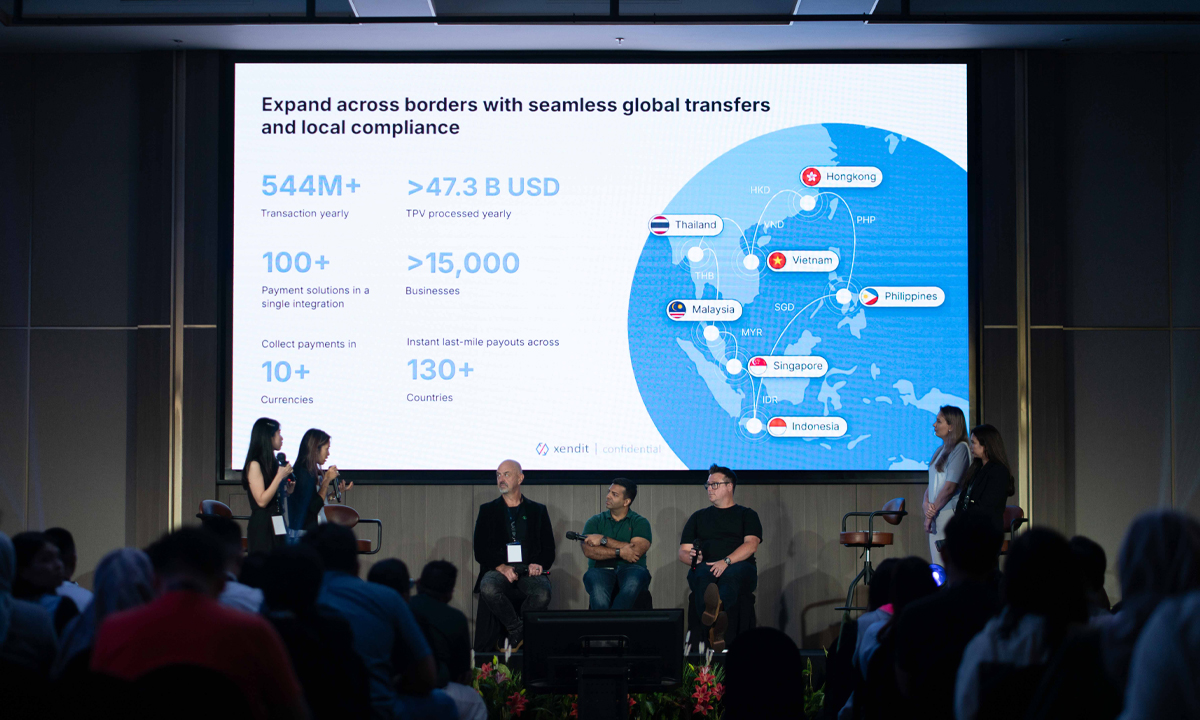
SINGAPORE, September 23, 2026 (EZ Newswire) -- Most payment companies plug into someone else's rails and resell the access. Xendit, led by CEO and co-founder Moses Lo, built its own instead — its own bank connections, e-wallet integrations, and regulatory licenses, market by market, across Indonesia, the Philippines, Thailand, Malaysia, Vietnam, Singapore, and Greater China. The company started at Y Combinator in 2015, with a rule to solve real problems instead of chasing trends, building from inside the region rather than as an outsider. That decade of infrastructure work now processes $47.3 billion a year across more than 15,200 merchants.
Global brands often assume a lighter-weight aggregator — reselling access to banks it doesn't own — is enough for a market this fragmented. Xendit's numbers say otherwise: its owned infrastructure touches 3% of Indonesia's GDP and 5% of the Philippines' GDP, a share resellers competing on price alone haven't matched.
Governments are Rebuilding the Rails
Southeast Asia's digital economy crossed roughly $300 billion by the end of 2025, backed by 600 million people and a combined GDP of $3 trillion. Governments across the region are racing to build their own real-time payment systems — a race Xendit has been pulled into, advising central banks on API design and fraud policy. Keeping pace with regulators who move market by market takes what Lo calls "the muscle": humility to treat each market as sovereign, curiosity to find unsolved problems, and doggedness to fix them for years, not quarters. That doggedness is what Indonesia took — Xendit's first and hardest market, three product pivots over twelve months to find a model that worked. That same muscle is already showing up outside the region — Xendit partners with large Latin American brands like Farmacias del Ahorro, an early signal of how transferable the approach could be globally.
“Southeast Asia is arguably the hardest possible proving ground — different currencies, regulators, payment rails, and consumer habits within a single region,” says Moses Lo, CEO and co-founder of Xendit.
Xendit Owns the Rails, Not Wrappers
Surviving a market that hard comes down to one decision, Lo says: own the infrastructure instead of renting it. Xendit draws that line between "processing" and "infrastructure" — processing touches a payment and passes it along someone else's pipes; infrastructure means owning them outright, with control over uptime, settlement speed, and pricing instead of inheriting someone else's limits. In Indonesia alone, Xendit routes payments through up to seven separate bank connections, so one failure doesn't take a transaction down with it. Native QR refunds in Thailand, for example — a feature Xendit says resellers can't offer — are a direct product of that ownership.
“We've actually gone bottoms-up and said: we're going to build our own bank connections, our own e-wallet integrations directly with them, get our own licenses, build into the central bank systems — market by market — instead of reselling or wrapping someone else's infrastructure,” says Lo.
Licensing Is the Barrier Xendit Removes
Xendit's merchant base now spans an individual seller and a licensed bank on the same infrastructure. Enterprise partners include Traveloka, which started with Xendit in Indonesia alone and now spans 180 countries, telco XL Smart, hospitality group Archipelago International (100+ hotel properties), and banks including BRI. The base has widened further, into education and "traditional corporate" sectors like insurance and utilities that need automation more than flexibility — a sign, Lo says, of infrastructure maturity, not just growth. That range is possible because Xendit holds direct bank and regulator relationships in each market — without them, it can't reach institutional-grade merchants. Licensing gets Xendit in the door, but trust keeps clients there, Lo says: Xendit often advises companies before they've even signed on, translating not just language but cultural context.
“Unlike a lot of our competitors, we're pretty open and transparent about the realities of what we can and can't do,” says Lo.
Xendit Is Built for What's Next
Real-time, account-to-account payments already outpace cards across most of Southeast Asia — QRIS, DuitNow, e-wallets lead — and Lo sees it as a preview of where global payments are heading, not a regional quirk. That ownership shows up in the details: Xendit runs one of the region's most complete QR and instant-transfer networks, including native refunds competitors still can't offer. Stablecoins are next, already used by enterprise clients moving hundreds of millions in volume — Xendit is a founding partner of the Open Transaction Layer, an industry protocol launched May 28, 2026, to standardize on-chain transaction coordination. AI is compressing a third trend: easier integrations are lowering switching costs, pushing small merchants toward running two or three PSPs instead of one. Lo weighs new rails against four questions: where end-user behavior is heading, what merchants want, where governments are moving, and what's good for the world.
About Xendit
Xendit is the financial technology platform built for businesses that move fast and scale globally. Rather than reselling access to someone else's rails, Xendit owns the infrastructure itself — bank connections, e-wallet integrations, and regulatory licenses in every market — delivering one unified solution for payments, disbursements, and financial services across Southeast Asia and beyond. That model removes the operational complexity that slows companies down, replacing fragmented local integrations with one intelligent infrastructure layer. Xendit serves businesses of all sizes, from high-growth startups to global enterprises, processing billions of dollars in transactions across Indonesia, the Philippines, Thailand, Malaysia, Vietnam, Singapore, Greater China, and Latin America, with more markets on its global expansion roadmap. For more information, visit xendit.co.
Media Contact
The Executive Insight on behalf of Xendit
contact@pangeaglobe.com
+1 332-242-4643