.jpeg)
.jpeg)
.jpeg)
.jpeg)
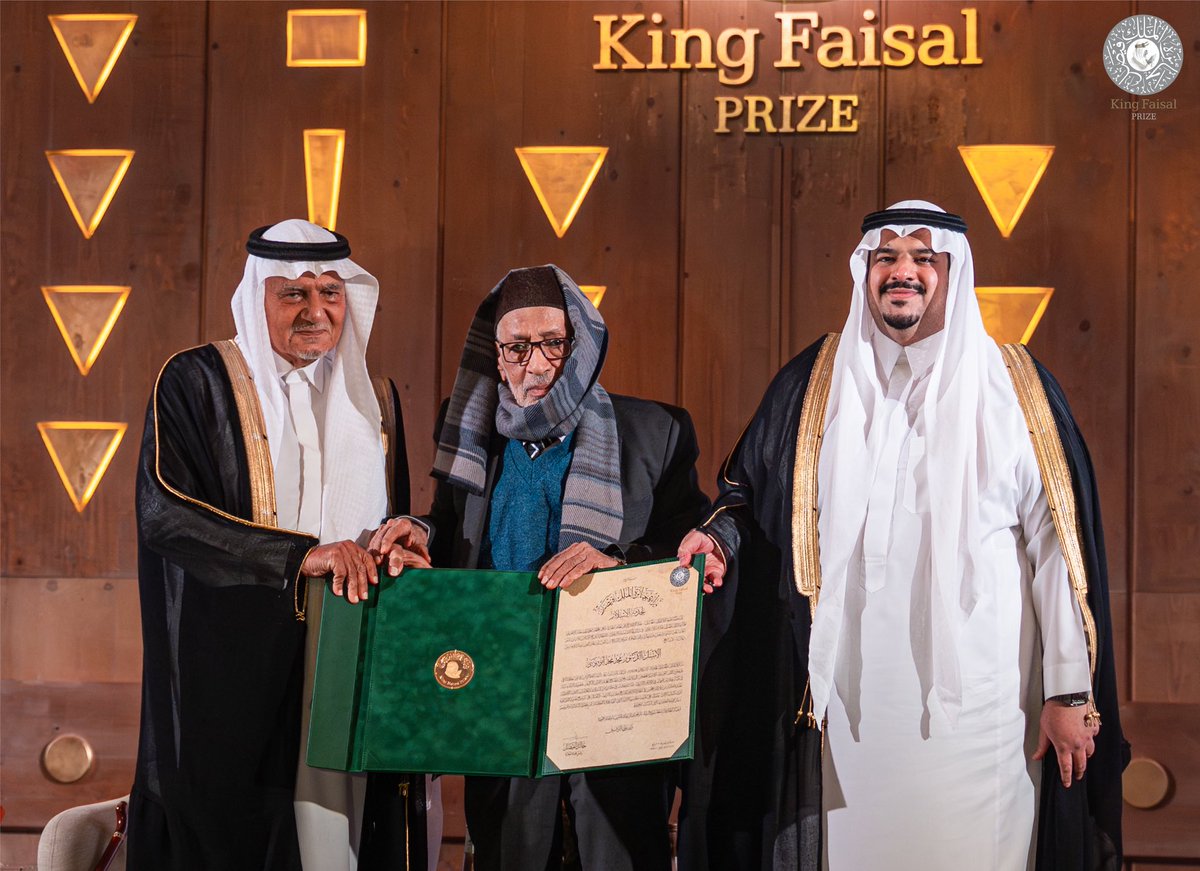
Under the patronage of the Custodian of the Two Holy Mosques, King Salman bin Abdulaziz Al Saud, and on his behalf, Prince Mohammed bin Abdulrahman bin Abdulaziz, Deputy Governor of Riyadh, honored the winners of the 2026 King Faisal Prize during its 48th edition ceremony held on Wednesday evening at the Prince Sultan Grand Hall in Al-Faisaliah Hotel in Riyadh.
In a speech delivered during the ceremony, Prince Turki bin Faisal bin Abdulaziz, Chairman of the King Faisal Center for Islamic Research and Studies, said the prize remains committed to honoring knowledge and celebrating scholars whose contributions serve humanity, in line with the Kingdom’s leadership directives aimed at advancing development at the national, regional, and global levels. He extended congratulations to the laureates.
Secretary General of the prize, Abdulaziz Alsebail, then introduced the seven winners, recognizing their distinguished achievements across the fields of service to Islam, Islamic studies, Arabic language and literature, medicine, and science.
The Service to Islam prize was awarded jointly to Sheikh Abdullatif Ahmed Al Fozan, Chairman of the Board of Directors of Al Fozan Company, in recognition of his distinguished approach to charitable work, including his support for high-impact initiatives addressing developmental needs, and for establishing the “Ajwad Endowment” as a community-based platform for initiating and developing humanitarian programs.
The prize was also awarded to Dr. Muhammad Muhammad Abu Musa, Professor at Al-Azhar University in Egypt, for his scholarly contributions to the Arabic language, particularly rhetoric, through authoring more than 30 specialized books that illuminate the miraculous nature of the Holy Quran. He was also awarded the prize for his role as a founding member of the Council of Senior Scholars at Al-Azhar, his participation in numerous international academic conferences, his delivery of more than 300 scholarly lessons at Al-Azhar Mosque on classical texts, and his efforts to strengthen cultural identity among young people.
Regarding the King Faisal Prize for Islamic Studies, themed “Trade Routes in the Islamic World,” the committee awarded the prize jointly to Dr. Abdelhamid Hussein Mahmoud Hammouda, Professor at Fayoum University in Egypt, for his comprehensive and objective scholarly work examining land and maritime trade routes, their networks, and branches across the Islamic East, Iraq, Persia, the Arabian Peninsula, the Levant, Egypt, and the Sahara.
The prize was also awarded to Dr. Muhammad Wahib Hussein, Professor at the Hashemite University in Jordan, for his original research based on direct archaeological field surveys supported by precise GPS-based coordinate documentation and detailed analytical maps. His methodology was distinguished by linking Qur’anic texts with geographical and field data, offering a balanced academic reading of the Meccan trade route within its historical and geographical context. His work was considered a qualitative addition to the documentation of early trade routes in the Arabian Peninsula.
As for the King Faisal Prize for Arabic Language and Literature, themed “Arabic Literature in French,” the prize was awarded to Professor Pierre Larcher of Aix-Marseille University in France. The award recognized his innovative presentation of Arabic literature to French-speaking audiences, which has earned wide acclaim among critics and scholars, as well as his rigorous academic methodology in studying classical Arabic poetry and situating it within French cultural contexts. His critical project includes distinguished French translations of the Mu‘allaqat and in-depth scholarly studies of pre-Islamic poetry.
The King Faisal Prize for Medicine, themed “Discoveries Transforming Obesity Therapeutics,” was awarded to Professor Svetlana Mojsov of Rockefeller University in the United States. The committee cited her pioneering discovery of the biologically active glucagon-like peptide-1 (GLP-1) as a hormone with receptors in the human pancreas, heart, and brain. Through advanced biochemical peptide techniques and precise physiological studies, her research demonstrated that GLP-1 is a powerful stimulant of insulin secretion, contributing significantly to the development of a new class of treatments for diabetes and obesity.
Meanwhile, the King Faisal Prize for Science, themed “Mathematics,” was awarded to Professor Carlos Kenig of the University of Chicago in the United States. The prize recognized his pioneering contributions to mathematical analysis, which have fundamentally advanced the understanding of nonlinear partial differential equations. His work has introduced influential mathematical techniques now widely used in research, with applications spanning fluid mechanics, fiber optics, and medical imaging.