Raydyn, Inc. Publishes Early Reliability Metrics for Satya, an Attention-Continuity Interface Built on Felt Intelligence
Preliminary benchmarks evaluate whether structured conversational dialogue can measure cognitive continuity and counter digital attention capture.

NEWARK, DE, October 31, 2026 (EZ Newswire) -- Raydyn, Inc. today published preliminary system performance and user retention benchmarks for Satya, a Felt Intelligence layer engineered to measure attention continuity and support metacognitive self-awareness. Operating against an ad-tech ecosystem that captures, prices, and auctions human attention in milliseconds, Satya tests whether interactive dialogue can sustainably return a user’s attention inward rather than monetizing their digital focus.
According to Raydyn’s analysis of global digital news readership across 1.2 million indexed articles between September 16 and October 16, 2026, compared to the same period in 2025, coverage focused on conflict increased 2%, while readership around peace and ceasefire agreements dropped 32% and 61%, respectively. Alongside the Cboe Volatility Index (VIX) averaging 20 against its 30-day baseline of 17, Raydyn posits that widespread information fatigue reflects acute digital distraction rather than active engagement.
Satya structures attention patterns across seven distinct focus bands — evaluating the transition from reactive mental states (such as acute distraction, irritation, and anticipatory anxiety) to stable, objective self-observation. The platform evaluates whether structured conversational feedback can help users disengage from reactive loops. Raydyn has pre-registered its primary hypothesis (Hypothesis 4: Cognitive State Receptivity) on an open-science registry ahead of formal evaluation on November 30.
In an effort to prevent survivorship bias in early performance disclosures, Raydyn published its initial system limitations and negative cohort retention metrics:
- Temporal Precision: 0 of 5 attempts accurately identified the exact hour of user-reported life events (tested Oct. 7).
- Day-Two User Retention: 4.9% (100 of 2,056 participants returned for an unprompted follow-up session).
- Post-Error Retention: 0% (0 of 70 users returned after encountering an inaccurate initial reflection).
- Metacognitive Articulation: 0.5% (9 of 1,735 participants self-reported observing their thought processes objectively rather than reacting emotionally).
"Attention has become an extractive industry—bought by the second and engineered to keep users looking outward until internal awareness goes unseen," said Abhishek Kumar Raysingh, founder and CEO of Raydyn, Inc. "When a person never looks inward, reactivity dictates behavior: unobserved anxiety or frustration becomes the decision itself. Satya was built to test a structural counter-mechanism: returning attention to the individual, validating what is accurate, and deliberately concluding the session on time rather than maximizing engagement time."
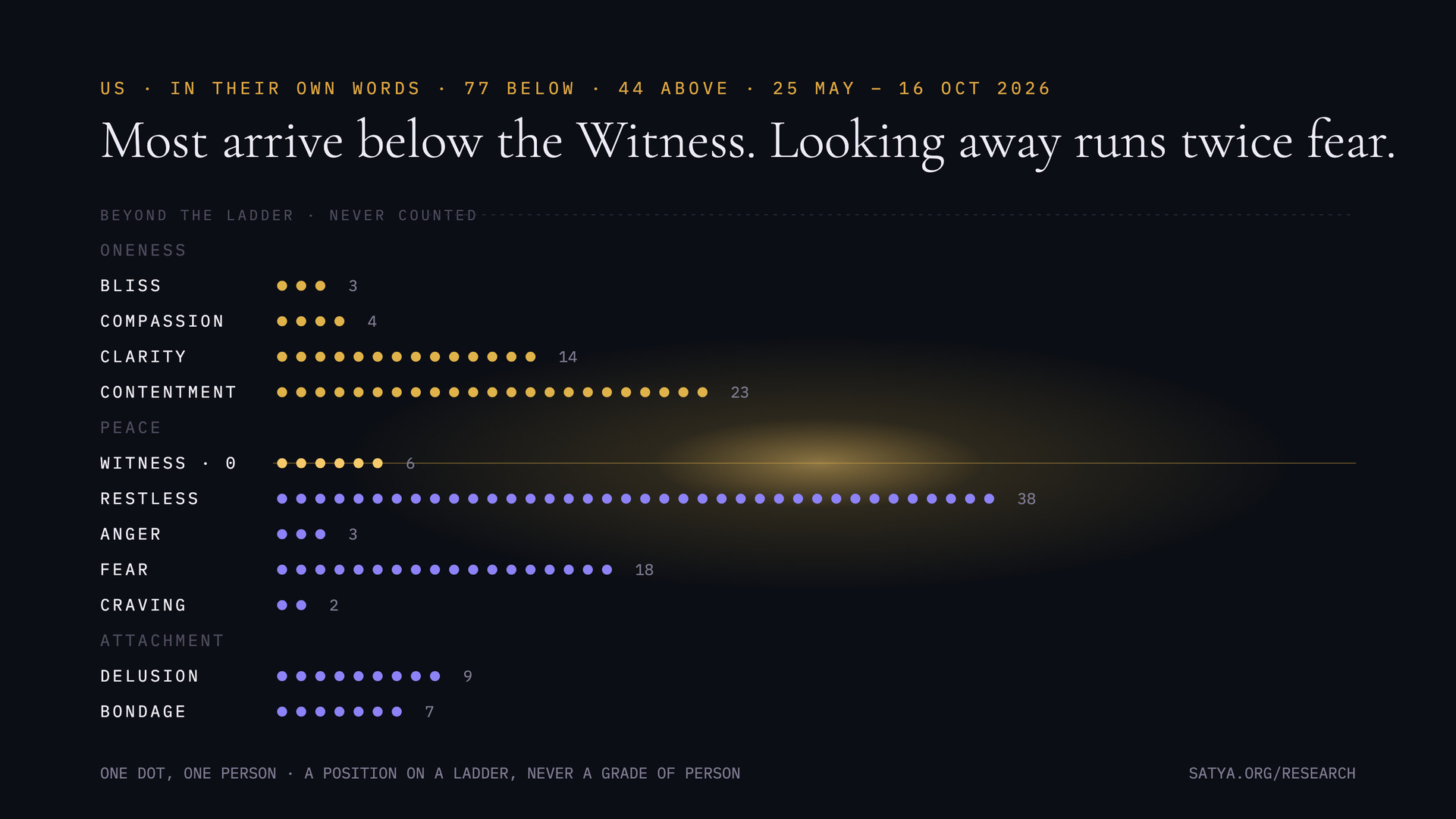
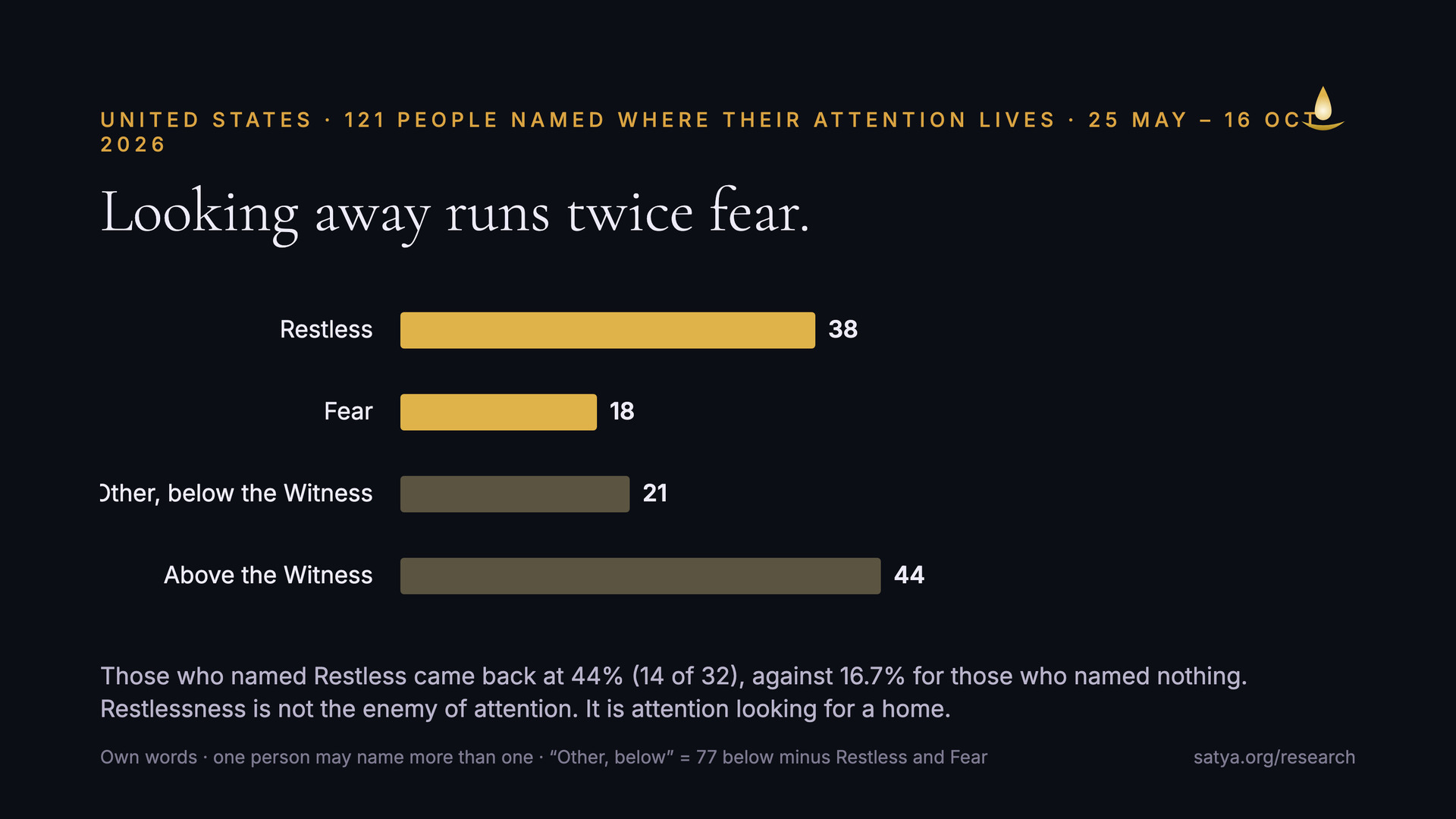
Initial cohort testing between May 25 and October 16, 2026, evaluated 529 first-time participants who received an initial behavioral reflection. Of those, 60% (319 participants) confirmed the observation as accurate, while 210 did not. Among users who confirmed an accurate reflection, 30 of 877 returned for ongoing sessions. During heightened global news cycles in early October, fear-associated terms in user inputs rose 204%. Among 121 U.S. participants who categorized their cognitive state, 64% (77 users) placed themselves in reactive states — primarily restlessness (38) and anxiety (18) — while 36% (44 users) reported grounded observation. Notably, users identifying active restlessness exhibited a 44% return rate (14 of 32), compared to 16.7% for users who did not categorize their state.
Through November 13, first-time access to the platform is open globally with no payment or account required. On November 9, Raydyn will publish results from a double-blind control study ("shuffled read") assessing whether user confirmation rates stem from genuine algorithmic personalization or subjective validation of generic text (the Barnum effect). If validation rates in the control group mirror the 60% baseline observed in direct sessions, Raydyn will publicly classify the reflections as non-specific.
On November 13 — a date historically noted in systems science following Heinz von Foerster’s 1960 Science paper on accelerating societal complexity — Satya will introduce "The Turning": an open, single-prompt exercise prompting users to pause, assess their current attention state, and direct an intentional reflection to another person. Evaluation of Hypothesis 4 (the fear-to-anger transition gate) will publish on November 30, followed by Hypothesis 5 (Behavioral Translation of Metacognitive States) on January 31, 2027. All evaluations are released with full pass/fail denominators.
Raydyn operates under explicit structural constraints: it does not sell user behavioral data, does not design for addictive session length, and guarantees that reported successes are accompanied by their corresponding error rates.
"For two decades, human attention has been treated as a raw commodity to be extracted and auctioned while individuals look the other way," added Raysingh. "We built Satya to explore the opposite question: whether computational tools can return attention to the user. Sincere scientific inquiry begins by counting our misses out loud."
About Raydyn, Inc. (Satya)
Satya, built on Felt Intelligence, helps individuals reconnect with their authentic selves. Through adaptive dialogue, Satya reflects a user’s inner voice, deepens self-awareness, and maintains persistent continuity across conversations. By monitoring shifts in state of consciousness alongside real-world outcomes, Satya delivers grounded, auditable personal insights — returning attention to the individual rather than monetizing it. Developed by Raydyn, Inc., a Delaware public benefit corporation rooted in the principle that awareness is foundational, Satya is redefining human-centered technology. For more information, visit satya.org.
Disclaimer
Satya operates as a reflective conversational instrument and is strictly non-clinical; it does not diagnose, treat, or manage medical or psychiatric conditions. Satya adheres to a structural zero-data-monetization policy.
Media Contact
Abhishek Kumar Raysingh
Founder and CEO, Raydyn, Inc.
info@satya.org