

SHENZHEN, China, November 25, 2026 (EZ Newswire) -- On Nov. 12, the openKylin Global Ecosystem Conference was held in Shenzhen, bringing together user group delegates from countries such as Sierra Leone and Iraq, alongside international guests, including the consul general of the UAE in Guangzhou and representatives from the German Jordanian University. Discussions centered on operating system innovation in the AI era and global open-source collaboration, exploring how open cooperation can bring together innovative resources, expand the application of digital technologies, and drive the development of the global open-source ecosystem.
In his opening remarks, Xie Shaofeng, chairman of the OpenAtom Foundation, highlighted that openKylin's trajectory demonstrates the innovative strength and international collaboration potential of China's open-source operating systems. The foundation will continue to support openKylin in expanding global partnerships, deepening international community exchanges, nurturing talent, and working with partners worldwide to build an open, thriving open-source ecosystem.
AI Moves Beyond the Chatbox: Operating Systems Redefine Human-Computer Interaction
When computers no longer merely await commands but begin to understand user intent, how will operating systems evolve? openKylin's answer lies in deeply embedding AI into core system operations: interpreting tasks, orchestrating tools, and connecting applications to assist users with their authorization. Under specific benchmark environments and task suites, its optimized multitasking scheduling reduces task latency, response time, and overall completion duration by more than 70%.
Upgraded to the Linux 7.0 kernel, openKylin 3.0 delivers over 180 updated core components and introduces support for 18 additional languages. In his keynote address titled "Open Source Knows No Borders: Bringing Intelligence to Diverse Scenarios," Wu Qingbo, chief scientist of China Electronics Corporation and chair of the openKylin Technical Committee, shared the community's latest advances in intelligent operating system technology and cross-scenario integration.
188 Countries and Regions, 28 Million Deployments
openKylin's global footprint is built upon broad developer engagement and strong industry collaboration. Today, the community features over 32,000 developers across 158 special interest groups (SIGs), nearly 30,000 valid merge requests, more than 3,000 ecosystem partners, and over 8 million compatible software and hardware adaptations. With users spanning 188 countries and regions, deployments have surpassed 28 million units, supported by 60 overseas user groups across more than 30 nations.
International interest in openKylin continues to grow. In November 2026, openKylin ranked fifth on the weekly chart of DistroWatch, a well-known information platform for Linux distributions, reflecting its growing visibility and influence in the international open-source community.
Chen Zehui, vice president of Asia Pacific at the Linux Foundation, recognized openKylin's achievements from the perspective of the global open-source ecosystem. He noted that openKylin's ranking among the world's top five active open-source communities reflects the positive impact of China's open-source community in building the global Linux ecosystem. The Linux Foundation will continue to support community governance, security, and compliance, empowering openKylin to deepen international collaborations and expand its global footprint and influence.
Deepening Global Partnerships: From Agreements to Real-World Impact
During the event, openKylin signed ecosystem cooperation agreements with Macao Polytechnic University, Shenzhen University, Shenzhen Technology University, Guangdong Open University, and SpacemiT, further strengthening collaboration among industry, academia, and research institutions, bringing together innovative resources from universities, research organizations, and industry partners to explore new ways for open-source technologies to drive digital development.
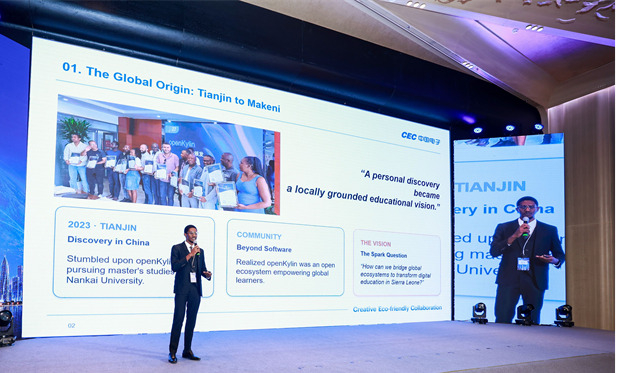
Community representatives from diverse countries and fields also shared their on-the-ground experiences in collaborative ecosystem building. Zamo Rzgar, head of the Iraq User Group, detailed progress on Arabic localization; Edward Kamara, deputy head of the Sierra Leone User Group, highlighted initiatives promoting open-source education among local youth; Wu Wei, ambassador for RISC-V International, presented explorations into building an embodied AI ecosystem on openKylin; and a user representative from the Airport Authority Hong Kong outlined the technological approach to translating technical vision into practical solutions for critical infrastructure.
Breaking down technological and geographical barriers to transform AI innovations into inclusive capabilities accessible to all — and extending the benefits of open innovation across society — remains a core mission of open source and a shared pursuit driving global digital advancement.
Looking ahead, openKylin will continue to strengthen its international partnership network and support overseas communities in launching localized distributions tailored to regional needs. It will also deepen collaboration with global open-source foundations, academic institutions, and industry partners to bring more technological advances to countries and regions worldwide. These efforts will provide a more open platform for developers and industry partners around the world to contribute to innovation in intelligent operating systems.
About openKylin
openKylin is an open-source initiative founded by KylinSoft Corporation and incubated and operated by the OpenAtom Foundation. Dedicated to building a world-leading intelligent open-source operating system community, openKylin embraces an open-source, collaborative approach to cultivate a robust partner ecosystem. By uniting hardware and software vendors, developers, and industry stakeholders, the community co-develops an intelligent OS that spans architectural adaptation, AI integration, refined desktop experiences, and broad application compatibility.
Media Contact
Jemma Wen
openKylin
contact@openkylin.top
+44 7536 943507