Lemon.io Report Unveils the Four Essential AI Engineering Roles for 2026
Demand for AI-capable engineers has surged 60% in the past year, but as hiring accelerates, companies are increasingly struggling to distinguish true AI expertise from surface-level familiarity.

Lemon.io’s new report, “The Four Essential AI Engineering Roles for 2026,” reveals how the once-unified “AI engineer” title has fragmented into four distinct, high-impact specializations. Drawing on data from over 1,500 vetted developers from more than 40 countries and a year of screening insights, the report helps companies understand which roles they actually need — and how to identify genuine AI expertise in an increasingly crowded talent market.
Over the past year, AI-related mentions in client hire requests at Lemon.io — a curated marketplace for senior developers — have more than twice. The surge isn’t limited to demand: the number of candidates identifying themselves as “AI engineers” in their CVs has grown at a comparable rate.
This creates a practical problem for any startup or SMB trying to hire: how do you tell apart a developer who uses AI tools from one who genuinely engineers with them?
“In 2026, the 'AI engineer' label has fragmented into a specialized spectrum where most businesses demand AI-augmented workflows as a baseline requirement. We’re seeing a clear shift away from generalist requests toward high-impact roles such as AI agent architect and AI automation architect.
Besides, at Lemon.io, our data confirms that while traditional ML demand remains steady, the real competitive edge now lies in AI integration across every development layer. The market is no longer asking for AI specialists — it is demanding a new standard of AI-native engineering,” noted Anastasiia Andriienko, Talent Matching Lead at Lemon.io.
The goal of the report is to give leads seeking tech talent a clear, tool- and skill-focused picture of what engineering with AI looks like in 2026, role by role.
Four AI Engineer Roles — Four Skill Sets. What the AI Job Market Looks Like in 2026
Client demand for AI competencies currently clusters around four distinct roles. Understanding which one you need can save significant budget and hiring time.
AI API Integrator
These developers, who typically charge $90–$180 per hour, build product features using existing AI models — connecting LLM APIs, designing RAG pipelines, and embedding AI capabilities into live products. They don't train models; they use them to automate product flows and unlock growth.
AI-Assisted Engineer
These are traditional full-stack developers who typically charge $40–$130 per hour and have meaningfully incorporated AI coding tools into their workflow — achieving 3–5x speed improvements on standard development tasks. The role is about leveraging, not specialization.
Machine Learning Engineer
These professionals, who typically charge $120–$250+ per hour, build and train ML models, design neural network architectures, and optimize model accuracy — the job initially associated with custom AI development. Machine learning engineers typically hold a formal background in Computer Science, Mathematics, or Statistics and have work experience in Data Science and Deep Learning Algorithms. They are most in-demand at deep-tech startups.
AI Optimizer / LLMOps
These specialists, who typically charge $110–$200 per hour, ensure deployed AI systems are neither too slow for users nor too expensive to run. They focus on inference optimization, cost management, and production observability.
The screening process at Lemon.io reveals that hiring for AI is no longer about finding a single profile, but rather identifying one of four distinct mindsets. While an ML engineer focuses on models and mathematical frameworks, an API Integrator prioritizes product functionality. Meanwhile, AI-Assisted Developers center their work on speed, and LLMOps specialists focus on production cost and system reliability.
To align these industry trends with practical hiring, Lemon.io maps these skill sets to standardized specializations that developers recognize. While the “four roles” describe the market’s functional needs, the platform is expanding its vetting to include high-demand titles like AI agent architects and AI automation architects, alongside a new vertical for data annotators to support custom model fine-tuning
“While we categorize talent under recognized titles like AI and ML Engineers to match developer naming conventions, we are actively expanding our specializations to include AI agent and automation architects,” stated Andriienko. “By also integrating data annotators into our talent pool, we ensure that whether a client needs a high-level architect or the foundational data support for a custom model, we have the specific expertise ready to deploy.”
The AI Engineer Markers: Which Tools Are Showing Up on Profiles
One of the clearest signals of genuine AI fluency is which specific tools a developer mentions — and whether those mentions hold up under questioning. Below is what we tracked across more than 1,500 candidate profiles, comparing Q1 2025 to Q1 2026:
The Rise of AI APIs
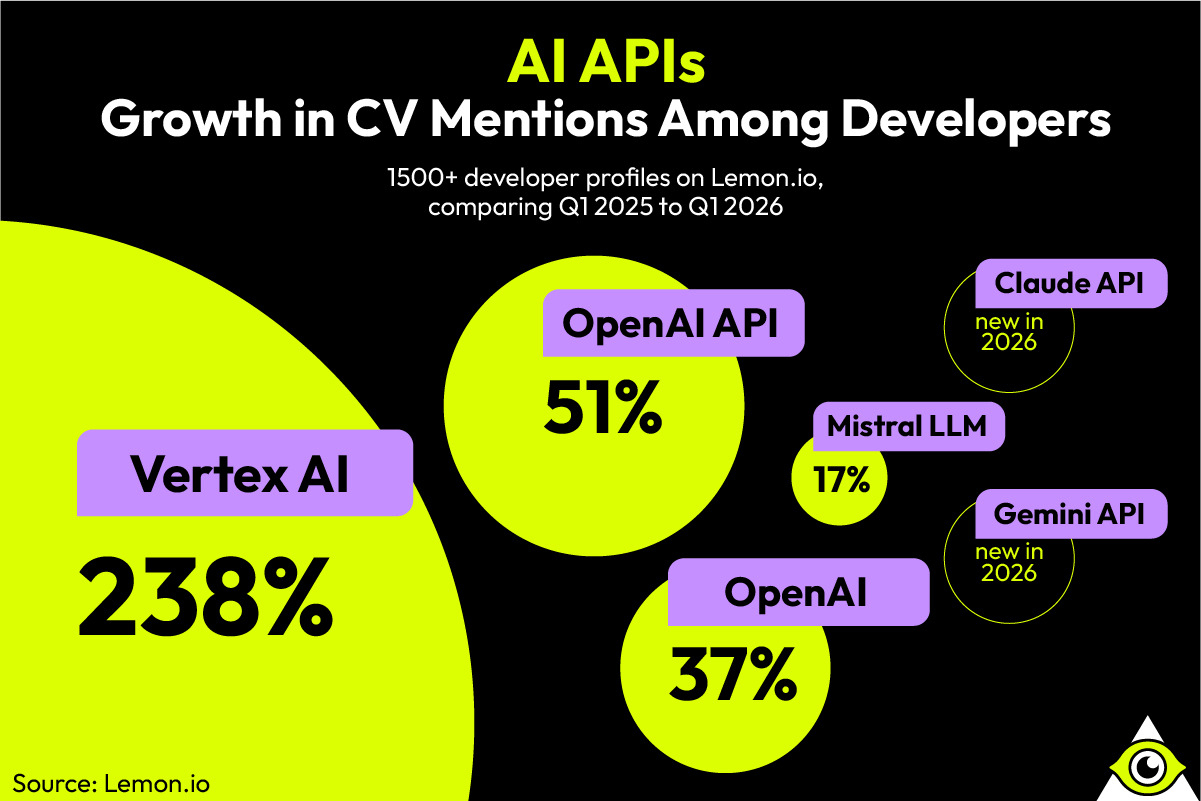
The modern developer’s toolkit is shifting toward pre-built intelligence, making the AI Integrator a pivotal role in 2026. Lemon.io’s data shows a massive surge in API adoption, led by Vertex AI with 238% growth and a steady 51% increase in OpenAI API mentions. The emergence of newcomers like the Claude and Gemini APIs this year highlights a diversifying market where plugging in ready-made models is the new standard.
Growth in CV Mentions of AI Tools Among Developers:
- Vertex AI (Google AI API): 238% growth
- OpenAI API: 51% growth
- OpenAI: 37% growth
- Mistral LLM: 17% growth
- Claude API: Appeared in 2026
- Gemini API: Appeared in 2026
The New Coding Standard — AI IDEs
Coding is no longer a manual craft but a collaborative process between humans and AI, defining the era of the AI-assisted engineer.
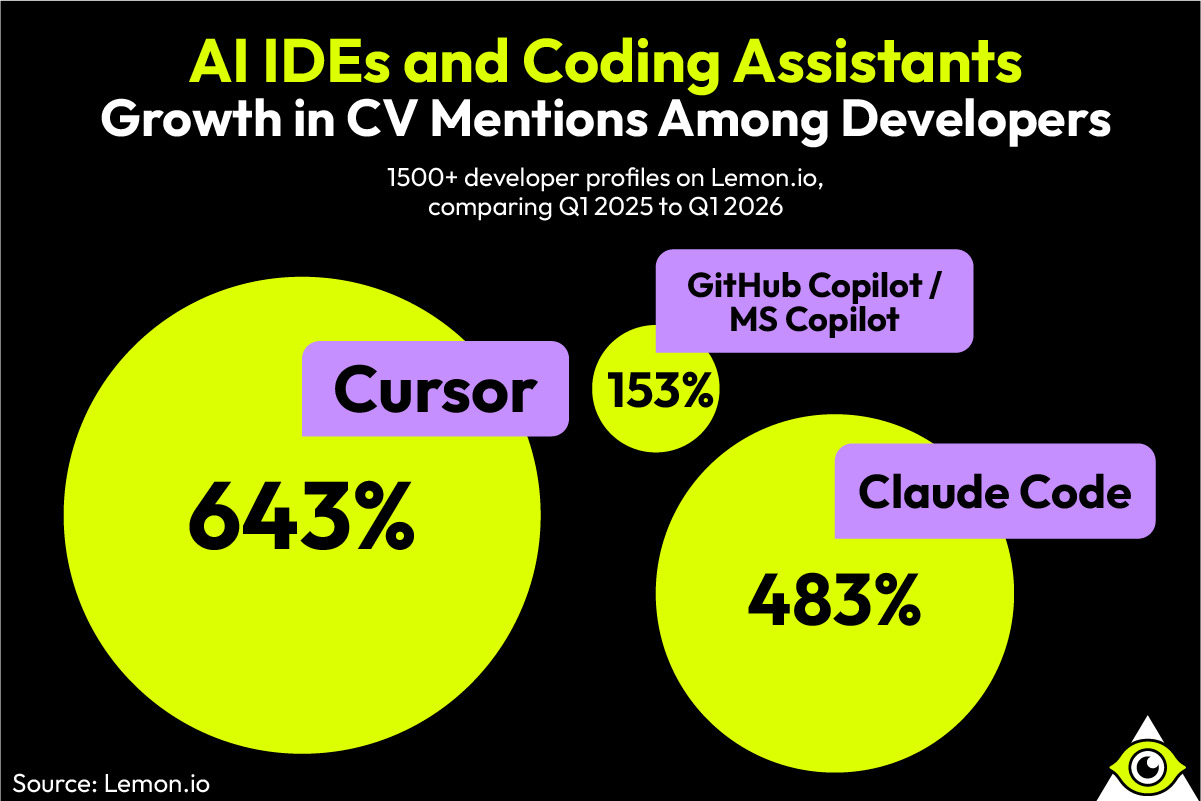
The explosion of specialized tools is undeniable, with Cursor seeing a staggering 643% growth and Claude Code following at 483%. Even established players like GitHub Copilot continue to dominate with a 153% increase in developer adoption. All these tools have transitioned from “nice-to-have” assistants to mandatory environments for high-velocity delivery.
Growth in CV Mentions of AI IDEs and Coding Assistants:
- Cursor: 643% growth in CV mentions
- Claude Code: 483% growth
- GitHub Copilot / MS Copilot: 153% growth
Mastering AI Orchestration and Observability
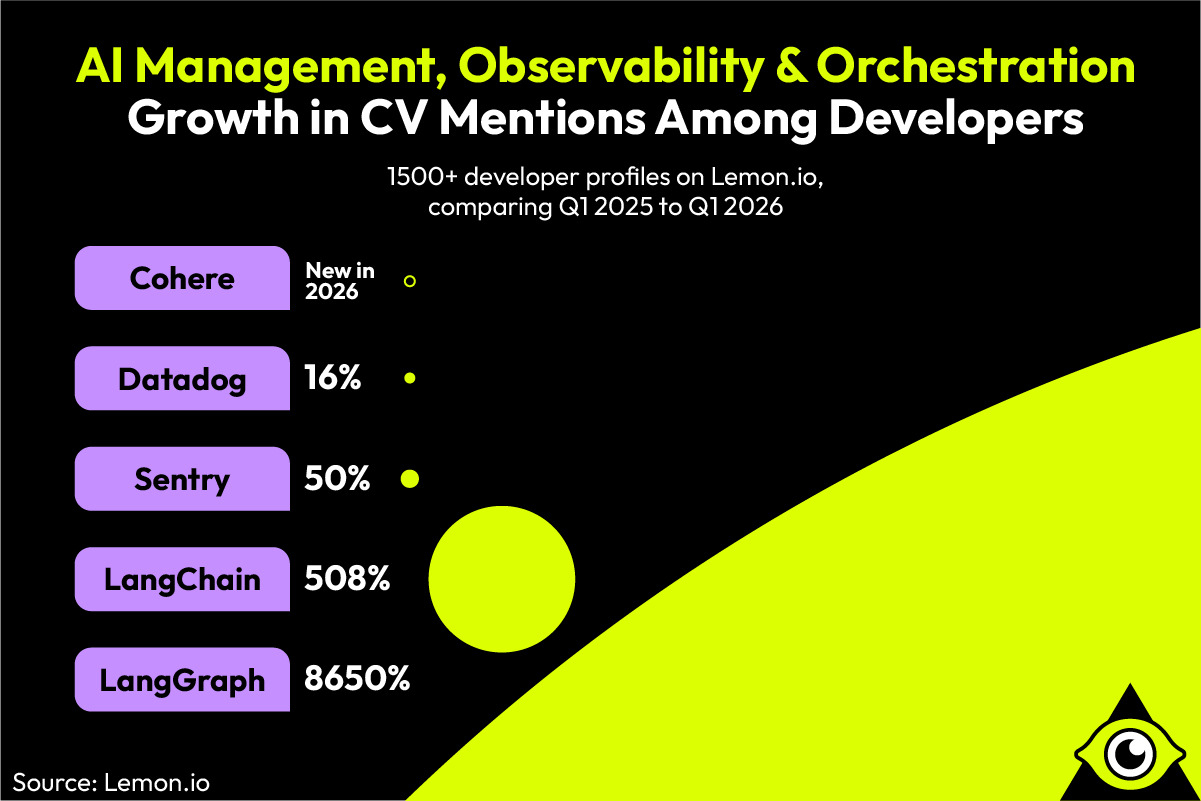
As AI moves from experimental labs to production, the focus has shifted to AI Optimizers who can manage complex workflows. This is best illustrated by the astronomical 8650% growth of LangGraph, signaling a massive move toward agentic orchestration, alongside a 508% rise in LangChain mentions.
Traditional monitoring giants like Sentry (50% growth) are also pivoting to capture this AI workload observability trend. In short, the industry’s priority has moved from simply “running” an LLM to “governing” its behavior at scale.
Growth in CV Mentions of AI Management, Observability, and Orchestration Tools:
- LangGraph: 8650% growth in CV mentions
- LangChain: 508% growth
- Sentry: 50% growth
- Datadog (AI workload monitoring): 16% growth
- Cohere: appeared in 2026
The Resilient Core of ML Frameworks
While generative AI captures the headlines, the underlying infrastructure managed by ML Engineers remains the bedrock of the industry.
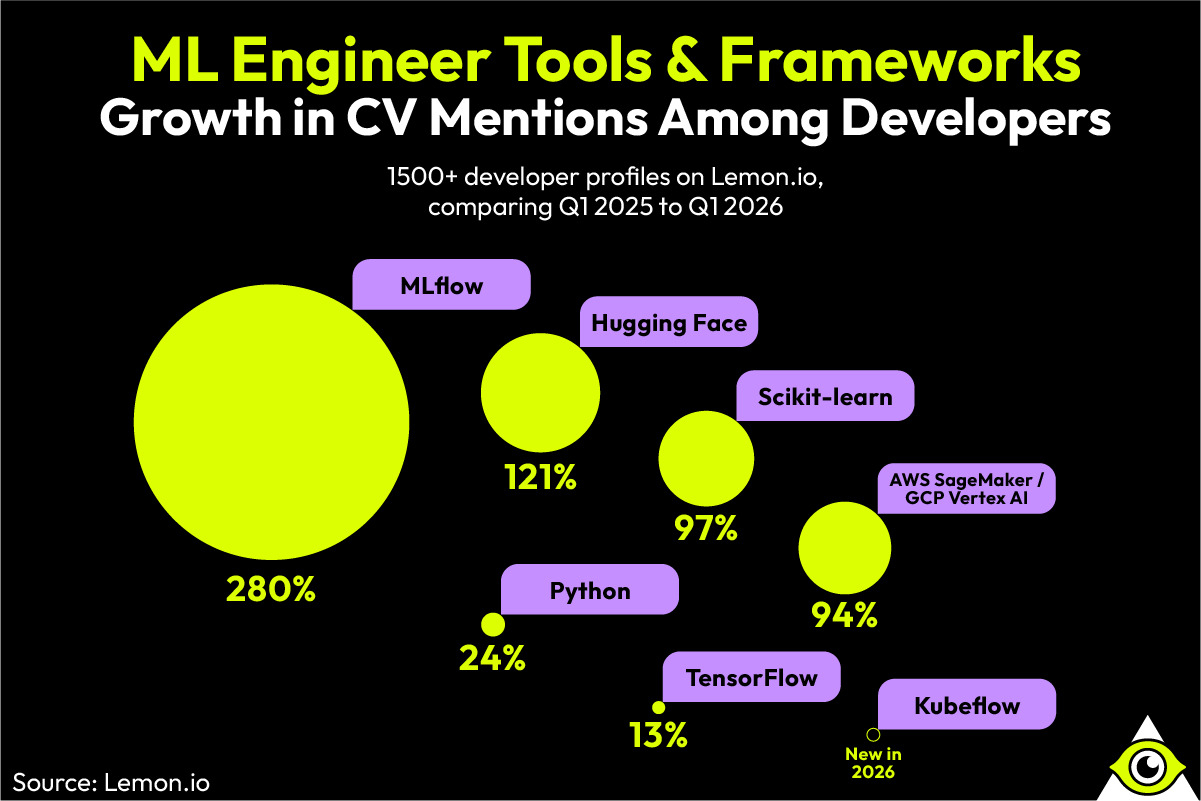
Proven frameworks like MLflow have seen a 280% surge in importance, while Hugging Face (121% growth) remains the go-to repository for model deployment. Even foundational giants like AWS SageMaker and GCP Vertex AI maintain strong momentum with 94% growth, proving that robust MLOps are still essential for scaling.
The takeaway is clear: the AI revolution is being built on a matured and rapidly expanding technical pipeline.
Growth in CV Mentions of ML Engineer Tools and Frameworks:
- MLflow: 280% growth in CV mentions
- Hugging Face: 121% growth
- Scikit-learn: 97% growth
- AWS SageMaker / GCP Vertex AI: 94% growth
- Python: 24% growth
- TensorFlow: 13% growth
- Kubeflow: appeared in 2026
Important note: A growing mention count is not the same as demonstrated competency. Listing Anthropic API on a resume is not equivalent to having architected a production RAG pipeline with it. This distinction is what our vetting process is designed to surface.
AI Engineer Vetting Criteria
When we look at candidates who list AI specializations versus those who can demonstrate them in a live technical session, a meaningful gap emerges. In particular, passing Lemon.io's AI-focused technical interview requires demonstrating:
- Practical experience with at least one production AI integration
- Ability to reason about tool selection (why LangGraph over a simpler chain, for instance)
- Understanding of cost and latency tradeoffs in LLM deployment
- For senior roles, the ability to articulate what particular AI implementation changed at the product or business level
These criteria are the baseline for experts who have shipped AI features in a real product. Critically, Lemon.io moved away from take-home assignments toward live collaborative sessions.
“Live tasks expose candidates who rely on AI output without a genuine understanding: we change task parameters mid-session and observe how candidates adapt. For remote engineering roles, this kind of real-time reasoning matters more than polished homework,” explained Inna Chernova, Talent Acquisition Recruiting Lead at Lemon.io.
Furthermore, clients are increasingly looking for more than just technical proficiency. They seek individuals capable of taking ownership of technical decisions, conducting autonomous innovation research, understanding the competitive landscape, and making their work more effective with top-notch AI tools.
Thus, AI (or any other tool) fluency is not enough. Modern startups need product visionaries with niche experience rather than just executors. “Pure coding or architectural knowledge is no longer the primary competitive advantage. The decisive factor is product thinking — understanding how every feature impacts the business as a whole,” pointed out Aleksandr Volodarsky, CEO and founder at Lemon.io.
Additional insights on AI’s impact on hiring are outlined in a recent hiring guide for founders by Lemon.io.
The challenge our vetting data show is that the volume of candidates claiming this experience has grown much faster than the volume demonstrating it, which is precisely why structured vetting, rather than resume review, is the only reliable filter.
Practical Guidance for Hiring Teams in 2026
AI engineering hiring requests have grown dramatically, but the tools on a resume have grown faster than the skills behind them. For teams navigating this gap, a few principles make the difference between a costly mismatch and a high-impact hire:
-
Define the role before writing the spec: The four roles above have meaningfully different requirements, real-world tasks, and rate bands. Conflating them inflates expectations and costs
-
Ask for live demonstrations, not polished portfolios: A candidate's ability to adapt to a changing problem in real time reveals more than any take-home project
-
Treat tool mentions as a starting point, not a credential: Use the identifier tables above to ask better follow-up questions: When did you use it? What were you trying to solve? What would you do differently now?
-
Expect business context from senior candidates
The most effective AI engineers in 2026 can explain what their work changed — not just how they built it.
“At Lemon.io, we surface pre-vetted candidates matching these criteria within 24 hours. Our structured intake process — combining precise role identification with multi-layer technical screening and soft skill check — means clients spend less time filtering and move one to onboarding a new hire who fits their environment,” underlined Andriienko.
For a deeper breakdown of AI engineering role-specific requirements, visit Lemon.io's blog on AI engineer role requirements.
About Lemon.io
Lemon.io is a curated talent marketplace that connects startups and midsized companies with the top 1.2% of pre-vetted, senior software engineers across 100+ tech stacks. The platform manages the entire pipeline — from vetting to contracts and payments — and delivers qualified developer matches within 24 hours. For more information, visit lemon.io.
Media Contact
Denys Velykozhon
Head of Organic Growth, Lemon.io
d.velykozhon@lemon.io