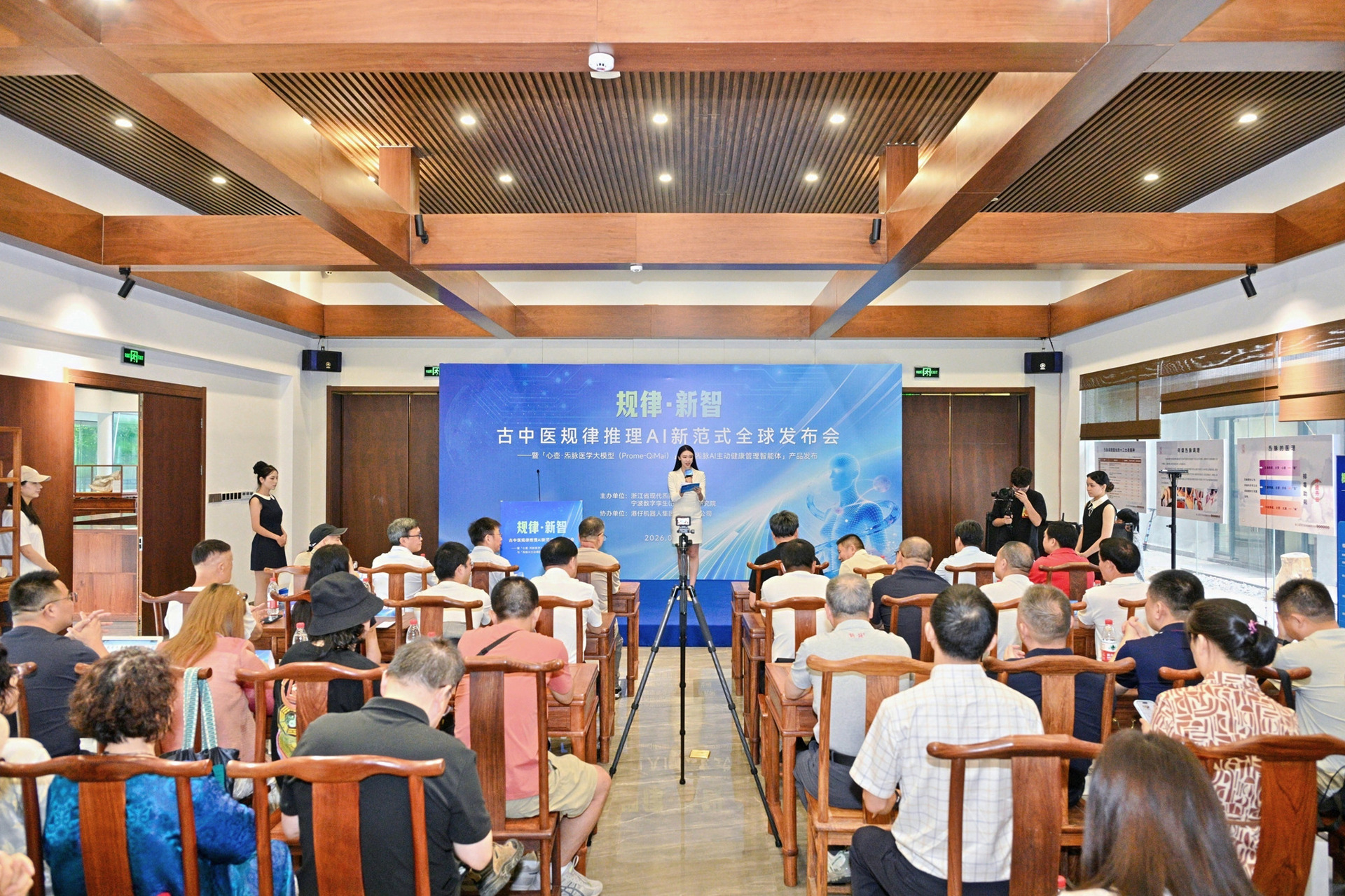
HONG KONG, September 29, 2026 (EZ Newswire) -- What happens when the underlying patterns of classical Chinese medicine meet artificial intelligence? The “Patterns · New Intelligence” Global Launch Conference for a New Pattern-Reasoning AI Paradigm in Classical Chinese Medicine was held on September 24 at the Xixi Creative Industry Park in Hangzhou, China. The event was jointly organized by Zhejiangsheng Qi-Mai Health Institute, Eastern Institute of Technology, Ningbo, Ningbo Institute of Digital Twin (Eastern Institute of Technology), and Hong Kong Robotics Group Holding Limited. At the event, the organizers officially unveiled the Xinhu · Qi-Mai Medical Large Model (Prome-QiMai) and the Qi-Mai AI Proactive Health Management Agent.
The newly released system draws on the classical Chinese medicine principle of “syndrome differentiation to identify causes” to establish a computable framework for pattern reasoning. It incorporates a closed-loop architecture of “five-dimensional diagnosis + intervention + feedback + closed-loop validation,” with the aim of addressing industry challenges associated with the black-box nature of conventional probabilistic AI and its difficulty in aligning with the diagnostic reasoning of traditional Chinese medicine.
According to the organizers, the pattern-reasoning AI is built on the systematic principles of classical Chinese medicine. It is designed to interpret patterns related to life and health, trace problems to their underlying causes, and generate closed-loop intervention plans. Rather than functioning merely as a data-fitting tool, the organizers position it as foundational AI infrastructure intended to support proactive health management at scale and the modernization of traditional Chinese medicine, using contemporary technology to revitalize the knowledge and practices of traditional medicine.
The implementation of the initiative is supported by close collaboration among three principal partners spanning research, technology, and industry, with clearly defined roles across the development and deployment chain.
Zhejiangsheng Qi-Mai Health Institute serves as the core provider of theoretical and content expertise. Drawing on sustained research into classical Chinese medicine, the Institute carries forward foundational concepts including holistic medicine, the unity of humanity and nature, and syndrome differentiation to identify causes. It has developed a systematic theoretical framework for pattern reasoning in classical Chinese medicine, together with a computable reasoning framework that provides the traditional-medicine foundation and knowledge core for the Qi-Mai Medical Large Model and the AI Proactive Health Management Agent.
Ningbo Institute of Digital Twin (Eastern Institute of Technology) provides the project’s core technical support. Leveraging an independently controlled technology architecture, core algorithms, high-precision sensing technologies, and multimodal AI capabilities, the Institute seeks to advance AI from “seeing phenomena” to “understanding patterns.” It is also leading the preparation of the white paper on pattern-reasoning AI for classical Chinese medicine, intended to provide academic and technical support for the standardized, regulated, and scientifically grounded development of AI applications in traditional Chinese medicine.
Hong Kong Robotics Group Holding Limited is responsible for end-to-end industrial implementation and scenario operations. Building on AI-enabled health assessment technologies, wellness and eldercare robotics hardware, and full-stack robotics operations capabilities, the company is developing an integrated, full-cycle AI proactive health management service system. The initiative is intended to connect the broader industrial value chain and make traditional Chinese medicine technologies more accessible for routine and home-based use.
The event also marked the formal launch of work on the white paper on pattern-reasoning AI for classical Chinese medicine. Through on-site case comparisons and visual demonstrations of AI reasoning pathways, the organizers presented the system’s reasoning process. Participants also signed the Pattern AI Safeguards Declaration, which states that AI is not intended to replace clinical physicians and is to be used only as a health-support and companion tool.
Disclaimer
The Xinhu · Qi-Mai Medical Large Model and associated AI proactive health tools are designed solely as wellness support and companion systems; they are not certified medical devices, do not provide clinical diagnoses or medical advice, and are not intended to replace the professional judgment of licensed physicians. Additionally, this press release contains forward-looking statements regarding planned technology deployment, white paper development, and commercial robotics adoption, all of which are based on current organizational expectations and subject to operational, regulatory, and technological risks that could cause actual results to differ materially.
Media Contact
royzhong@hkrobotics.ai