Haiku Highlights Process Documentation as AI Moves Into Enterprise Workflows
As artificial intelligence becomes more integrated into enterprise operations, Haiku emphasizes the importance of clear process documentation to support efficiency, consistency, and successful adoption.
TEL AVIV-YAFO, Israel, October 14, 2026 (EZ Newswire) -- As companies move artificial intelligence from isolated experiments into day-to-day business operations, attention is shifting toward the processes, systems, and internal knowledge that support those deployments. Haiku is highlighting the role of process documentation in helping organizations capture how work is actually performed as business workflows become more technology-driven.
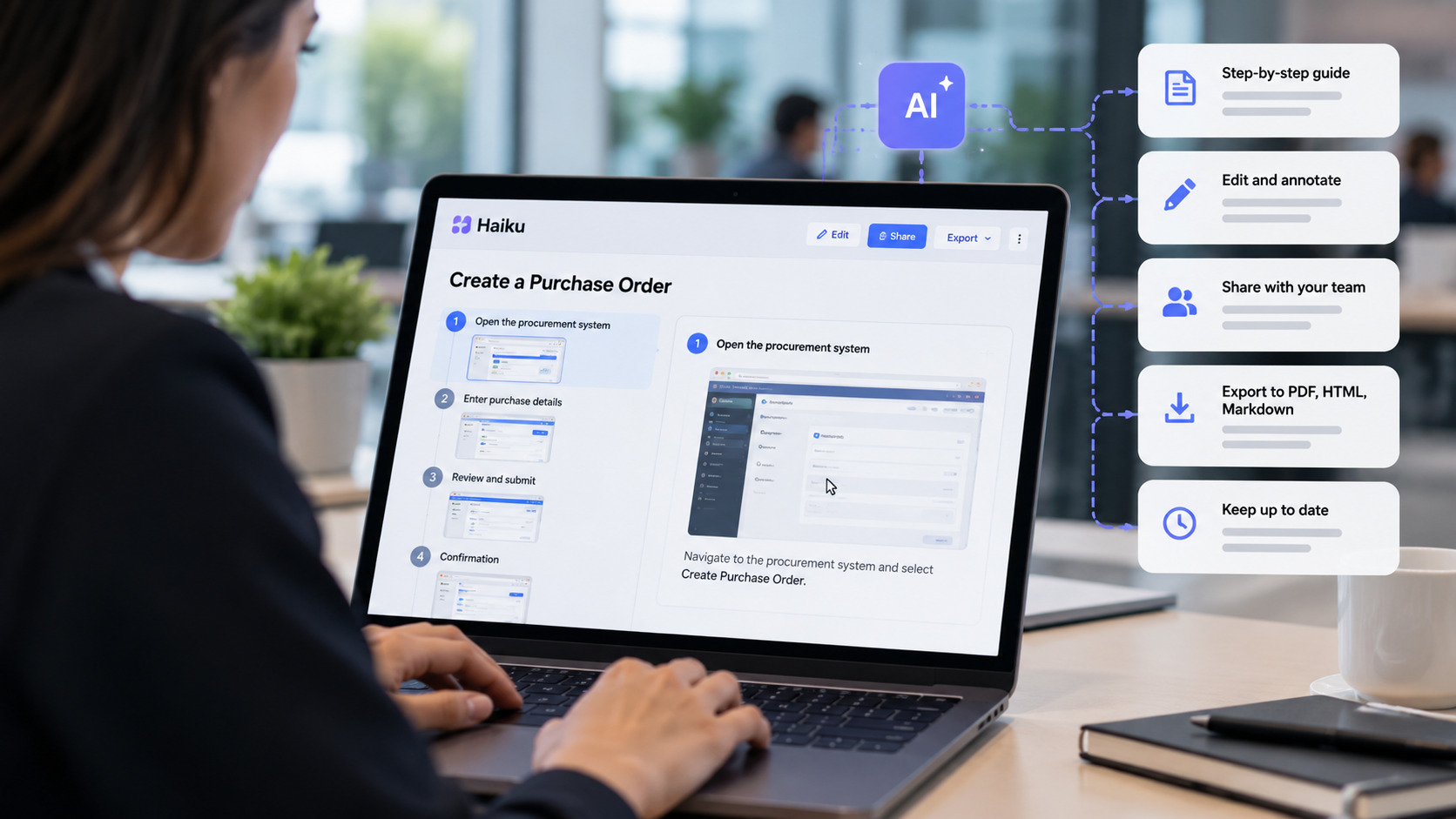
Built by WalkMe, Haiku is a corporate process documentation platform that records workflows and uses AI to turn them into step-by-step guides. The platform captures processes as employees complete them, rather than requiring teams to document each workflow manually from a blank page.
Documenting the Work Behind AI Adoption
The expansion of AI across business functions is creating new demands on organizations to understand how existing work gets done. Companies adopting automation tools need to identify processes, establish clear workflows, and ensure employees understand how those processes operate.
Haiku takes a capture-first approach. Users can record a workflow through its browser extension while completing the process normally. The platform captures clicks, navigation, and form fields, then generates descriptions and organizes the activity into a step-by-step guide.
The resulting documentation can be edited, annotated, and shared through links or embedded into tools such as Notion and Confluence. Guides can also be exported in formats including PDF, HTML, and Markdown.
For businesses, the significance is less about producing another document and more about creating a record of how a process is performed in practice.
From Process Capture to Operational Knowledge
Traditional process documentation often depends on subject-matter experts remembering each step and finding time to write it down. That can make documentation difficult to maintain as software interfaces, internal procedures, and responsibilities change.
Haiku's model begins with the workflow itself. An employee performs the task, the activity is captured, and the resulting guide can then be reviewed and adjusted before it is shared.
The approach is relevant across several business functions. Haiku identifies operations, human resources, learning and development, engineering, product, quality, compliance, and finance among its use cases.
For teams working across multiple software systems, documenting processes can also provide a common reference point for onboarding, training, and operational handoffs.
Enterprise Software Is Moving Toward Process Automation
The focus on workflows comes as enterprise software companies increasingly position AI around practical business processes rather than standalone demonstrations.
In April, Reuters reported that Box was preparing to launch Box Automate, an AI service designed to handle routine business work such as invoice processing and extracting information from corporate documents. The Box Automate rollout reflects the broader movement toward software that can participate directly in operational workflows.
That shift creates a parallel need for businesses to understand the processes being automated. Before a workflow can be improved, transferred, or automated, organizations still need a clear view of the steps involved, the systems employees use, and the points where human judgment is required.
Haiku's documentation model addresses that narrower layer by capturing and structuring the workflow itself.
Documentation Becomes Part of Modernization
Enterprise AI adoption is also exposing weaknesses in older technology environments. In July, Reuters reported that Capgemini expected a multiyear wave of IT modernization as companies prepared to deploy AI more extensively. The modernization cycle was linked to fragmented systems, legacy technology, and the difficulty of deploying AI across disconnected environments.
Process documentation sits at a different level from infrastructure modernization, but the two issues are connected by a common requirement: organizations need to understand how their operations work before changing them.
Documentation can help make those workflows visible to employees, managers, and technical teams. It can also record changes over time, especially when organizations move between software systems or introduce new automated tools.
Capturing Knowledge Before It Disappears
The business case for process documentation is not limited to AI. Employee turnover, new software deployments, and organizational restructuring can all leave companies dependent on knowledge held informally by individual employees.
Recording a workflow as it's performed creates a structured reference that can be reviewed and updated. Haiku's platform also supports version history on its paid plans, giving teams a way to maintain documentation as processes change.
That matters when different departments, new employees, or external stakeholders need to understand the same procedure. Instead of relying entirely on a person to explain a process repeatedly, the organization can point to a documented sequence of steps.
About Haiku
Haiku is a process documentation platform built by WalkMe. It enables users to capture workflows through browser and desktop recording, generate step-by-step guides with AI, edit and annotate those guides, and share or export the resulting documentation. WalkMe's corporate headquarters are in Tel Aviv, Israel. The company was founded in 2011 and SAP acquired it in 2024. For more information, visit gethaiku.ai.
Media Contact
nieem@prsoprano.com