
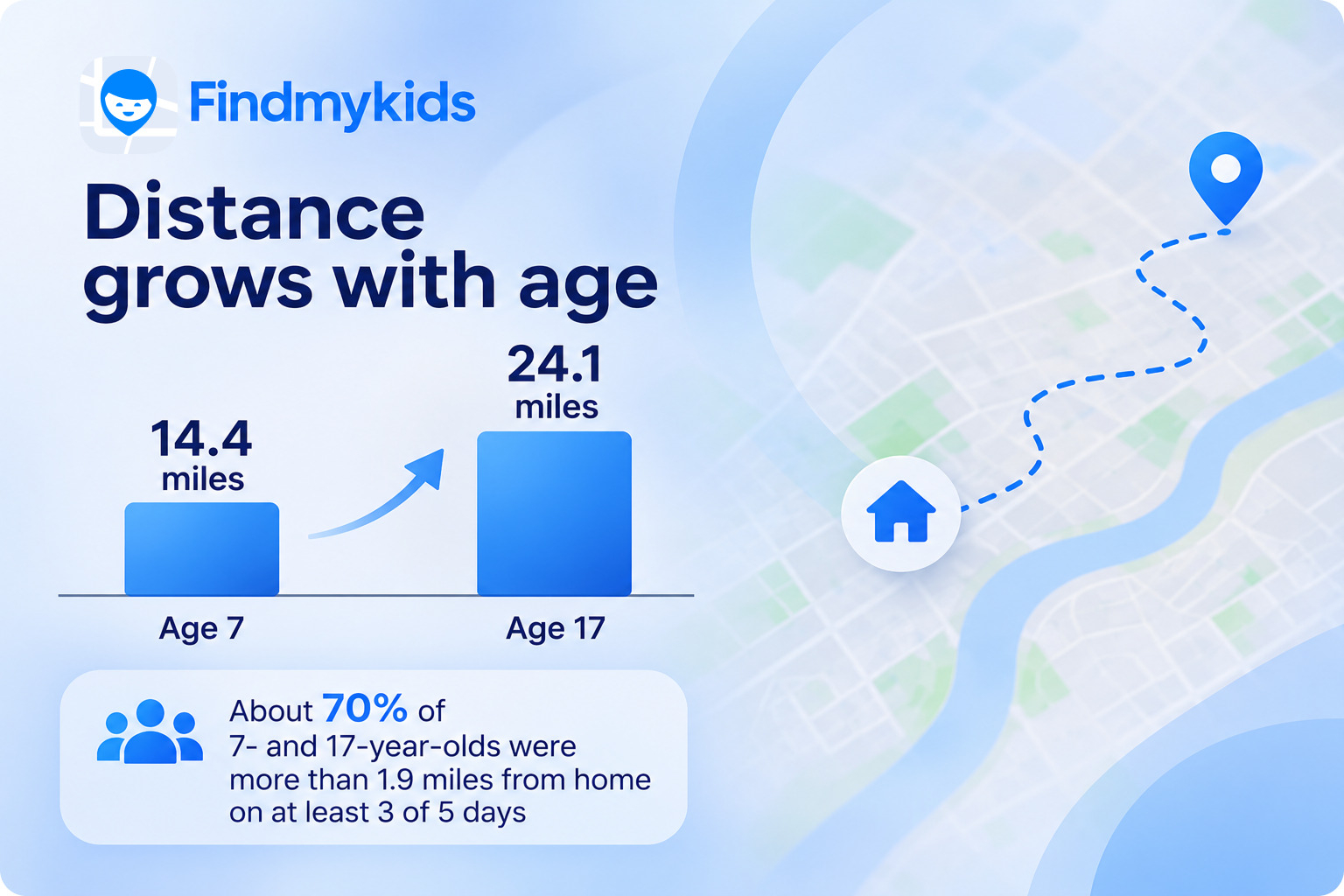
NEW YORK, NY, November 10, 2026 (EZ Newswire) -- Findmykids, a family location app, has released an analysis of how far U.S. children ages 7 to 17 travel from home over a month and over a typical school week. Half of the 7-year-olds in the analysis were more than 14.4 miles from home at least once during a single month. Among 17-year-olds, the median farthest point reached 24.1 miles.
The full analysis draws on anonymized, aggregated location data from 6,589 U.S. children whose families use Findmykids. Distances were measured in a straight line from home to the farthest point recorded between September 8 and October 7, 2026.
One caveat shapes every number: the data does not show whether a parent was with the child. A single drive to a grandparent's house can set a child's monthly figure.
Key Findings
- Farthest point in a month: The median rose from 14.4 miles at age 7 (111 children) to 24.1 miles at age 17 (390 children).
- No single turning point: Medians tend to be higher among older children, but they don't climb steadily. The 8-year-old median, 20.9 miles, sits above those for ages 9 and 10. Differences between neighboring ages were too uncertain to call any age a jump.
- A couple of miles is routine: In one school week, 69.8% of 7-year-olds and 69.0% of 17-year-olds were more than 1.9 miles from home on at least three of five weekdays.
- Places kids keep returning to: In a separate week-long sample of 1,952 children, 36.1% had a recurring place outside home. The farthest such place was a median 2.8 miles away, visited four days a week.
A School Week, Not Just a Long Trip
A monthly maximum can come from one outing. To look at routine, the analysts measured on how many of five weekdays a child was, at some point, more than 1.9 miles from home.
The result held at both ends of the age range: about seven in 10 children at 7 and at 17. The 7-year-olds were the smallest group, 53 children, so their figure is the less certain of the two. Shares dipped at ages 8 and 9, to 54.3% and 51.7%, and the data does not explain why. For most children in the sample, being a couple of miles from home is an ordinary weekday, not an event.
Some of that distance follows a pattern. A recurring place was defined as somewhere a child spent at least 20 minutes on three or more days in the week. The data does not identify what these places are: a school, a practice field and a grandparent’s house look the same on a map.
Far From Home Is Not the Same as on Their Own
How far a child’s week reaches and how far a child goes without an adult are separate measures. The Findmykids data captures the first. The second is a decision parents make.
Research indicates parents approach independent mobility with caution. According to a 2016 study of 497 U.S. parents published in Preventive Medicine Reports, about half of 7-year-olds were permitted outside unsupervised only within their own yard or driveway. Independent range expanded with age and perceived neighborhood safety: children were four times more likely to have a wider roaming radius if their parents viewed the neighborhood as safe. Additionally, a 2022 review of 53 studies published in the International Journal of Environmental Research and Public Health identified several other key variables, including a child's confidence, parental trust, local traffic, and distance to destinations.
That autonomy plays a significant role in childhood development. A 2024 review of 23 studies in the Journal of Transport & Health linked independent mobility to improved spatial navigation skills along with social and emotional growth, though the authors noted that relatively few studies measure those outcomes directly.
“Parents often ask us what the right age is to let a child go out alone. Our data shows that most kids already cover real distance every week, but it can’t tell you whether a child is ready,” said Maria Novak, Partner Manager at Findmykids. “The better question is whether this child is ready for this route. Distance is something families can see; readiness is something they build together.”
No Single Age for Going Out Alone
A fenced backyard, a friend’s house two streets away and a park across a busy road each ask for different skills. The age guidance that exists is tied to specific situations. The American Academy of Pediatrics says children usually aren’t ready to walk to school without an adult until about fifth grade, or around age 10. Safe Kids Worldwide advises that children under 10 cross streets with an adult, since most can’t yet judge the speed and distance of oncoming cars. Both stress that every child is different.
Readiness is also negotiated. University of British Columbia researchers interviewed 105 Canadian children ages 10 to 13 and 135 of their parents. They found mismatches both ways: some children wanted more freedom than parents would give, and some parents were ready to give more than the child wanted. The authors suggest treating the child as a participant in the decision.
Findmykids suggests three steps for planning a first solo route together:
- Pick one short, familiar route, such as to a friend’s house or a place the child goes several days a week, and check it for busy roads and crossings. Familiar isn’t the same as safe.
- Walk it together a few times with the child leading, then let them try it while you stay close.
- Agree on boundaries and check-ins, such as a call, a text or an arrival notification. Check-ins help parents know where a child is; they don’t show whether the child is ready.
Two answers say a lot about readiness: what the child would do if they got hurt, and what they would do if a friend wanted to go past the boundary. When the answers hold and the route goes smoothly, the next one can be a little longer.
Methodology
- Source: Anonymized, aggregated location data from U.S. users of the Findmykids app, ages 7 to 17. Age comes from the birth date entered in the app or, if missing, the stated age. Distances were calculated in kilometers and converted to miles.
- Farthest distance: 6,589 children, September 8 to October 7, 2026, each with at least five well-observed days. Measured in a straight line from the child’s home area to the farthest recorded point, not along a route.
- Weekday routine: 4,287 children from the same sample with data on all five weekdays of one school week in early October 2026; threshold 3 km (1.9 miles).
- Recurring places: A separate, later sample of 1,952 children with a full week of data in early October 2026. Figures from the two samples should not be combined.
- Age differences: For each pair of neighboring ages, the analysts estimated the difference in medians with a 95% interval, built by resampling accounts and adjusted for multiple comparisons. Every interval included zero.
- Not measured: Whether an adult was present, how the child traveled, and what the places were.
- Limits: Results describe Findmykids users, not all U.S. children. GPS gaps, how home was identified and different observation lengths affect precision; teens were observed a few days longer than 7-year-olds on average.
Charts, the full methodology and the FAQ are available in the Findmykids data hub.
About Findmykids
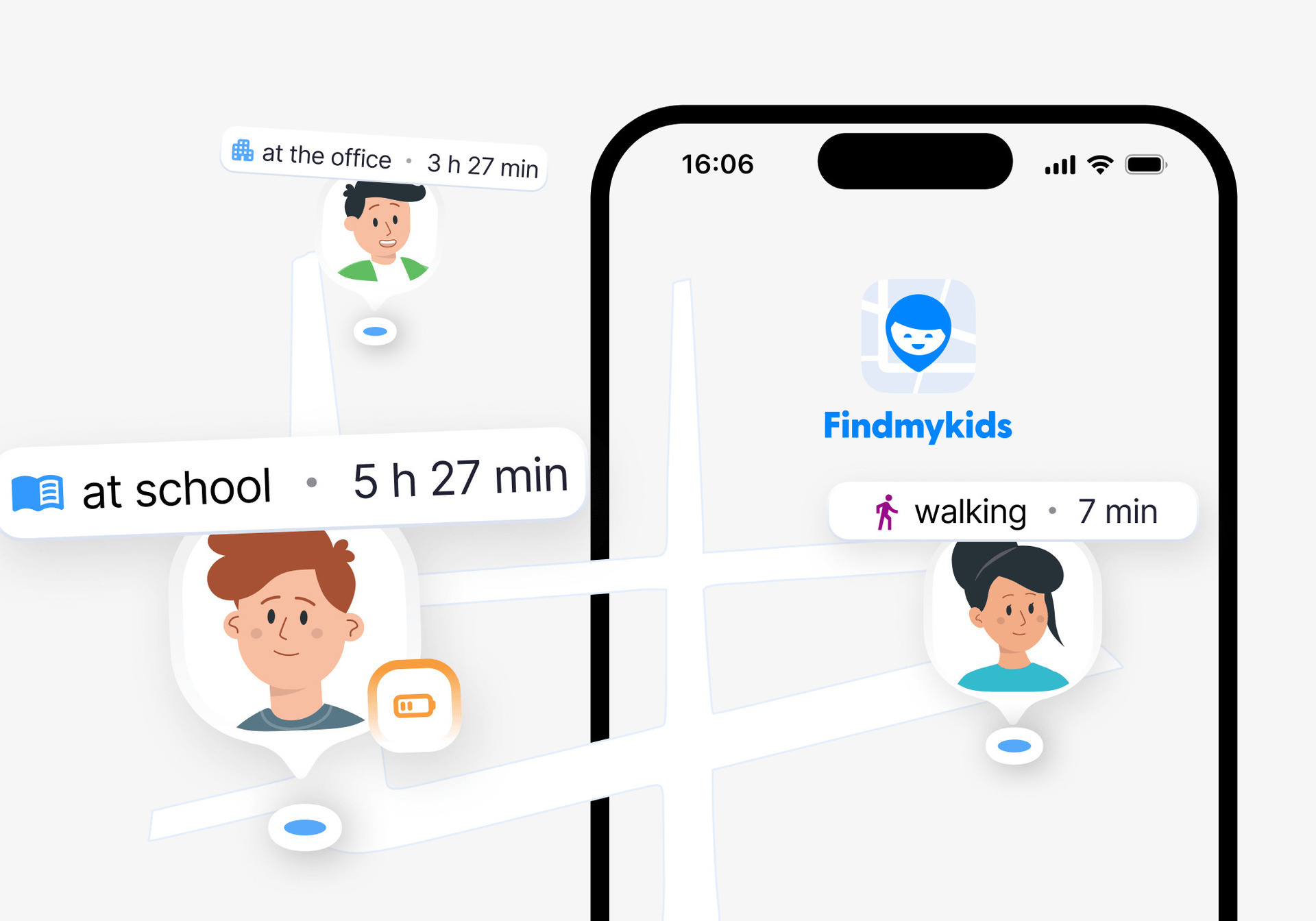
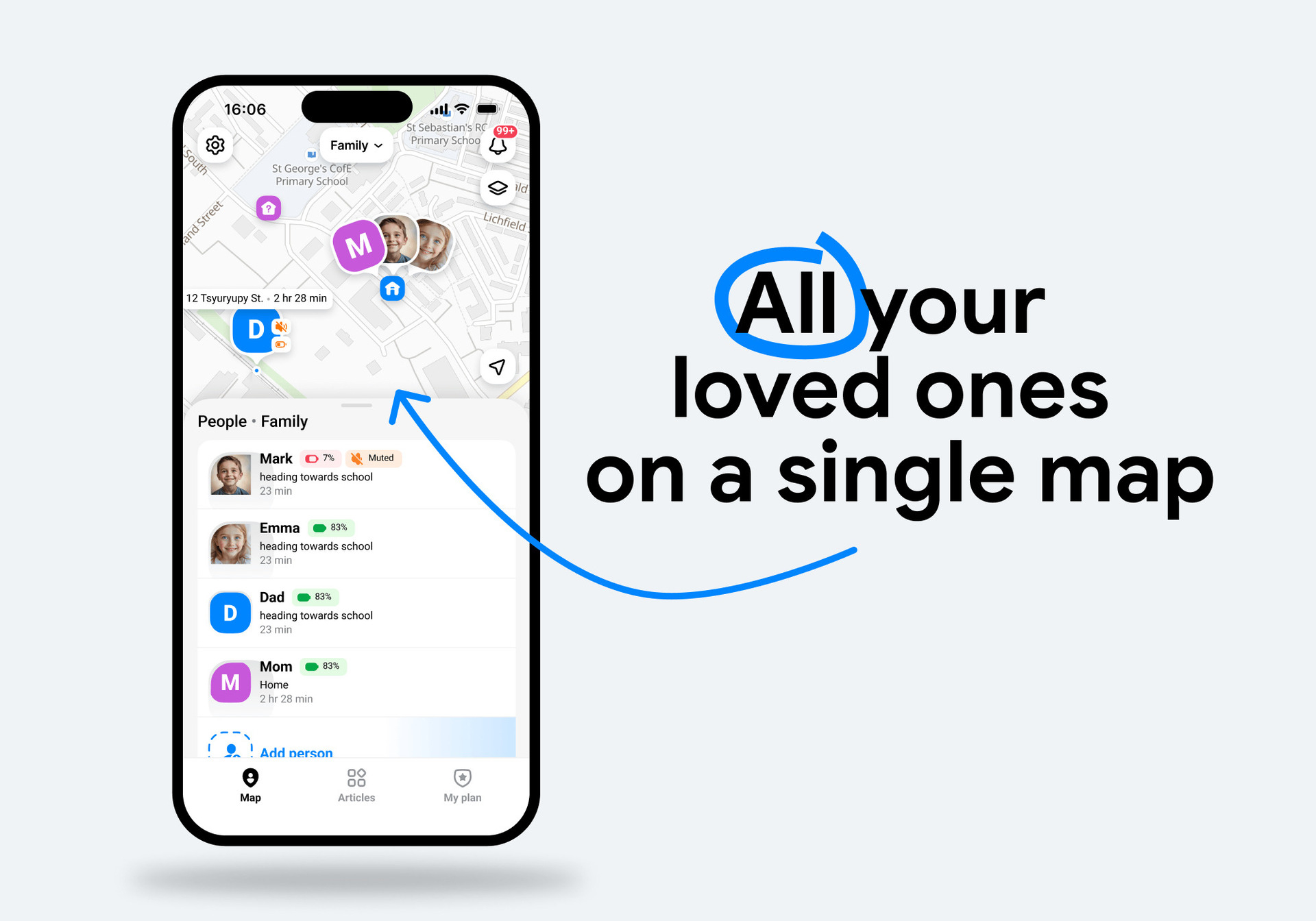
Findmykids is a family location app that shows the whole family on one map, from children to partners and older relatives. Parents can mark a place and be notified when a child arrives at or leaves it, and can reach a child with a Loud Signal that rings even when the phone is on silent. On the child's side, it works on a phone or a GPS watch. For more information, visit findmykids.org.
Media Contact
Maria Novak
Partner Manager, Findmykids
mnovak@findmykids.org
+1 830-410-8165