American Kratom Association Warns Consumers Not to Let the 7-OH Industry Hijack HHS RFI
AKA cautions that the HHS Request for Information seeks scientific evidence — not consumer testimonials — and warns that manufacturers of chemically manipulated 7-OH products are pressuring natural kratom consumers to flood the federal docket.
The American Kratom Association (AKA) today warned natural kratom consumers not to be used as cover for the 7-OH industry, as manufacturers and vendors of chemically manipulated 7-hydroxymitragynine (7-OH) products urge consumers to flood the federal government with comments opposing the scheduling of those products.
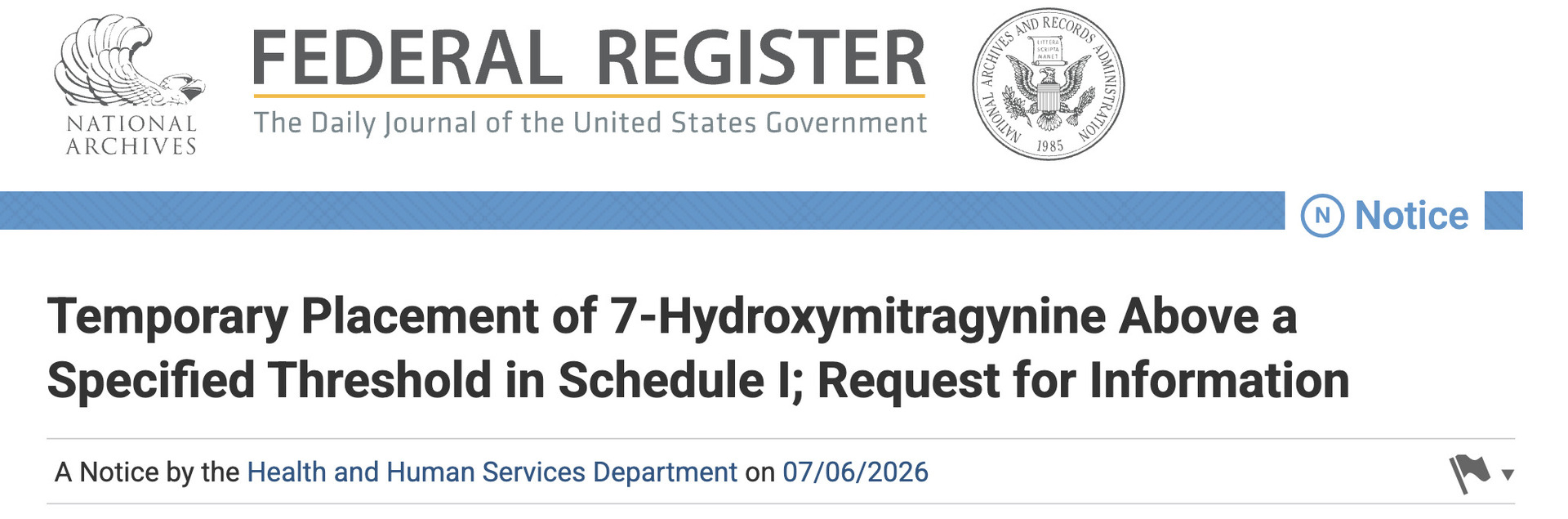
The 7-OH industry is encouraging natural kratom leaf consumers to submit mass comments to the U.S. Department of Health and Human Services (HHS) Request for Information (RFI) on the 7-OH threshold. The AKA cautioned that the campaign misrepresents both the purpose of the RFI and the scope of the federal action it concerns.
“Consumers who care about natural kratom are being set up,” said Mac Haddow, Senior Fellow on Public Policy for the American Kratom Association. “The 7-OH industry manufactured a crisis, dressed up high-potency opioids as kratom, and now wants to hide behind the very consumers it put at risk. Natural kratom consumers should not do that industry’s work for it.”
The RFI Is a Request for Science, Not a Referendum
The HHS Request for Information is not a public referendum on whether consumers like 7-OH opioid products, and it is not a request for personal testimonials, political talking points, form letters or generalized claims that someone believes 7-OH helped them.
The request is narrowly limited to scientific evidence addressing whether the threshold established for 7-OH should be adjusted and whether a different method of measuring that threshold would better protect public safety. HHS specifically requested additional scientific data supporting the proposed or an alternative threshold — including evidence identifying the concentration or quantity of 7-OH that constitutes an imminent hazard to public safety — and scientific data supporting alternative ways to express or measure that threshold.
In practical terms, HHS is asking for toxicology, pharmacology, analytical chemistry, product-testing data and other legitimate scientific research. It is not asking consumers to submit personal experiences in an effort to overwhelm the docket or create the false appearance of scientific disagreement.
Natural Kratom Leaf Is Not the Target
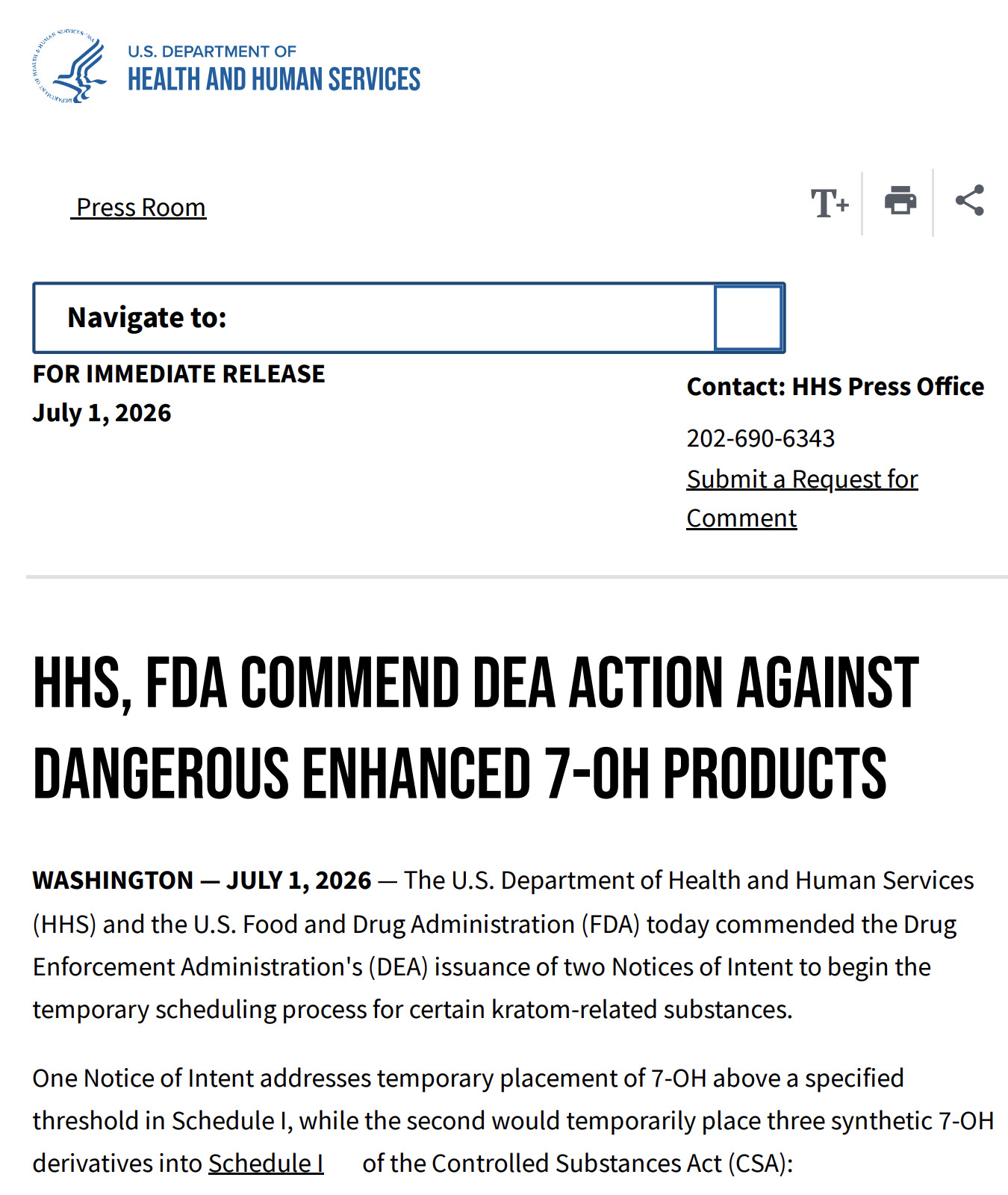
DEA, HHS and FDA have expressly distinguished natural kratom leaf from chemically manipulated 7-OH products. The federal action targets 7-OH above a specified threshold and separately addresses mitragynine pseudoindoxyl, MGM-15 and MGM-16. HHS has stated the action is not intended to regulate natural kratom leaf that does not contain enhanced levels of 7-OH, and DEA has confirmed that botanical kratom products containing naturally occurring 7-OH below the specified threshold are not covered by the temporary scheduling action.
Claims that scheduling concentrated 7-OH will automatically result in natural kratom leaf being scheduled are false, the AKA said, and are designed to frighten natural leaf consumers into defending an entirely different class of products.
“This is exactly the confusion the 7-OH profiteers depend on,” Haddow said. “Scheduling a high-dose opioid product does not put a single natural kratom leaf at risk. Anyone telling consumers otherwise is protecting a business model, not a botanical.”
A Campaign Built on a False 2016 Parallel
The manufacturers responsible for producing and selling chemically manipulated 7-OH products now want natural kratom consumers to recreate the grassroots opposition that successfully defended natural kratom leaf in 2016. The circumstances are fundamentally different.
In 2016, consumers defended a botanical product with a long history of use and presented legitimate scientific objections to the proposed scheduling of mitragynine and 7-hydroxymitragynine as naturally occurring constituents of the kratom plant. Today, the federal government is targeting commercial products containing highly elevated or synthesized 7-OH and related opioid compounds. FDA has stated that its action is specifically focused on concentrated 7-OH products — not natural kratom leaf.
The 7-OH industry, the AKA said, should not be permitted to hide behind natural kratom consumers after deliberately marketing chemically manipulated opioids as though they were ordinary kratom products.
Personal Experience Is Not the Evidence HHS Requested
A consumer may sincerely believe that a 7-OH product helped with pain, withdrawal or another personal concern. That experience may be important to that individual, but it does not establish a scientifically defensible safety threshold; the concentration at which 7-OH presents an imminent public-health hazard; the pharmacokinetic or toxicological effects of particular doses; the accuracy of product labels; the presence of pseudoindoxyl or other derivatives; the safety of repeated or escalating use; or a scientifically valid alternative method for measuring 7-OH.
Submitting personal stories as though they answer these technical questions risks contaminating the scientific record with irrelevant material. It also assists manufacturers seeking to portray an opioid-protection campaign as a natural kratom consumer movement.
Defending the Distinction Protects Natural Kratom
Natural kratom consumers have a direct interest in ensuring that regulators maintain a clear line between natural kratom leaf and properly manufactured traditional extracts on one hand, and chemically manipulated 7-OH opioids and related compounds — such as mitragynine pseudoindoxyl, MGM-15 and MGM-16 — on the other. Blurring that distinction does not protect natural kratom; it places natural kratom at greater risk by allowing manufacturers of high-potency opioid products to keep calling their products “kratom.”
The AKA urged consumers to reject manufacturer-drafted form letters disguised as scientific comments, to stop repeating the false claim that scheduling elevated 7-OH automatically schedules natural leaf, to decline to contact Congress merely because a 7-OH vendor claims natural kratom is under attack, and to refuse to let their support for natural kratom be exploited to preserve the profits of companies selling chemically manipulated opioid products.
Researchers, toxicologists, analytical chemists, and other qualified experts who possess responsive scientific evidence should submit it. Consumers should not be manipulated into pretending that personal testimonials constitute the scientific data HHS requested.
The Bottom Line
The HHS Request for Information is a request for science — not a political pressure campaign. The AKA called on natural kratom leaf consumers to reject every attempt by the 7-OH industry to misuse the proceeding, manufacture fear or falsely claim that defending concentrated 7-OH opioids is necessary to protect natural kratom.
“Protect natural kratom leaf. Reject chemically manipulated 7-OH opioids,” Haddow said. “Let legitimate science — not industry-organized misinformation — guide the federal government’s decision.”
About American Kratom Association (AKA)
American Kratom Association (AKA) is a consumer-based, nonprofit organization, focused on furthering the latest science as guidance for kratom public policy. AKA works to give a voice to millions of Americans by fighting to protect their rights to access safe and natural kratom. For more information, visit www.americankratom.org and learn more at kratomanswers.org.
Media Contact
Senior Fellow on Public Policy
press@americankratom.org
+1 571-294-5978