American Kratom Association Applauds DEA Emergency Scheduling of Dangerous 7-OH-Related Opioid Compounds
DOJ recognition of trace-level MGPI enforcement discretion protects natural kratom consumers while targeting chemically manipulated opioid products.
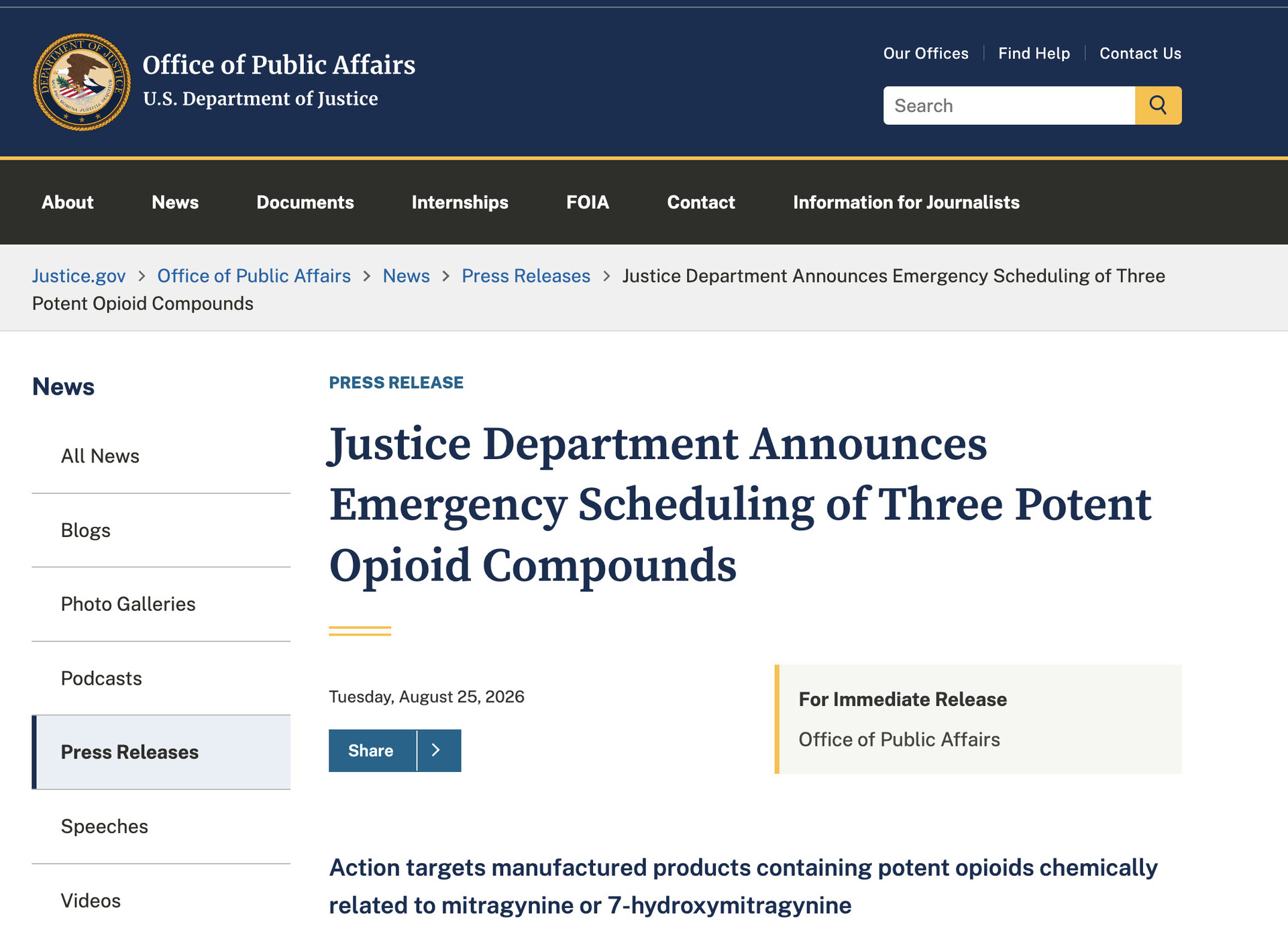
WASHINGTON, DC, August 26, 2026 (EZ Newswire) -- The American Kratom Association (AKA) today applauded the U.S. Department of Justice and the Drug Enforcement Administration for the emergency scheduling of three potent opioid compounds chemically related to 7-hydroxymitragynine: mitragynine pseudoindoxyl (commonly known as MGPI or MP), MGM-15, and MGM-16.
The Justice Department announced that the DEA is temporarily placing these three 7-OH-related substances in Schedule I of the Controlled Substances Act because they pose an imminent hazard to public safety. DOJ stated that preclinical evidence indicates all three are potent mu-opioid receptor agonists and may present risks associated with other mu-opioid agonists, including dependence and respiratory depression.
“This action is a critically important step in protecting American consumers from dangerous chemically manipulated opioid products that never should have been marketed as kratom,” said Mac Haddow, Senior Fellow on Public Policy for the AKA. “The DEA and DOJ are properly targeting manufactured, concentrated, fortified, or intentionally added opioid compounds — not safely formulated natural kratom leaf products.”
The AKA particularly commends the DOJ for recognizing that the federal action is directed at deliberately manufactured and concentrated opioid products, not traditional botanical kratom, and that the Department will exercise enforcement discretion when only incidental trace amounts of MGPI are confirmed in a product otherwise consistent with botanical kratom.
“That recognition is essential,” Haddow said. “Trace detection is not the same as chemical manipulation. The same principle that supports a threshold for dangerous 7-OH products should apply to MGPI: regulators should target intentionally manufactured or concentrated opioid compounds, while protecting consumers’ access to legitimate natural kratom products that are safely formulated, properly labeled, and age-restricted.”
“This is exactly the kind of precision that consumer protection requires,” Haddow added. “Bad actors have been chemically manipulating kratom alkaloids into opioid products and selling them in ways that put consumers at risk. At the same time, millions of responsible consumers rely on natural kratom leaf products. Those two categories must not be confused.”
The AKA has consistently urged federal and state policymakers to draw a bright line between natural kratom leaf and chemically manipulated products such as high-potency 7-OH, MGPI, MGM-15, and MGM-16. Responsible kratom regulation must protect consumers from adulterated, synthetic, semi-synthetic, concentrated, or manipulated products while preserving lawful access to natural kratom leaf products manufactured under appropriate consumer protection standards.
“The path forward is clear,” Haddow said. “Remove dangerous chemically manipulated opioids from the marketplace. Hold the perpetrators accountable. Preserve access to real kratom products that are safely formulated, accurately labeled, tested for contaminants, and restricted to adults.”
The AKA calls on state legislatures, attorneys general, health departments, and law enforcement agencies to align their enforcement strategies with the federal approach: target chemically manipulated opioids and bad actors, not natural kratom consumers.
“Natural kratom consumers deserve clarity and protection,” Haddow said. “This action recognizes that dangerous manufactured opioid compounds are the problem — not trace-level analytical findings in legitimate botanical kratom products.”
About American Kratom Association (AKA)
The American Kratom Association is a consumer advocacy organization dedicated to protecting the rights of Americans to safely use natural kratom products. The AKA supports federal and state enforcement actions targeting chemically manipulated 7-OH products and advocates for the Kratom Consumer Protection Act — including product testing, labeling standards, and age restrictions — in states across the country. For more information, visit americankratom.org and learn more at kratomanswers.org.
Disclaimer
The American Kratom Association (AKA) is a 501(c)(4) advocacy organization. This press release is provided for informational and public policy purposes only. Information contained herein reflects the policy analysis of the issuing party regarding federal administrative actions and does not constitute legal or medical advice. Statements made regarding natural kratom have not been evaluated by the Food and Drug Administration (FDA) and are not intended to diagnose, treat, cure, or prevent any disease. Readers should consult qualified medical professionals before using any botanical products.
Media Contact
Mac Haddow
Senior Fellow on Public Policy
press@americankratom.org
+1 571-294-5978