What Is Flat-Rate Press Release Distribution? What It Costs and How It Benefits Startups
Flat-rate press release distribution is a bundled, on-demand pricing model that helps startups secure targeted placements on multiple premium news sites at once to build credibility efficiently and cost-effectively. This guide covers how it works, how it compares to traditional newswire pricing models, and why it delivers stronger ROI.

What this blog covers
- What flat-rate release distribution is
- How it compares to traditional newswires
- Why it’s beneficial for startups
- How it improves ROI and credibility
- The origin of the legacy pricing model
For startups and early-stage companies, distributing eligible, newsworthy press releases should be more than mere wishful investments; they should be predictable growth levers.
Legacy pricing for bulk wire distribution has long been needlessly expensive for many established and new businesses. But EZ Newswire’s flat-rate, targeted distribution model changes that calculus.
Here, the cost of distribution is tied solely to the bundled publisher tier you choose, eliminating traditional long-term contracts and legacy charges for word count, images, and logos from the equation entirely. This puts marquee publishers including Reuters and Fortune as well as over 100 other reputable publishers within affordable reach for startups looking to foster trust and credibility amongst investors and customers quickly and painlessly.
Here's what it means, why it works particularly well for startups, and why the old way of paying for press release distribution was never really about value in the first place.
What flat-rate distribution actually means
Unlike legacy distribution that relies heavily on broad syndication across vast networks and incurs add-on charges for additional content elements, flat-rate press release distribution is a fixed pricing model based purely on high-quality placements.
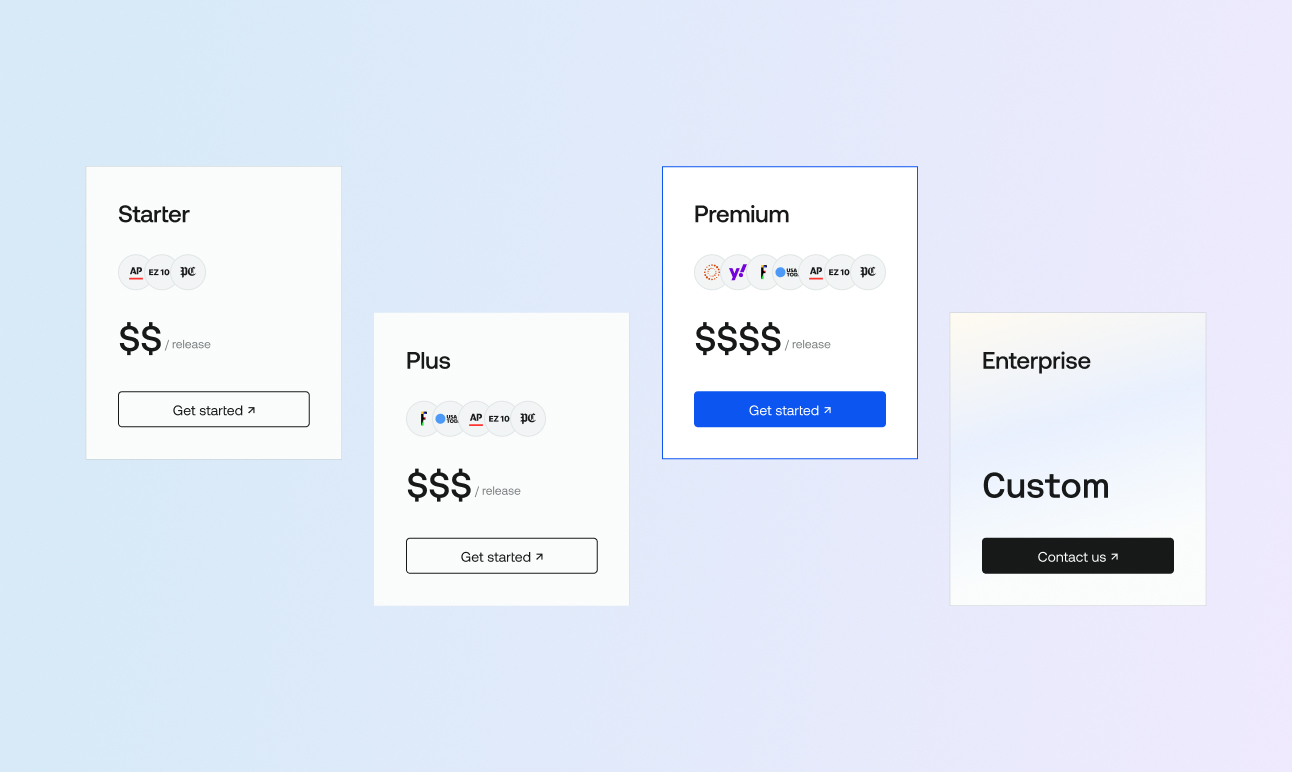
This means the only factor determining total cost is the targeted publishers — not long-term contracts, word count overages, image attachments, or vague distribution markets. With EZ Newswire, organizations can choose from three transparently priced distribution packages — Starter ($750/release), Plus ($1,250/release), and Premium ($1,500). Each offers access to a curated mix of trusted publishers and news platforms, including opportunities to appear on distinguished outlets such as Reuters and Fortune.
For startups or early-seed companies with lean marketing teams or in-house PR teams, this kind of fixed pricing and transparent placement clarity transforms press release writing and distribution from a murky ROI expense into a predictable, scalable asset organizations can deploy when it makes sense to.
In other words, it is a convenient, low-cost alternative to traditional newswire distribution cost structures that deliberately append arbitrary line items to press release length, media attachments, and regional markets with unclear endpoints.
How is flat-rate distribution different from the legacy model?
Consider what you're actually purchasing: a flat-rate placement on multiple premium publisher sites that deliver immediate credibility — a highly reputable byline attached to your company's news that can be referenced in investor decks and displayed on your website.
Through this approach:
- You choose the bundle with the exact publishers you want (e.g., Starter, Plus, or Premium)
- You pay the flat corresponding rate or a discounted rate if purchasing multiple releases at once
- You avoid legacy pricing templates that include membership subscriptions, complicated rate cards, and aggravating add-on line item fees
The value is concrete, targeted, and lasting. And thanks to EZ Newswire’s industry-leading API integration with Reuters and Fortune, users have the option to update their news releases even after it’s live. That way, coverage can always reflect accurate, up-to-date information — flexibility that matters enormously for startups iterating quickly.
With EZ Newswire, you can:
- Select premium publishers from three bundled distribution packages
- Avoid word-count overage pricing, add-on fees for images and logos, and arbitrary prices assigned to regional distribution markets that claim to cater to industry-specific outlets
- Edit press releases on Reuters and Fortune placements after they’re live, if necessary
On top of strengthening PR strategy, this modern approach to newswire distribution prioritizes precision over volume and ensures your press releases appear on credible news outlets that your target audience already trusts.
Now compare that to what you get from a legacy newswire contract: annual commitments that lock organizations into recurring costs regardless of how often they actually need to distribute announcements. Plus, the distribution networks those newswires provide organizations access to are largely composed of spammy, low-traffic sites that don't meaningfully reach the investors, media, or relevant parties that early-stage companies are actually trying to inform.
Why flat-rate release distribution works better for startups
For startups that distribute relatively few press releases a year — funding announcements, product launches, or key hires, for example — paying per release for digital real estate on publisher sites and newsrooms that actually matter delivers substantially more real-time value per dollar than an annual contract built around a traditional distribution network that doesn't.
1. Affordable, static pricing
With EZ Newswire, startups who might publish as few as 2–4 press releases per year can avoid:
- Expensive annual contracts with traditional newswires or retainers with PR agencies
- Wasting capital on unused press release services throughout the year
- Paying extra for word-count, media assets, and regional distribution markets
Instead, startups can invest in specific placements that foster credibility and support broader earned media strategies driven by modern press release distribution services.
2. Access to premium publishers
EZ Newswire’s premium publisher network — Reuters, Fortune, Yahoo Finance, and USA Today, most notably — bolsters organizations’ credibility and positive brand perception far better than the hundreds of random, low-traffic outlets included in legacy distribution networks.
Targeted placements on highly respected outlets like Reuters or Fortune, for instance, can:
- Strengthen investor relations
- Improve brand reputation
- Drive significant organic traffic to your business
3. Greater ROI Per Dollar Spent
Startups can expect higher ROI because they are paying for verified placements on trusted publishers — high-prestige placements that initiate credible media coverage for:
- Investor decks
- Sales conversations
- Website trust signals
Unlike legacy distribution networks that prioritize volume, EZ Newswire’s model delivers greater relevance for newsworthy announcements. Combined with placement on top-tier news outlets, it strengthens credibility, reputation, and trust amongst audiences and stakeholders — unlike many traditional syndication outlets that instead fuel skepticism, diminish search rankings, and precipitate minimal engagement as a result.
In many ways, flat-rate distribution minimizes the need for designated media database tools. Instead of managing large media lists and countless follow-ups with media contacts, users directly select the publishers that matter most and improve their visibility.
It also simplifies traditional PR workflows, where teams often spend significant time on outreach, coordination, press release formatting requirements, and SEO optimization that don’t impact actual distribution outcomes.
Why the legacy model was never really about value
The legacy pricing structure that still governs PR Newswire and GlobeNewswire today wasn't designed around the value of press distribution — it was designed around the cost of telegraph infrastructure. The physical transatlantic cable that transmitted news from Europe to the United States is the literal origin of the word "wire."
Though groundbreaking for its time, it was also expensive to operate. Every word transmitted required a human operator to input manually. More words meant more labor and more labor meant more money. Hence, the convention of keeping press releases to 400 words or less.
But in the age of the internet where digital communication no longer carries a marginal, word-contingent cost, there is no labor-bearing reason for wire services to continue charging extra for distributing press releases that exceed 400 words, nor to extend that logic to images, media attachments, or regional markets.
Why EZ Newswire was founded
Startups and early-stage companies trying to market themselves are precisely the ones that legacy newswire pricing punishes. EZ Newswire was founded to right that ship.
Startups generally don't distribute news every week; only when it’s necessary — a successful funding round, a flagship product launch, a key hire. For those defining moments, paying into an annual contract and coughing up PR spend on costly fees to articulate your news beyond 400 words and a single image has never made sense. And yet for decades, it was the only option, perpetuating a cycle of chronic overspending or financially limiting leagues of up-and-coming startups from sharing critical news updates altogether.
Flat-rate press release distribution is a straightforward correction to that problem. Pay for the publishers that matter to your business. Skip the ones that don't. No contracts, no arbitrary add-on fees, no antiquated cost structures passed off as industry standard.
When distributed correctly, an effective press release can:
- Build credibility with investors
- Generate media interest
- Increase brand awareness
- Drive traffic to your business
If you're a startup or early-stage company ready to distribute your news without the legacy markups, EZ Newswire's bundled, flat-rate press release distribution model puts premium media outlets like Reuters and Fortune within reach. Explore our publisher options and pricing — and get your story in front of the audiences that matter.
Frequently asked questions (FAQs)
What is EZ Newswire?
EZ Newswire empowers organizations to turn their news into brand visibility and measurable performance. Our AI-enabled platform, distribution network, and advanced data and verification capabilities make it easy to publish authoritative news in premium environments. From startup to scale-up to S&P 500, the most influential organizations rely on EZ Newswire to communicate smarter. For more information, visit www.eznewswire.com.
How is EZ Newswire different from PR Newswire or GlobeNewswire?
EZ Newswire uses a transparent, flat-rate publisher-bundle pricing model with no contracts or per-word fees. Legacy providers like PR Newswire and GlobeNewswire by contrast charge various costly fees and line items on top of requiring pricey membership subscriptions.
Why is legacy newswire pricing so expensive?
Legacy newswire pricing is expensive because it is based on outdated per-word models that date back to the 19th century. On top of annual contracts, providers including PR Newswire, GlobeNewswire, Cision, and PR Web continue to rely on this cost structure, which they extend to images and regional distribution markets.
Why do newswires charge per word?
Newswire pricing comes from the telegraph era when each word had a transmission cost. Today, this model is outdated but still widely used.
Is flat-rate distribution better than a newswire subscription?
Yes, flat-rate distribution is better for most startups because it offers flexibility, cost control, and targeted distribution, especially if news isn’t being announced on a daily or weekly basis. Newswire subscriptions typically only make sense for large enterprises or public companies.
Is flat-rate distribution good for startups?
Yes, it allows startups and small businesses to invest in high-impact placements and surface in AI search engine answers without having to pay into long-term contracts to access service. It improves cost efficiency and audience targeting.
Can I edit my press release after publishing?
Yes, platforms like EZ Newswire allow edits after it goes live on Reuters and Fortune. This is a meaningful advantage for fast-moving companies that need to keep published information accurate and current.