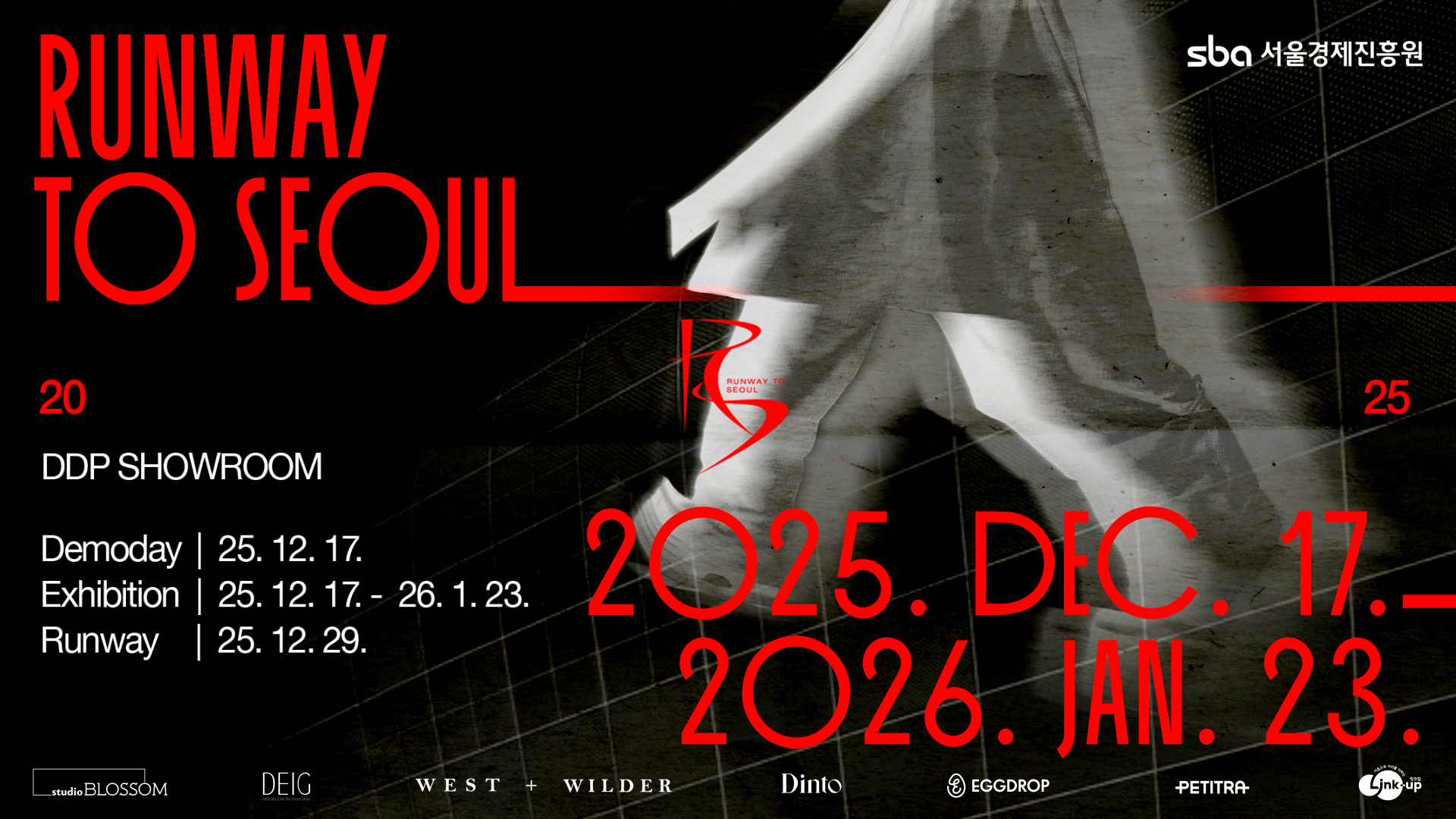

RUNWAY TO SEOUL (RTS), a fashion business platform hosted and organized by the Seoul Business Agency (SBA), has successfully concluded its full 2025 season, including both its exhibition and runway programs.
RTS is a platform-based fashion project that spotlights Seoul-based fashion brands through an integrated program linking exhibitions, Demo Day, and runway presentations. Held at the DDP SHOWROOM from Dec. 17, 2025, to Jan. 23, 2026, the project was designed as a long-term, content-driven platform that moves beyond a single event to foster sustained brand exposure and engagement.
Timed with the year-end season and weekends, the program maintained a lively on-site atmosphere throughout the exhibition and related events. The venue drew both the public and fashion industry professionals, positioning the space as an open platform for engaging with Seoul fashion.
The RTS exhibition program was designed to allow visitors to engage closely with the philosophy and design language of Seoul-based fashion brands. In total, 17 brands participated in the exhibition: Alter, BSRABBIT, BYSEOWOO, Deiiiibydeiiii, DUCKDIVE, ERR BY ERRORIST, Fakiii, Honkyo, LOVE CHARM, MONTSENU, OKIIO LOUNGE, PHENOMENON SEEPER, STAND OIL, TRIPLEROOT, uncharted aesthetic quest, VALOREN, and WOOALONG.
Participating brands presented exhibition content that extended beyond traditional garment displays, combining collections with design objects, spatial installations, and brand storytelling elements. Through these curated environments, each brand conveyed its creative vision and narrative, enhancing visitors’ understanding of its identity and design direction.
The exhibition remained open to the public throughout the program period, allowing visitors to naturally engage with the current landscape of Seoul fashion within an accessible cultural setting.
To mark the launch of the exhibition, an opening party was held on the first day of the program. The event featured performances by 82MAJOR and DJ TRUEUNSOL, setting the tone for the exhibition with live music and DJ sets.
Music and performances unfolded throughout the exhibition space, elevating the atmosphere and encouraging natural interaction among fashion professionals, artists, and visitors. The opening party showcased how the RTS exhibition extended beyond a conventional opening to become a cultural event in its own right.
During the exhibition period, Brand Day programs were held with active involvement from the exhibiting brands, enhancing visitor engagement. Each Brand Day was designed to highlight individual brand identities through a wide range of experience-based content, moving beyond traditional, presentation-led formats.
Brand Day programs included styling shows that brought collections to life, small-scale concerts and performances by invited artists, and hands-on workshops that encouraged direct visitor participation. Through these programs, the RTS exhibition evolved beyond a traditional viewing-focused format into an immersive, experience-driven platform where visitors could engage more closely with each brand’s identity and creative vision.
The main runway event was held on December 29 at the DDP SHOWROOM, featuring seven brands: TRIPLEROOT, BSRABBIT, MONTSENU, Gyouree Kim, OKIIO LOUNGE, VALOREN, and HDEX. Each brand presented a performance-driven runway that integrated music, live performance, and visual direction, expanding the format beyond a conventional fashion show.
A wide range of expressive elements unfolded on stage, with different brands introducing distinct performance elements aligned with their individual concepts. These included ballerina-led choreography, live violin performances delivering musical interpretations, rap performances presented directly on stage, and other dynamic forms of artistic expression that expanded the visual and performative scope of the runway.
In addition, some brands incorporated graffiti live drawing performances, creating visual artworks in real time on stage and highlighting moments where fashion and art converged. As each brand employed its own performance style, stage composition, and musical flow, the runway was structured to allow audiences to experience a diverse range of expressions and aesthetics within a single program.
From high-energy stages rooted in street sensibilities to conceptual, performance-centered presentations, the runway showcased the broad spectrum of Seoul fashion brands. Audience engagement grew with each stage transition, as interest in the performances and the creative direction of each brand continued to build.
The runway expanded the traditional fashion show format into an entertainment-driven medium that conveyed brand narratives and creative messages. Following the runway, the program naturally transitioned into the after party, completing a seamless flow in which the atmosphere established on stage extended into interaction and networking.
The after party featured performances and DJ sets by AxMxP, Holybang, and DJ DAMIE, further elevating the on-site atmosphere. As each artist took the stage, strong audience engagement was sustained throughout the performances, adding momentum to the evening.
More than a performance program, the after party functioned as a networking space where fashion professionals, artists, influencers, and visitors freely interacted. Driven by music and live performances, the vibrant atmosphere continued until the end of the event, encouraging ongoing communication and exchange. Through this structure, RTS extended interaction and networking beyond the runway stage, reinforcing its role as a platform for connection across fashion and culture.
RTS was further supported by sponsorships from brands across diverse sectors, contributing to the expansion and enrichment of the project. Participating sponsors included Studio BLOSSOM, a comprehensive entertainment platform collaborating with a wide range of artists including actors, singers, and influencers; DEIG, a brand that delivers moments of comfort for the skin every day; Bottleshock, a U.S. wine import specialist; Dinto, a narrative-based, vegan-certified beauty brand conveying philosophical sensibility and aesthetic contemplation; EGGDROP, a premium egg sandwich brand; and Link-up, a DX-focused liquor distribution company.
Alongside the exhibition and runway programs, RTS also operated business-focused initiatives designed to support the growth of fashion companies. During Demo Day, fashion and fashion-tech companies presented their business achievements and future plans, while investors and buyers participated in networking sessions.
Through this approach, RTS moved beyond a brand exposure-focused event to function as a comprehensive platform supporting the sustainable growth and industry connectivity of Seoul fashion brands. By integrating exhibition, experience-based content, runway presentations, entertainment, and business programs, RTS reinforced its role as a multi-dimensional fashion and cultural platform.
Launched in 2023, RTS has steadily evolved into a convergence project led by SBA, integrating fashion with entertainment, technology, and commerce. As the platform moves forward, SBA plans to further elevate RTS to strengthen the content competitiveness of Seoul fashion brands and support their expansion into global markets.
About SBA (Seoul Business Agency)
The Seoul Business Agency (SBA) is a specialized support institution established to foster the growth of small and medium-sized enterprises (SMEs) and startups while boosting the global competitiveness of Seoul's strategic industries. As a key engine for Seoul’s economic development, the agency provides a comprehensive "one-stop" support system that spans from business incubation and investment to global marketing and talent recruitment. SBA is currently spearheading the expansion of the "Seoul-style Creator Economy" by integrating the city's vibrant beauty, fashion, and cultural content industries with advanced technologies. A premier example of this initiative is SeoulCon, a global influencer-led festival designed to broadcast Seoul's lifestyle and industrial prowess to a worldwide audience. The agency also focuses on revitalizing major industrial clusters — such as DMC, G-Valley, and Magok — and transforming the Dongdaemun area into a global fashion hub centered around the Dongdaemun Design Plaza (DDP). Furthermore, SBA addresses the future needs of the industry through SeSAC (Seoul Software Academy), an elite training program dedicated to nurturing software talent and bridging the digital gap for local enterprises. By fostering high-growth sectors including animation, gaming, and individual media, SBA continues to create high-quality job opportunities and drive innovative growth, ensuring Seoul remains a leading global city for business and creativity. For more information, visit www.sba.seoul.kr.
Media Contact
Sehyun Cho
SBA (Seoul Business Agency)
cmk143@sba.seoul.kr