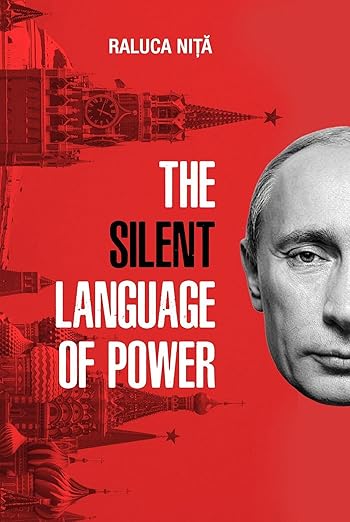

Renowned political communication expert Raluca Niță, author of "The Silent Language of Power," has released a compelling new analysis examining Donald Trump’s nonverbal communication during his recent interactions with global leaders, particularly Chinese President Xi Jinping. The study offers a rare behavioral and geopolitical insight into how Trump’s gestures, posture, and micro-expressions continue to influence his diplomatic strategy and international power projection.
Niță’s latest work highlights how Trump’s persona extends far beyond his words — existing vividly through how he stands, gestures, and engages with his counterparts. By decoding Trump’s nonverbal cues — from directive hand movements to controlled facial expressions — Niță sheds light on the subtle interplay of confidence, caution, and calculated restraint in his China-related communication.
The analysis also revisits the U.S.-China meeting in Korea, revealing how underlying power signals shaped the encounter. Despite reports suggesting a policy reversal, Niță explains that Trump’s posture and decision-making demonstrate a strategic maintenance of tariffs, underscoring that China’s leverage only reached limited bounds.
Trump and Xi: Familiarity Meets Strategic Distance
During their October 29 meeting, Trump adopted his signature open-body expectancy posture — signaling warmth and recognition — while Xi Jinping maintained a more formal, evaluative stance. Xi’s reserved body language and carefully controlled gaze reflected strategic distance rather than personal warmth, communicating, in Niță’s words: “I am present, I am listening, but I do not yield emotional ground.”
This encounter revealed how Trump projected personal rapport, while Xi responded with institutional discipline, a dynamic that continues to define their broader political relationship.
Strategic Nonverbal Insights: Emotional Leakage and Message Discipline
According to Trump’s body language, he was not as pleased with the outcome of his meeting with Xi as he indicated verbally. In her analysis, Niță observes subtle nonverbal inconsistencies in Trump’s televised remarks about China during his 60 Minutes Overtime interview. Downward-right gaze shifts and muted gestures suggested moments of emotional containment beneath assertive rhetoric. According to Niță, these signals imply internalized tension — “a calibrated blend of confidence, caution, and strategic ambiguity.”
Trump’s transition from expressive hand gestures to restrained movements signals increased self-monitoring and message discipline, underscoring how his body language evolves with geopolitical context.
The Cartesian Coordinator: Trump’s Gesture Architecture of Power
Niță describes Trump as a “Cartesian coordinator” — a leader who asserts control through deliberate structure and spatial dominance. His right-hand dominance, “accordion” gestures, and assertive posture are physical expressions of logic and authority. Yet, in Asia, Niță observes a shift toward diplomatic humility: restrained gestures, quiet posture, and situational respect. This contrast, she notes, reveals a leader capable of modulating power presence depending on the environment — assertive at home, adaptive abroad.
Trump and Putin: Contrasting Archetypes
Drawing from her broader framework, Niță contrasts Trump with Vladimir Putin, calling them “the Cartesian Coordinator” and “the Sensitive Autocrat.” Where Trump thrives on personal validation, Putin navigates power through restraint and civilizational symbolism. Niță explains how Putin strategically mirrored Trump’s emotional style to establish psychological leverage — feeding Trump’s recognition drive through controlled reciprocity.
Recent rhetorical shifts, Niță notes, show Trump’s recalibration of tone toward Moscow — blending disappointment with a harder strategic edge, reflecting the limits of personal diplomacy in the face of geopolitical pragmatism.
A Post-Truth Performer in a Truth-Fragile World
In an era where emotional resonance outweighs factual precision, Niță characterizes Trump as a “post-truth performer” — a communicator who thrives in ambiguity and emotional dominance. His ability to control conversational rhythm and transform factual disputes into subjective narratives reflects an evolved form of populist performance politics.
Beyond the Label: The Human Frame
Niță cautions against reducing Trump to a single archetype, noting that his nonverbal behavior reveals layers of empathy, familial loyalty, and Christian-coded modesty intertwined with assertive dominance. She interprets his humility remarks not as irony, but as a populist inversion of redemption — portraying leadership as service, not sanctity.
The Strategic Narrative: Relational Power in a Hard-Power Era
Ultimately, Niță argues that Trump’s diplomacy is relationship-driven rather than institution-bound. His framework of “deal over doctrine” prioritizes personal bonds over systemic logic. In a world defined by geopolitical blocs, this method humanizes diplomacy while simultaneously challenging structural norms.
As Niță concludes, “The world is watching his words. His rivals are watching his posture. And history — whatever version of truth one aligns with — will record both.”
About Raluca Niță
Raluca Niță is a specialist in political nonverbal communication, geopolitics, and political philosophy. She is the author of "The Silent Language of Power" and has analyzed the gestures and leadership behaviors of global figures for major international outlets, including the Daily Star and Ukraine National TV. Niță holds degrees in law and European studies, a master’s in diplomacy, and an Executive MBA.
Media Contact
Raluca Niță
info@ralucanita.com