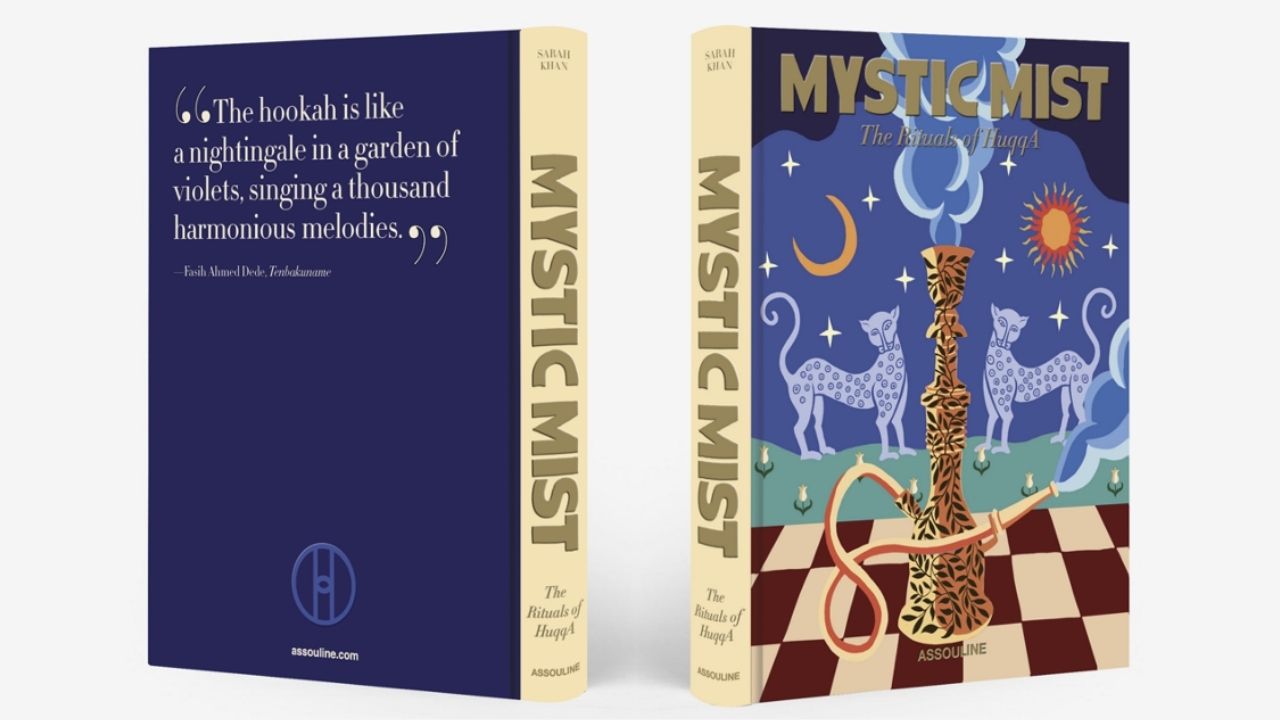

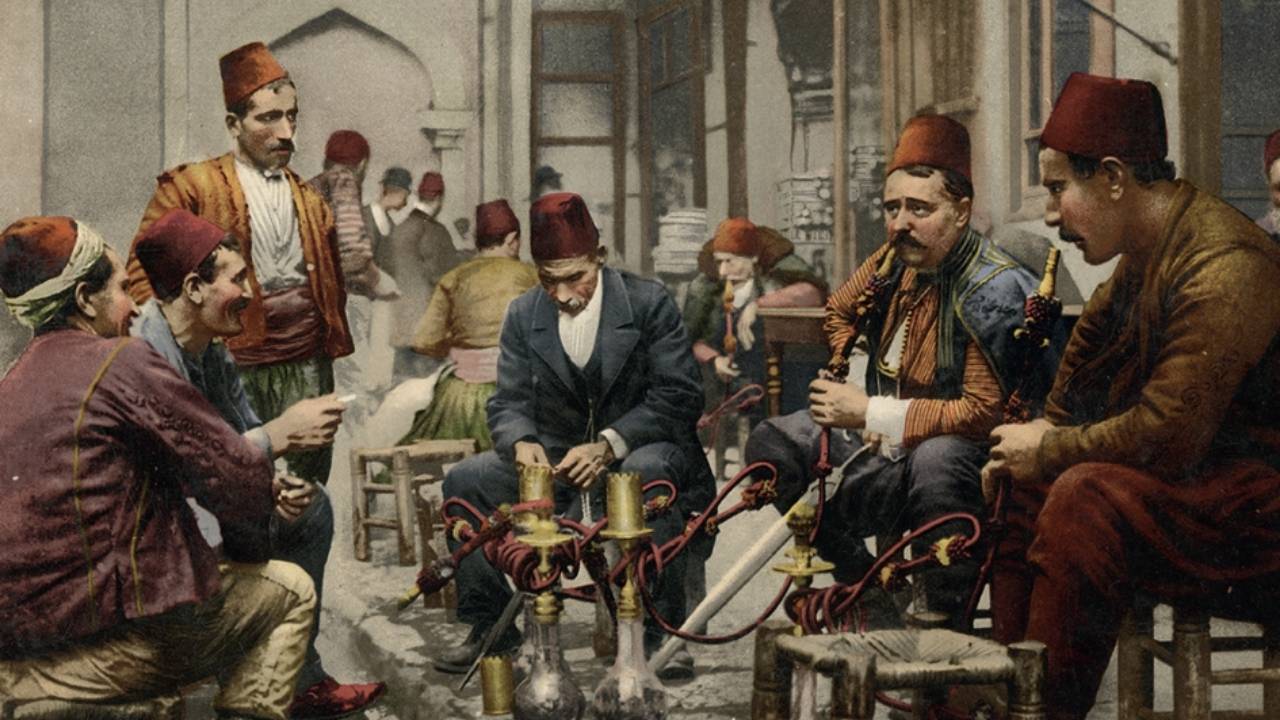

Published in November 2025 as part of the Classics Collection, "Mystic Mist: The Rituals of HuQQa" approaches the culture of hospitality through its historical background and its contemporary urban manifestations. The volume traces the links established between different geographies and focuses on how the ritual has transformed over time. While mapping the historical roots of the practice, "Mystic Mist" also examines how it is being reinterpreted in today’s cities. In doing so, the book offers an integrated framework for readers interested simultaneously in cultural history, design, gastronomy and urban sociology.
Historical Background Presented in a Documentary Tone
The book opens with an excerpt from "Tenbakuname," a work by Fasih Ahmed Dede that reaches back several centuries. In its introductory section, it recounts in chronological order how tobacco travelled from the New World to the elite circles of the Mughal and Persian empires. Within this framework, the narrative follows how the ritual moved beyond a mere leisure practice to become an instrument of status, aesthetics and social interaction. The study conveys historical information in direct, accessible language, opting for a documentary tone rather than academic abstraction.
A Line From Ottoman Coffeehouses to European Salons
One section of the book examines how the ritual became part of social and literary conversations in Ottoman coffeehouses. The narrative reconstructs this period through scenes from daily life and contemporary testimonies. It then turns to the transfer of this practice to Europe through Western travellers and its evolution into a fashionable social habit. Cultural exchanges between different empires and cities are summarised in clear, concise prose. As a result, readers can see that the ritual does not belong to a single geography, but instead has a multi-layered and mobile history.
After setting out the historical framework, the book shifts its focus to the pace of contemporary urban life. It underscores how this ritual offers an opportunity to slow down, come together and talk within an otherwise hectic daily rhythm. In this newly presented volume, the practice is positioned not as a fleeting entertainment, but as a meeting space that unfolds over time. The work illustrates, through spatial examples from different cities, how such moments are designed and staged. In this way, readers are able to follow how the ritual is being reshaped by modern notions of experience and design.
Sarah Khan’s Approach Draws Academic Interest
The text of the book is written by journalist Sarah Khan, who has extensive experience in travel, fashion and gastronomy. Khan previously served as editor-in-chief of the Dubai-based Condé Nast Traveller Middle East. She brings observations gathered in different countries into this project, structuring her narrative in short, precise paragraphs aligned with the conventions of news writing. Her field experience at publications such as The New York Times informs a balanced treatment of cultural and urban detail throughout the volume. This approach makes the book not only readable for a general audience, but also of interest to researchers.
Photographs Turn the Text Into a Visual Record
The photographs in the book are by Oliver Pilcher, who has long collaborated with international magazines. Pilcher’s images render the historical and sociological background of the text visible through concrete spaces and people. The visuals document interior designs, details and atmospheres from different cities with archival precision. As a result, the book moves beyond a purely written narrative and acquires the character of a visual archive. The photographs also provide a comparative ground for examining how the ritual takes on different forms across various geographies.
İrem Kınay Adds a Regional Perspective to the Book
The project also includes İrem Kınay, who has worked with international publishing houses for many years. Kınay has played a key role in the production of several prestigious books on Istanbul and its surroundings. She previously led editorial processes for publications spanning topics from the Grand Bazaar to the Ottoman era. Her career focused on art and books brings to "Mystic Mist" a framework that combines a local perspective with a global publishing sensibility. In this way, the book achieves coherence not only in its text and visuals, but also in its overall editorial vision.
Foreword Sheds Light on a Bridge From Past to Present
The foreword is written by HuQQa board chairman Cihan Kamer. In his text, Kamer reminds readers that this ritual has long functioned as a form of gathering embedded in the rhythm of everyday life. The foreword associates the practice not only with pleasure, but also with hospitality, conversation and a culture of sharing. Kamer notes that in the contemporary world this tradition is both preserved and reinterpreted. He encapsulates the core aim of the work with the sentence, “This book builds a bridge between our heritage and today’s understanding of design and experience.” The foreword thus signals that the volume offers not a purely nostalgic glance backward, but a contemporary reading.
Sociological Insights for Contemporary Readers
Both in the foreword and in the following chapters, the book includes notes on the ritual’s current social role. Kamer stresses that in Türkiye this tradition still functions as a powerful social bond. With the phrase “It is not only about smoke; it is a reason to sit down, come together and talk,” he draws attention to the practice’s communal dimension. He also points out that, particularly for younger generations, it offers a chance to step away from the intensity of daily life and to regain a sense of presence. These observations strengthen the sociological dimension of the work for contemporary readers. In doing so, the book becomes a reference point that not only recounts history but also connects it with the present.
Shared Views Emphasize Respect for Tradition and Renewal
Among those quoted in the book is HuqqA co-founder Enis Ersavaştı, who characterises the approach in terms of respect for tradition and innovation. Ersavaştı notes that the brand does not remain static, but instead operates with the ambition of carrying its heritage into different cultures. He underlines that rituals of hospitality, design and connection are being reshaped for the modern world. These assessments show that the volume not only records the past, but also sheds light on contemporary international approaches to hosting. Through such commentary, readers can track how the balance between global expansion and local heritage is negotiated within the text.
HuQQa board member Mehmet Fevzi Yağlı offers a similar perspective in his contributions to the book. Yağlı foregrounds the aim of preserving the spirit of the heritage while growing on a global scale. In his assessment, he highlights spatial design and guest experience as the core components of this strategy.
Book Serves as a Resource for Researchers and Industry Professionals
Bringing together historical background, current sociological observations and spatial design, "Mystic Mist" offers a multi-layered reading experience for different audiences. The work is positioned as a potential reference source for researchers working in cultural studies, design, urbanism, hospitality and gastronomy. At the same time, industry professionals can use the book to trace similarities and differences between various cities and spatial configurations. The direct, news-oriented style adopted by the author and contributors allows the publication to address both academic circles and a broad general readership.
International Collaboration Brings the Book to a Wide Readership
"Mystic Mist" appears in the Classics Collection of international cultural publisher Assouline, helping the project reach readers across the world. The volume emerged from an editorial process shaped by observations drawn from the brand’s venues in different cities and the experience of the HuQQabaz team. As such, the book functions as a comprehensive archive that carries the culture of hospitality from past to present. It has now taken its place on the shelves for both sector professionals and readers who closely follow cultural transformations.
About HuQQa
HuQQa is a global gastronomy and lifestyle brand that blends contemporary design, refined cuisine and an innovative shisha culture. As a flagship of its group, it offers guests a luxurious dining and shisha experience where traditional tastes meet modern interpretations throughout the day, from breakfast to late-night gatherings. Each space is created in collaboration with leading designers, turning HuQQa into a destination where architecture, ambiance and gastronomy come together. With its distinctive menu, curated shisha creations and stylish indoor and outdoor settings, HuQQa positions itself as a true “pleasures of time” hub for cosmopolitan guests. For more information, visit www.huqqa.com.
Media Contact
Muaz Kalayci
web@too.ae