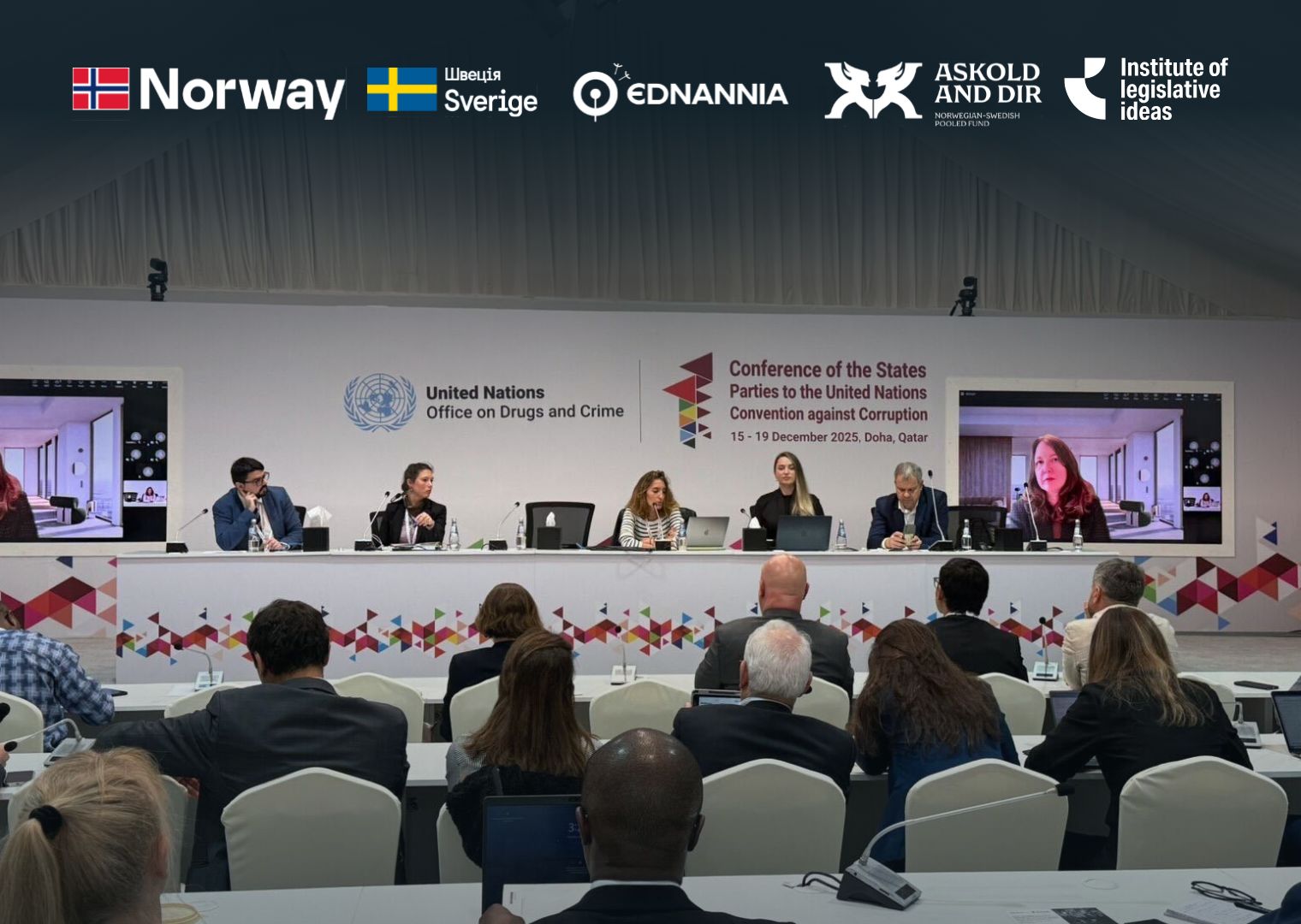

Sanctions can serve as a real financial mechanism for compensation and the reconstruction of Ukraine. Issues of compensation for victims of the war, sanctions policy, and anti-corruption reforms in post-war recovery were among the key topics at UNCAC CoSP11, held in Doha, Qatar. The analytical center Institute of Legislative Ideas took part in this global anti-corruption event as a co-organizer and as the civil society focal point for Ukraine.
During the international discussion, ILI Chairwoman Tetiana Khutor, noted that Russia’s invasion of Ukraine began with state capture — systematic penetration into politics, the economy, the media, and strategic assets.
“Wars rarely start with tanks. Ukraine’s experience shows that long before 2022, Russia attempted to take over Ukraine without weapons — through corruption networks, proxy structures, and control over critical infrastructure. Corruption became a key instrument of this process. State capture did not prevent the full-scale invasion — it prepared the ground for it,” she emphasized.
The expert added that Ukraine’s response has been to strengthen its anti-corruption infrastructure, apply sanctions, use wartime asset confiscation, and develop an investment screening system as tools to genuinely block and neutralize hostile influence — before it turns into a military threat. This experience is universal and relevant far beyond Ukraine.
The ILI also brought to the international discussion one of the most complex issues following war and mass human rights violations: how to make perpetrators pay and ensure that victims actually receive compensation. Tetiana Khutor presented analysis on how sanctions can function as a real financial mechanism for compensation. Using concrete examples from the United States, Canada, and the EU, she demonstrated how these mechanisms already work in practice and what is needed to scale them globally.
“Those who caused harm must pay. The core logic is simple and principled: if an individual or a company facilitated the circumvention of sanctions related to armed aggression, the financial consequences of such violations should be directed toward compensating the damage caused by that aggression. For the ILI, this is systematic work to ensure that justice has a financial dimension and that impunity carries a real cost,” Tetiana Khutor said.
Within the framework of the conference, the ILI co-organized an event focused on integrating anti-corruption tools into post-war recovery so that risks are identified before decisions are made, rather than after scandals emerge. The Head of the ILI stressed that the resilience of Ukraine’s anti-corruption system is the result of constant stress-testing and the role of civil society, which prevents the system from breaking down. The key to this resilience is prevention, particularly at the lawmaking stage.
The ILI also presented the concept of an AI-based system for anti-corruption analysis of legislation. Built on extensive expert datasets, the system enables the automated identification of corruption indicators in draft laws; structuring of risks by type and level of threat; operation through separate user accounts for different users; continuous learning from new data and practice; and transparent, scalable publication of analysis results.
About Institute of Legislative Ideas
The Institute of Legislative Ideas is an independent analytical center working on legislative reforms in Ukraine. Its mission is to analyze public policy, identify problems, and find solutions so that citizens feel protected and comfortable in their country. The Institute works to build a country of equal opportunities, strengthen democracy, and uphold the rule of law.
The organization promotes the development of accountable institutions, expands opportunities for citizens to participate in decision-making, supports the implementation of reforms based on the principles of openness, effectiveness, and democratic governance, and contributes to securing international support for Ukraine. For more information, visit izi.institute.
Disclaimer
This media content is produced by NGO Institute of Legislative Ideas with the support of the Askold and Dir Fund as part of the Strong Civil Society of Ukraine — a Driver of Reforms and Democracy project, implemented by ISAR Ednannia, funded by Norway and Sweden. The contents of this publication are the sole responsibility of NGO Institute of Legislative Ideas and can in no way be taken to reflect the views of the Government of Norway, the Government of Sweden and ISAR Ednannia.
Media Contact
Bogdan Pavlenko
communications@izi.institute
+380 99 925 5495