Global Kratom Coalition Reiterates Support for Bilirakis END 7-OH Act as New Data Exposes Mislabeling Crisis
New data shows poison center calls were flat for six years — until synthetic 7-OH flooded the market.
The Global Kratom Coalition today reiterated its strong support for the END 7-OH Act (H.R. 8000), warning that misleading narratives around the safety of natural kratom leaf are obscuring the real driver behind a recent spike in poison center calls: mislabeled, synthetic products being misleadingly sold as natural kratom. The Coalition emphasized that protecting consumers and preserving access to natural kratom leaf requires urgent, targeted action against these deceptive products.
News reports citing a 1,200% rise in kratom-related poison center calls since 2015 are missing the most important variable: what kind of product is actually driving the surge.
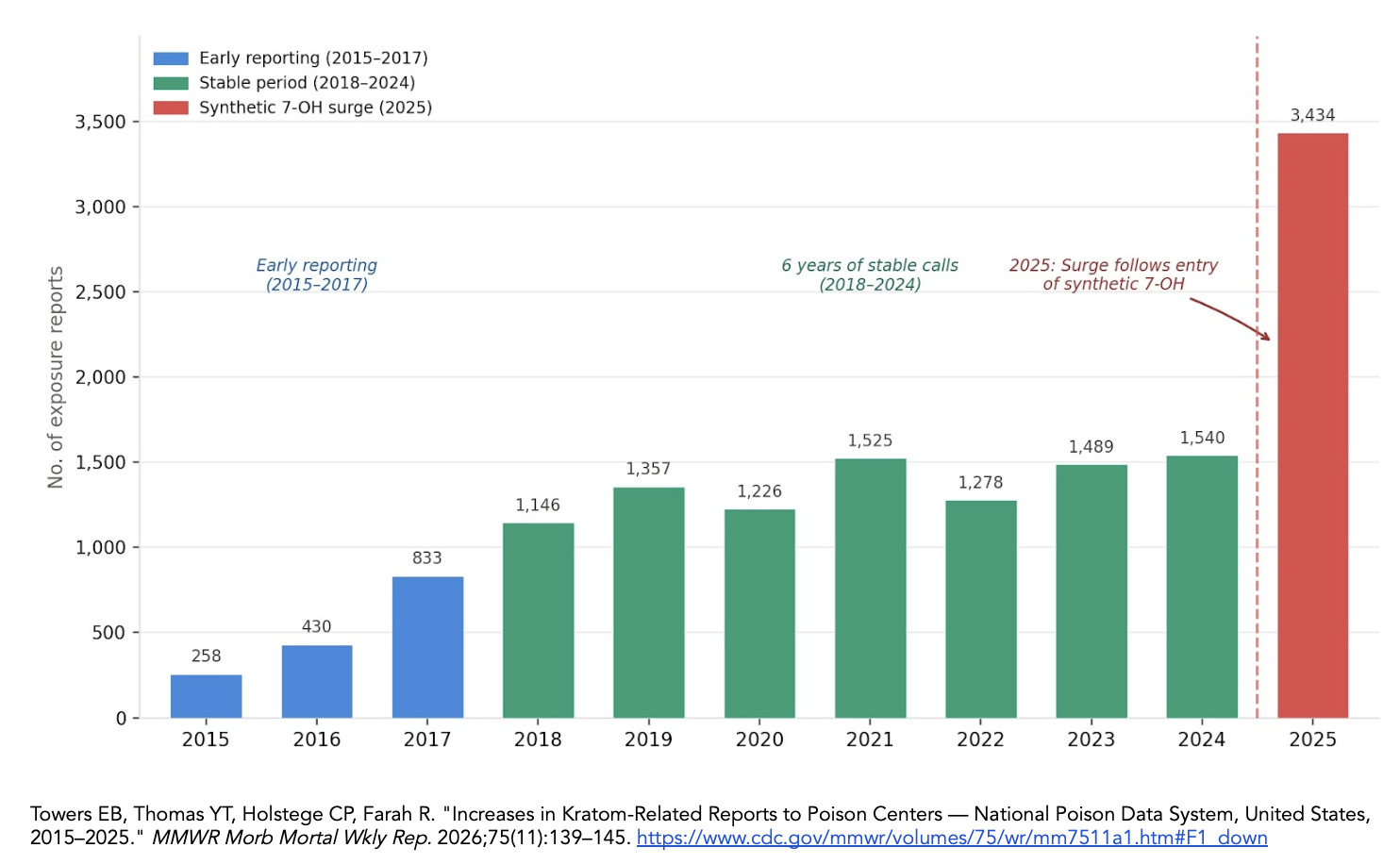
The data tells a clear story. From 2018 through 2024, annual poison center calls involving kratom-labeled products held essentially flat, ranging from 1,146 to 1,540 calls per year over six consecutive years according to the National Poison Data System (NPDS). That is not the profile of a worsening public health crisis. Then came 2025: 3,434 calls — more than double the highest prior year, and a number that spikes the trend line.
What changed? Concentrated synthetic 7-OH products entered the market. These products are falsely marketed as kratom, deceiving consumers who had no way of knowing they were buying a semi-synthetic opioid — a deception that led the FDA to issue a formal warning and recommend federal scheduling for 7-OH as a dangerous controlled substance. The Global Kratom Coalition has consistently warned that failure to distinguish between natural kratom leaf and these engineered compounds puts consumers at risk and undermines evidence-based policymaking.
In July 2025, the FDA recommended scheduling concentrated synthetic 7-hydroxymitragynine (7-OH), while explicitly stating that its action is not on natural kratom leaf. That recommendation has since gained legislative momentum: Rep. Gus Bilirakis introduced the END 7-OH Act (H.R. 8000), cosponsored by Reps. Laurel Lee (R-FL) and Vern Buchanan (R-FL) — both also from Florida, which moved to emergency-schedule concentrated synthetic 7-OH at the state level. This bill would schedule concentrated synthetic 7-OH while explicitly leaving natural kratom leaf untouched. The Coalition strongly supports this approach as a science-driven solution that targets the real source of harm without penalizing responsible consumers.
In June 2024, University of Florida and Johns Hopkins researchers issued a scientific statement on natural 7-OH, noting that it is found in minuscule amounts as an oxidative byproduct of drying kratom leaves, meaning products with high concentrations of 7-OH are semi-synthetic drugs that are masquerading as natural kratom, and companies calling such products "kratom" are making claims that are not scientifically credible and are false.
The March 2026 CDC's MMWR Report on Kratom-Related Reports calls for surveillance to distinguish product types in order to properly assess risk. This is an implicit acknowledgment that lumping concentrated synthetic 7-OH under the "kratom" label distorts the data and causes perverse outcomes for the 23 million natural kratom consumers in the U.S. The Global Kratom Coalition urges regulators and public health officials to adopt clearer definitions and reporting standards to prevent further confusion and protect consumers.
To put the numbers prior to 2025 into context: data from America's Poison Centers data on Kratom vs. caffeine and CBD shows that between 2017 and 2023, kratom-related calls were lower than cannabis, lower than caffeine, energy drinks and CBD. The 2025 surge is alarming precisely because it breaks from that established baseline, not because natural kratom has historically been a major driver of poison center volume.
The data shows a stable six-year baseline followed by a sharp break in 2025. What it does not show is a long-term trend driven by natural kratom leaf. Blaming natural kratom leaf for a crisis driven by a lab-made synthetic opioid isn't just scientifically inaccurate, it directs public health attention away from the actual problem. The Coalition continues to call for targeted enforcement against bad actors and greater transparency in product labeling to ensure consumers know exactly what they are purchasing.
About Global Kratom Coalition
The Global Kratom Coalition is an alliance of natural kratom consumers, experts, and industry leaders dedicated to protecting access to natural leaf kratom while advancing scientific research, driving consumer education, and developing robust regulations to protect consumers. To learn more about the Global Kratom Coalition and its mission, visit globalkratomcoalition.org.
Disclaimer
The information provided in this press release is for informational and educational purposes only and does not constitute legal, regulatory, or medical advice. Support for the END 7-OH Act (H.R. 8000) represents the advocacy position of the Global Kratom Coalition based on publicly available legislative text, FDA recommendations, and scientific literature as of June 2026. This release references data from third-party sources, including the National Poison Data System (NPDS) and the Centers for Disease Control and Prevention (CDC); these references do not imply endorsement or official partnership. Statements regarding the safety, chemical composition, or classification of natural kratom leaf versus synthetic compounds have not been evaluated by the Food and Drug Administration (FDA). Kratom products are not intended to diagnose, treat, cure, or prevent any disease. Forward-looking statements regarding legislative progression or regulatory scheduling are subject to change without notice.
Media Contact
Media Contact
info@globalkratomcoalition.org