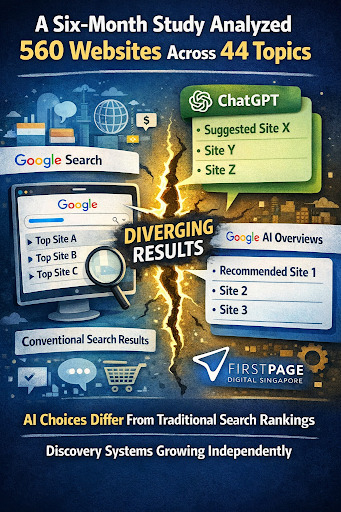

A six-month study analyzing more than 560 websites across 44 commercial topics found that tools such as ChatGPT and Google’s AI Overviews often recommend different companies than those appearing at the top of conventional Google Search results. The findings suggest that online discovery systems are no longer operating in alignment but are instead developing independently.
The research, presented at Google Summit 2025 and First Page Digital Summit 2025 — events hosted by industry groups including Singapore-based digital marketing company First Page Digital Singapore, who specialize in SEO — compared traditional search rankings with AI-generated responses across 20 industry sectors and four business types. First Page Digital is a full-service digital marketing agency based in Singapore offering search engine optimization and related services.
According to the study, which examined how artificial intelligence systems surface information online, brands that dominate Google’s traditional search results are frequently absent from AI-generated recommendations.
Limited Overlap Across Platforms
Overall brand overlap, measured using Jaccard similarity, averaged about 0.21 across all topics. Business-to-business categories showed higher overlap at roughly 0.36, while regulated “Your Money or Your Life” (YMYL) sectors such as legal services and early childhood education recorded overlap as low as 0.10.
Ranking agreement was similarly weak. Spearman rank correlation values averaged around 0.26, indicating that even when platforms surfaced the same brands, they often disagreed on their relative importance.
Agreement on the single most visible recommendation was lowest of all. ChatGPT and traditional Google Search matched on the top result roughly 20–25% of the time. Google’s AI Overviews aligned with standard search results in only 8–11% of cases. Across all AI tools analyzed, first-place agreement averaged below 20%.
Business Model Shapes Alignment
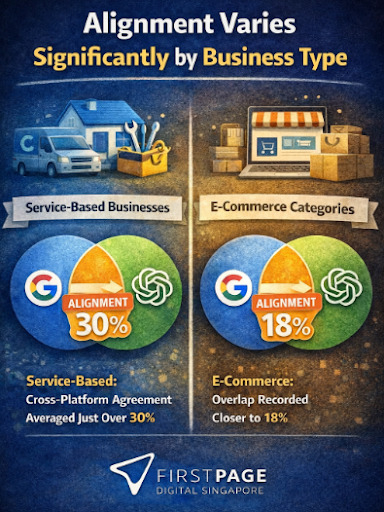
The degree of alignment varied significantly by business type. Service-based businesses showed higher cross-platform agreement, averaging just over 30%, while e-commerce categories recorded overlap closer to 18%.
The researchers attributed the difference to how trust and authority are evaluated. Service businesses tend to be assessed through professional credentials, demonstrated expertise and outcome-based signals. E-commerce platforms rely more heavily on comparative product frameworks, third-party reviews and distributed consumer feedback.
AI systems appear to reflect these distinctions, applying different relevance criteria depending on the commercial context.
Citation Behaviour Differs Sharply
The study also examined which sources AI platforms cited when generating responses. Google’s AI Overviews tended to favour brand-owned commercial pages and sources aligned with traditional ranking signals. ChatGPT more frequently cited editorial articles, listicles and aggregator websites, particularly in consumer and lifestyle categories.
Citation rates varied widely by content type. Consumer electronics listicles accounted for roughly 70% of citations across AI platforms. In home services, ChatGPT cited third-party recommendation lists in about two-thirds of cases, while Google AI Overviews cited brand-owned commercial pages at similar rates.
In regulated industries, AI tools relied heavily on institutional and directory sources. Law firms and preschool providers appeared in AI responses primarily when they were listed in recognised professional registries or government databases, regardless of their search ranking performance.
Authority As An Access Requirement
In YMYL sectors, authority functioned less as a ranking factor and more as a gatekeeper. Law firms appeared in AI outputs in about one-third of general AI Overviews and one-quarter of ChatGPT responses. Preschool providers appeared even less frequently.
The findings suggest that absence from official directories can prevent brands from appearing in AI-generated responses altogether, even when content quality and search performance are strong.
Frequency Over Prominence
Researchers also identified a small number of websites that appeared repeatedly across AI-generated responses, regardless of their position in traditional search results. These included large editorial publishers, comparison platforms, professional ranking organisations and government or regulatory sites.
Examples cited in the research included technology review outlets, legal ranking bodies, government registries and regional news publications.
The pattern suggests that frequency of appearance across multiple contexts increases the likelihood of AI citation. Each reference reinforces the next, creating what researchers described as a compounding effect.
A Structural Shift In Discovery
Unlike traditional search algorithms, AI systems do not evaluate originality or innovation in a qualitative sense. Instead, they generate responses based on statistical likelihood, favouring entities that appear consistently across multiple independent sources using familiar language.
Brands positioned near the conceptual centre of a topic — those described using standard industry terminology and corroborated by overlapping sources — were more likely to be recommended. Distinctive positioning or novel language, when unsupported by third-party references, reduced visibility.
Fragmentation Replaces Convergence
The research concludes that AI-driven discovery systems are no longer reinforcing traditional search performance. Instead, they apply separate relevance frameworks shaped by platform design, industry context and citation availability.
As AI tools become more prominent entry points for information discovery, researchers say visibility will increasingly depend on consistent representation across trusted third-party sources rather than ranking position alone.
The findings point to a broader fragmentation of online discovery, with implications for how companies, publishers and institutions measure visibility in an AI-mediated environment.
About First Page
First Page Digital is a performance-driven SEO agency based in Singapore, committed to helping businesses increase their search visibility and achieve measurable growth. By combining technical expertise, creative content strategies, and transparent reporting, the agency empowers clients to succeed in an increasingly competitive digital marketplace. For more information, visit www.firstpagedigital.sg.
Media Contact
Eugen Kim
info@firstpagedigital.sg