
Vera Clinic, internationally recognised as a leading centre of innovation in hair restoration surgery, has released the full findings of a controlled clinical validation study suggesting that its patented Vector-10™ CVD (Chemical Vapor Deposition) Lab-Grown Diamond blade may reduce post-operative epithelial healing time by up to 40% on average compared to surgical steel, and demonstrates potential improvements over the current industry-standard sapphire instrument across every measured clinical parameter.
The study, conducted in collaboration with material science firm Appsilon Enterprise, independently validated by CinarLabs, and Vera Academy's R&D centre, marks what the clinic describes as the most consequential advancement in FUE (Follicular Unit Extraction) instrumentation in over a decade.
From Sapphire to Diamond: A Lineage of Innovation
The announcement carries particular institutional weight: Vera Clinic was the originating force behind the sapphire-tipped incision tool, a technology that has since been adopted as standard across the global hair transplant industry. The Vector-10™ represents the clinic's deliberate successor to that benchmark, under full patent.
"We built the sapphire standard. We watched it become universal. That was validation enough," said Waleed Taleb, board member of Vera Clinic. "Vector-10™ is what we built after asking what comes next, and this time, the patent belongs to us."
The Clinical Findings of Vector-10™
The study stratified patients undergoing FUE procedures into three groups (historical steel-blade outcomes, a concurrent sapphire-blade control cohort, and the Vector-10™ intervention group) measuring epithelial healing time, inflammatory response, blade force consistency, and patient-reported intraoperative sensation. Key observations from this independent research are as follows:
Epithelial healing time
- Surgical Steel: 7–10 days
- Sapphire: 6–7 days
- Vector-10™ CVD: 5 days (~40% faster)
Visible scabbing at day 5
- Surgical Steel: 89% of patients
- Sapphire: 74% of patients
- Vector-10 CVD: 12% of patients
Blade durability
- Surgical Steel: ~1,000 incision cycles
- Sapphire: ~6,000 incision cycles
- Vector-10 CVD: 150,000+ cycles (zero degradation; ~25× sapphire)
Intraoperative sensation
- Surgical Steel: Detected
- Sapphire: Detected
- Vector-10 CVD: None reported (Ångström-level edge, 10⁻¹⁰ m)
Surgeon force consistency
- Surgical Steel: Degrades during session
- Sapphire: Degrades during session
- Vector-10 CVD: Uniform across 4,000+ grafts (100% of physicians)
Durability data comes from independent fatigue testing conducted by CinarLabs. Clinical outcomes are based on a controlled observational cohort study carried out at Vera Clinic in Istanbul.
"This is my second hair transplant. I felt the incisions in the first one. This time I didn't feel anything at all," said Daniel J. C., a Vector-10™ patient at Vera Clinic.
The Science Behind the CVD Lab-Grown Diamond Blade
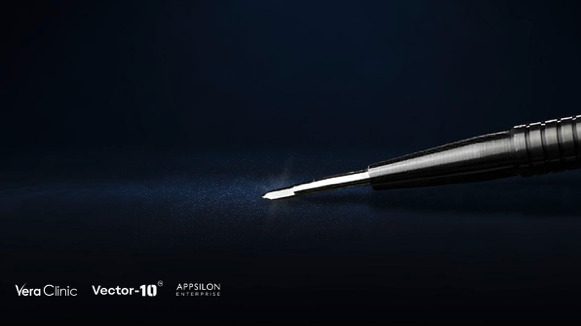
Vector-10™ is manufactured through a CVD process in which carbon atoms are deposited atom by atom onto a substrate in a controlled plasma environment, producing a fully sp³-bonded carbon lattice, the same tetrahedral covalent structure as natural diamond, achieved under laboratory precision. The resulting blade registers 10 on the Mohs hardness scale, the absolute maximum, and maintains an edge radius measurable in Ångströms rather than micrometres. By comparison, traditional sapphire blades register 9 on the same scale.
It is this material superiority, extreme hardness, zero edge degradation across 150,000+ incision cycles, and an Ångström-level cutting geometry, that underpins the clinical observations. The blade's ultra-fine edge is designed to displace rather than drag tissue, generating no frictional heat, no compression trauma, and no mechanical trigger for the inflammatory cascade that drives post-operative oedema, crusting, and extended recovery. These physical properties of the diamond edge are measurable constants; the degree to which individual patients experience accelerated recovery remains subject to biological variability (see Important Considerations below).
Scientific Context and Individual Variability
While these findings represent a meaningful advance in surgical instrumentation, Vera Clinic emphasises that hair transplantation is a biological process influenced by numerous patient-specific variables.
"Our goal with Vector-10™ was to provide our surgeons with the most precise tool possible to minimise trauma," said a lead researcher at Vera Academy. "While our data shows a clear trend toward faster surface healing, it is important to remember that 'recovery' is a multi-phase process. The ultimate success of a transplant still relies on the patient's overall health, their adherence to aftercare protocols, and their individual physiological response."
Vector-10™ Research with Vera Academy
The Vector-10™ was developed through Vera Academy, Vera Clinic's internal medical research and education division, which trains Turkish physicians in advanced hair restoration techniques and functions as the clinic's primary applied R&D arm.
The clinic's recovery infrastructure, including OxyCure (its in-house hyperbaric oxygen therapy system and the only such unit housed within a hair transplant facility globally), operates in clinical complement to the reduced-trauma profile of the Vector-10™.
Global Hair Transplant Market Evaluation with Vector-10™
The global hair restoration market is projected to reach $10.64 billion by 2031 (Grand View Research), driven by expanding patient demographics and the destigmatisation of aesthetic medicine. Istanbul has functioned as the global centre of FUE innovation for over a decade, a position Vera Clinic has shaped directly and which the Vector-10™ is designed to reinforce.
"The Vector-10™ is not merely a surgical instrument," the study concludes. "It is a catalyst for the next era of precision aesthetic medicine, with the potential to transform a daunting medical procedure into a premium refinement experience with a meaningfully accelerated path to recovery."
Important Considerations of the Study
- Individual Results May Vary: The observed average healing time of 5 days and the up-to-40% improvement in epithelial recovery are derived from controlled study parameters. Actual outcomes depend on factors including age, skin type, smoking status, scalp condition, and underlying medical health.
- Comparative Basis: The 40% figure represents the upper bound of improvement observed in a comparison between Vector-10™ and standard surgical steel blades within this study's specific cohort and conditions.
- Professional Consultation Required: Vector-10™ is a precision surgical instrument designed to assist the operating physician. It does not replace the need for a comprehensive medical evaluation, a personalised surgical plan, or qualified clinical oversight.
- Post-Operative Care: Optimal recovery outcomes are observed in conjunction with recommended aftercare, including OxyCure Hyperbaric Oxygen Therapy and prescribed scalp hygiene protocols.
About Vera Clinic
Vera Clinic is an Istanbul-based, internationally accredited centre for hair restoration and aesthetic surgery, operating from a purpose-built facility and serving patients across more than 60 countries. The originating institution behind the sapphire-tipped FUE incision tool and patent holder of the Vector-10™ CVD Lab-Grown Diamond surgical blade, Vera Clinic has twice set the instrumentation standard for an entire industry. Its research and training division, Vera Academy, drives applied R&D and delivers advanced education in hair restoration and facial cosmetic surgery to physicians across Turkey. That infrastructure extends to OxyCure, Vera Clinic's in-house hyperbaric oxygen therapy system and the only such unit housed within a hair transplant facility globally. The clinic's work has been recognised by the European Medicine Award (2021) as the best hair transplant clinic in Turkey, the IDA Design Award (2024), and in 2026 by the Global Excellence Award (GHB), the WhatClinic Patient Satisfaction Award, and the iF Design Award for clinic design.
Vector-10™ is a registered trademark and patented technology of Vera Clinic. All clinical data collected under institutional observational study protocols. CinarLabs independent validation report available on Vera Clinic's website.
Vector-10™ diamond blades demonstrated an average epithelial healing time of 5 days in controlled study conditions, representing an improvement of up to 40% compared to standard surgical steel. Results are subject to individual patient variability. Full study parameters available upon request. For more information, visit www.veraclinic.net.
Media Contact
Vera Clinic
info@veraclinic.net