
What this blog covers
- What press releases are
- The building blocks of a press release
- What to consider when choosing a newswire
What is a press release?
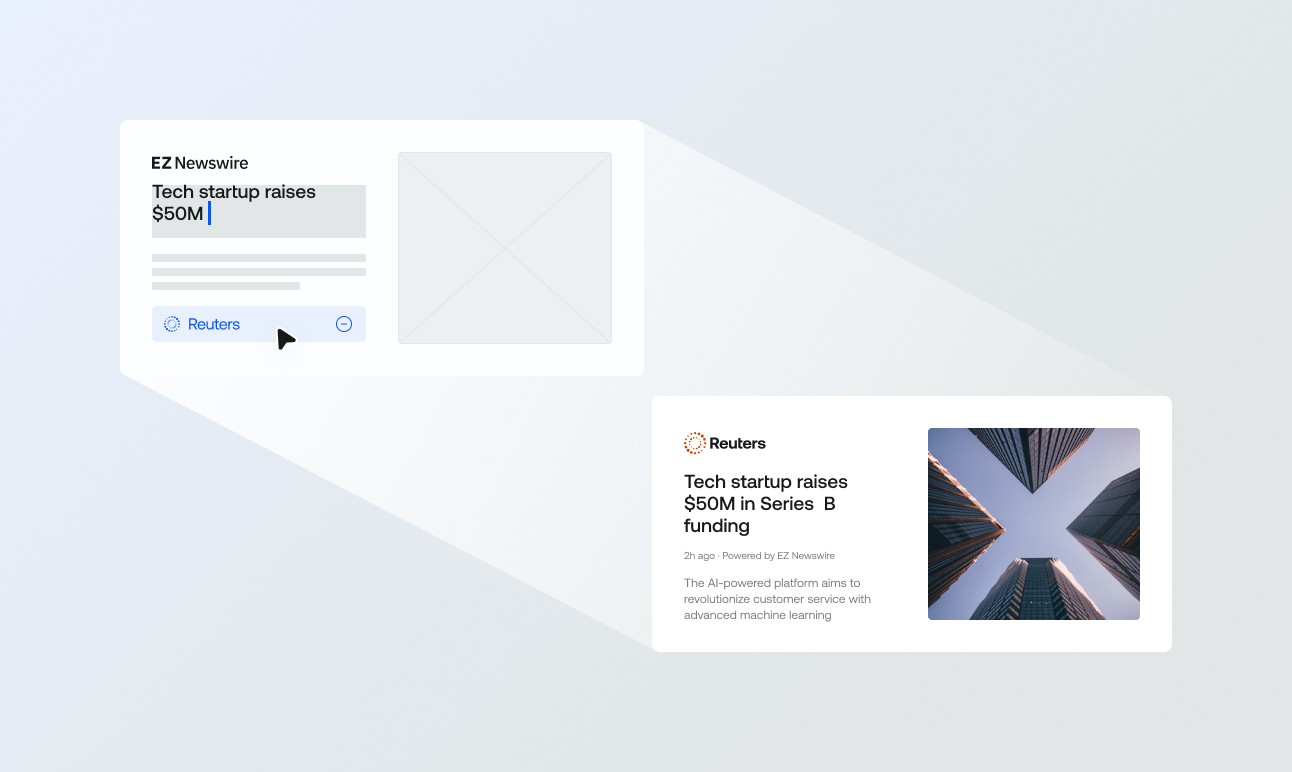
A press release is a short, formal news announcement written in a professional, journalistic style that businesses use to share newsworthy updates with the public and media.
Writing and distributing press releases are more than just due-diligence checks. Today, they’re uniquely powerful visibility assets that, when written properly, accelerate startups and SMBs ability to establish a record of their business’s growth, earn audience attention, and compound their credibility.
Step 1: Identify the news angle
A press release is warranted any time your company has time-bound, newsworthy information to share. Eligible news pegs include, but are not limited to:
- Funding announcements (seed, Series A, Series B)
- Product launches and major feature releases
- Partnerships and integration announcements
- Key executive hires
- Newly published reports
- Awards, certifications, and recognition
- New business location
Of course, not all announcements are required to encompass these categories exactly. For instance, a law firm could share news about a recent six-figure settlement; a cybersecurity company could reveal a successfully terminated cyberattack campaign; a nonprofit organization could announce raising significant capital for medical research; and so on.
As long as the news is focused on a time-sensitive, verifiable event — not a vague announcement or future aspiration — that creates a discernible change in your organization, it qualifies as a press release.
Step 2: Write the headline
Writing a strong news release headline is less about being clever — and more about being instantly clear, credible, and scannable. And given today’s notoriously limited attention economy, you’ve got no more than three seconds to hook the reader with a headline that identifies the company in question and the subject of its announcement.
Here are some guidelines to follow:
- Lead with the core of the news
- Be specific (numbers win attention)
- Keep it concise. 8-14 words for search engine optimization
- Use strong, active language that illustrates action and momentum (e.g., launches, secures, partners, expands, acquires, unveils, reports)
- Avoid empty superlatives as they reduce trust (revolutionary, game-changing, best-in-class)
- Refrain from blog/thought leadership-style headlines
Just remember, simplicity trumps complexity. When in doubt, follow this formula: [Who/what] + [what happened] + [specific detail or outcome]
Strong examples:
- Company X Raises $15 Million to Automate Cross-Border Invoicing
- Company Y Launches AI Hiring Platform to Cut Recruiting Time 60%
- Company Z Partners with Company X to Streamline International Payments Platform
Weak examples:
- How Invoicing Differs Across Countries and Why It Matters for Businesses
- How AI Is Changing the Hiring Process and Reducing Recruiting Time
- How Partnerships Are Revolutionizing the Future of International Payments
Step 3: Write the first paragraph (who, what, when, where, why)
After inputting the city and state from which your business operates (or the city and country, if outside the U.S.) the first body paragraph of a press release plays a very specific role: it encapsulates the full story right away. If your headline manages to earn the click, this paragraph determines whether an interested party continues reading.
Start by leading with a complete, self-contained summary that avoids contextual fluff. Rather, the first paragraph should answer these five core questions immediately within the first 2–3 sentences: who, what, when, where, and why it matters.
Remember, this paragraph should read like news — not marketing. Plain, factual messaging communicates credibility; hype language will fuel skepticism and will likely fail to meet publication standards for press release distribution in the first place.
Strong example:
- New York, NY — Company X today launched an AI-powered hiring platform designed to reduce recruiting time by up to 60%, as companies face increasing pressure to streamline talent acquisition.
Weak example:
- New York, NY — In today’s fast-changing hiring landscape, it is important to note that many companies are starting to look at new ways to attract talent. Company X’s industry-leading and cutting-edge hiring platform offers a revolutionary alternative.
If someone only reads the headline and this paragraph, they should fully understand the story. If they don’t, this section needs tightening.
Step 4: Write the body
The rest of the body text following the opening sentences should be driven by supporting information, quotes from key stakeholders, and insight detailing why the news matters. It should maintain an objective, professional tone and use clear, accessible language as much as possible. 800-1,000 words is the authoritative sweet-spot.
For supporting information: Avoid vague generalizations. Use factual data, statistics, research findings, and/or official achievements with appropriate hyperlinks to back up your claims.
For quotes: Avoid filler. Include quotes that advance the narrative, not ones that restate the headline. Good quotes add context, demonstrate expertise, or reveal nuance that numbers alone don’t show.
- Quotes that add context: A strong quote might provide insight into the strategy behind the announcement, the long-term vision, or the emotional impact on customers or employees.
- Quotes that demonstrate expertise: Quotes from a CEO, CTO, or team lead should leverage their authority to validate the news. For example, a quote from a CTO about a new technology should explain why that technology pushes boundaries, not just that it exists.
- Quotes that reveal nuance: The best quotes often reveal aspects that data alone may not communicate clearly, such as the company philosophy, commitment to a social cause, or an innovative path forward.
For insight: Dedicate a paragraph or two explaining the broader significance of the announcement like how your news affects the industry landscape, consumers, or the company’s growth moving forward.
Step 5: Add a boilerplate
Though optional, adding a boilerplate is highly recommended. A boilerplate in a press release is a short, standardized paragraph at the end that provides background information about the company or organization issuing the release. It typically includes key details like the company’s mission, services, and a brief overview to give readers context.
It is positioned at the end of every press release you issue and serves as an "About Us" section for quick reference. This crucial section provides readers — especially journalists — with a singular, concise, and informative paragraph that succinctly describes your organization. If multiple organizations are part of the announcement, each can have their own boilerplate appended to the news release.
Key Requirements:
- Length: Boilerplate length can vary, but five sentences is a good target. It must be brief enough to be easily digestible but comprehensive enough to convey the essence of your business.
- Content: It should include the company name, its mission, what it does or provides, and its primary audience or industry focus. Information often includes a key achievement, a major differentiator, or a market position. Sign off with a business URL.
- Consistency: Messaging should be identical in every press release. This consistency reinforces both brand identity and strengthens how your company is perceived online.
Strong example:
- Company X is a task management SaaS platform designed to help modern teams plan, prioritize, and execute work more efficiently. Its mission is to eliminate busywork by combining intuitive collaboration tools with intelligent automation. The platform offers dynamic task tracking, real-time workflow optimization, and AI-assisted prioritization in a unified workspace. Serving startups, distributed teams, and enterprise organizations, Company X is especially focused on technology, marketing, and operations-driven industries through its proprietary adaptive workflow engine. For more information, visit www.companyx.com.
Weak example:
- Company X is a company that makes a task management platform for teams to get things done. It offers different tools for tracking tasks and organizing work in one place. The goal is to help teams work better and stay on top of their projects. It is used by a variety of businesses across different industries. Company X continues to grow and improve its platform over time. Website: www.companyx.com.
Step 6: Add a disclaimer
Though optional, a disclaimer is necessary whenever a statement could be misunderstood as a guarantee, a promise, or an objective claim — especially in contexts involving projections, opinions, partnerships, or regulated industries. Common examples include forward-looking statements (e.g., growth expectations), financial or investment-related content, health or legal information, and situations where a company references third parties without implying endorsement.
Disclaimers serve three main purposes:
- They protect against legal risk by clarifying the limits of what is being claimed.
- They set accurate expectations for the audience, reducing the chance of misinterpretation.
- They signal transparency and professionalism, showing that the organization understands the boundaries of its statements.
To write a disclaimer effectively, keep it clear, specific, and proportional to the claim it supports. Generic, catch-all language is less effective than wording that directly reflects the actual risk or limitation involved.
Step 7: Add a media contact
Directly following the boilerplate (or the disclaimer, if you decide to include it), you are encouraged to provide clear and current media contact information. This is essential for journalists or any other interested party who’d like to schedule interviews or request additional information and materials.
Include any of the following:
- Contact name: The full name of the person authorized to speak to the media
- Title: The contact person's official job title
- Organization: The company name (even if redundant, it reinforces entity consistency)
- Phone number: A direct number where the contact can be reached during business hours
- Email address: A dedicated media or PR email address for written inquiries
Get started with EZ Newswire
With EZ Newswire, you can secure targeted placements on top-tier news outlets, strengthen your brand’s credibility, and track performance — without the guesswork.
And if you’re unsure where to start, don’t worry. EZ Newswire offers an assistive AI tool designed to organize your key messaging points into a professional press release suitable for premium publisher newsrooms, which you can fine tune as you see fit.
Release your announcement on EZ Newswire today or reach out directly at hello@eznewswire.com to learn how we can help amplify your next press release.
Frequently asked questions (FAQs)
What is EZ Newswire?
EZ Newswire empowers organizations to turn their news into brand visibility and measurable performance. Our AI-enabled platform, distribution network, and advanced data and verification capabilities make it easy to publish authoritative news in premium environments. From startup to scale-up to S&P 500, the most influential organizations rely on EZ Newswire to communicate smarter. For more information, visit www.eznewswire.com.
What makes a press release newsworthy?
A press release must center on a time-sensitive, verifiable event that represents a meaningful change — such as funding, product launches, partnerships, or major milestones. Vague updates or future plans without substance don’t qualify.
How long should a press release be?
To optimize for AI, aim for 800-1,000 words for your press release. This range achieves a balance of depth, substance, and visibility that outperforms shorter releases.
What is the most important part of a press release?
The headline and first paragraph are the most critical. Together, they should clearly communicate the full story — who, what, when, where, and why it matters — within seconds.
What should I include in the body of my press release?
Use concrete data, credible sources, and meaningful quotes. Strong quotes should add insight, demonstrate expertise, or provide context — not just repeat the headline.
When should I include a disclaimer?
Include a disclaimer whenever your release contains forward-looking statements, financial claims, legal or health-related information, or anything that could be misinterpreted as a guarantee.
Does a press release need a boilerplate?
While optional, a boilerplate is highly recommended. It provides a consistent, concise “About Us” section that reinforces your brand identity and helps journalists quickly understand your company.