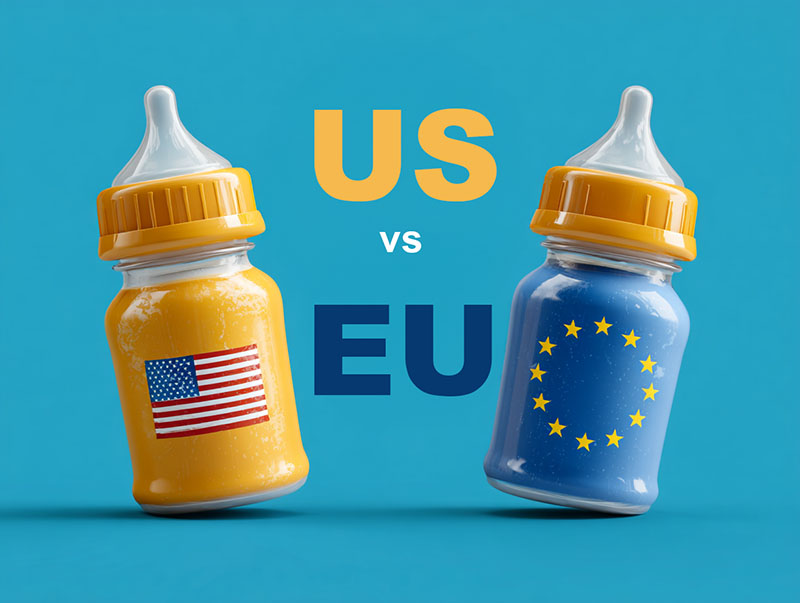

For parents seeking the safest organic baby formula, the differences between U.S., European, and Australian standards are more than regulatory nuance, they are a matter of health and trust. While the U.S. formula industry is shaped by corporate consolidation, weak oversight, and outdated nutritional guidelines, the E.U. and Australia prioritize infant safety through stricter regulations, cleaner ingredients, and mandatory third-party testing.
Over the past five years, the U.S. has faced multiple formula recalls due to contamination with bacteria and heavy metals. In contrast, E.U. and Australian formulas are held to higher standards for ingredient purity, environmental safety, and nutritional completeness. These countries ban additives like corn syrup solids, GMOs, and synthetic preservatives; all of which are still common in American formulas.
As more pediatricians recognize the benefits of international formulas, especially for babies with tummy sensitivities, parents are turning to trusted brands like HiPP, Holle, Kendamil, Jovie, and Sprout Organic. This article explores the systemic flaws in the U.S. formula market and why E.U. and Australian options offer a safer, more transparent alternative.
Formula Industry Regulatory Influence and Recalls
Between 2020 and 2023, the U.S. saw 12 formula recalls, seven of which were due to bacterial contamination like Cronobacter sakazakii. These incidents highlight the risks of relying on internal audits and industry-submitted safety data. E.U. and Australian regulators enforce independent testing and precautionary bans on questionable ingredients.
Formula Market Consolidation and Barriers
Four companies control 97% of U.S. formula production. This dominance creates supply chain fragility, as seen in the 2022 Abbott recall that led to a 74% stock-out rate.
The WIC program, while expanding access, reinforces single-supplier contracts that limit competition and innovation.
The FDA’s regulatory framework further entrenches this dominance. Extensive clinical testing and subjective approval timelines create artificial barriers to entry, especially for goat milk and plant-based formulas.
Ingredient Quality and Contaminants in US Baby Formula
The FDA is currently reviewing its nutrient standards for the first time since 1998.
There is a significant difference in the philosophy of the food regulators in the E.U. and Australia, as they ban ingredients if there’s any uncertainty about safety, especially for infants. Whereas the U.S. employs a more reactive model that allows ingredients until proven harmful, often relying on industry-submitted data, with such influence delaying reforms
A 2025 Consumer Reports study found concerning levels of contaminants in half of the 41 U.S. formulas tested:
- Lead and arsenic: Found at levels exceeding EPA limits
- PFAS and BPA: Linked to immune disruption and endocrine issues
- Acrylamide: A probable carcinogen formed during processing
E.U. and Australian formulas undergo mandatory third-party testing and adhere to strict contaminant limits.
Organic Formula Standards Comparison
E.U. and Australian organic standards for infant formula are stricter than U.S. standards, especially regarding synthetic additives, GMOs, and ingredient purity. Many formulas labeled “organic” in the U.S. would not qualify under E.U. or Australian rules.
The organic standards in the E.U. and Australia guarantee that the formula is free of hormones, GMOs, added sugars, artificial preservatives, antibiotics and pesticides.
HiPP and Holle meet even higher standards, such as Demeter and Biodynamic standards respectively.
Here are the key differences in organic standards for infant formula:
Minimum Organic Content
- U.S. (USDA Organic): 70% for “Made with Organic” label; 95% for “Organic” label
- E.U. Organic: 95% minimum
- Australia (ACO Certified): 95% minimum
GMOs
- U.S. (USDA Organic): Allowed in farming inputs; prohibited in final product
- E.U. Organic: Strictly prohibited; mandatory GMO testing
- Australia (ACO Certified): Strictly prohibited; mandatory GMO testing
Animal Welfare
- U.S. (USDA Organic): Outdoor access required; grazing not mandated
- E.U. Organic: Mandatory grazing and outdoor access
- Australia (ACO Certified): Mandatory grazing and outdoor access
Pesticides and Fertilizers
- U.S. (USDA Organic): Some synthetic inputs allowed
- E.U. Organic: Only natural inputs permitted
- Australia (ACO Certified): Only natural inputs permitted
How to Choose the Safest Organic Baby Formula
The U.S. baby formula market is riddled with systemic flaw, from regulatory capture and market consolidation to weak contaminant oversight and misleading organic labeling. These issues pose real risks to infant health and limit parental choice.
In contrast, E.U. and Australian formulas offer a cleaner, safer alternative. They ban questionable ingredients, enforce strict contaminant limits, and require essential nutrients like DHA and ARA.
Pediatricians such as Dr. Michelle Perro now endorse these options, especially for babies with tummy sensitivities or digestive issues.
For parents prioritizing purity, transparency, and minimal processing, international formulas like HiPP, Holle, Kendamil, Jovie, and Sprout Organic stand out. When sourced from trusted U.S. distributors like Grow Organic Baby, concerns about importing and storage are resolved.
Choosing the safest organic formula means looking beyond labels and marketing. It requires informed research, professional guidance, and a commitment to sourcing from brands that put infant health first. In today’s landscape, E.U. and Australian formulas aren’t just alternatives, they are the gold standard.
About Grow Organic Baby
Since 2016, Grow Organic Baby has provided U.S. families with premium European and Australian baby formulas. As the exclusive U.S. distributor of Sprout Organic infant formula, we deliver safe, clean-label nutrition trusted worldwide. With a curated range of the world’s best formulas and a commitment to ingredient purity, Grow Organic Baby ensures parents can access these products with confidence. Learn more at groworganicbaby.com.
Media Contact
Rodney Hyde
CEO, Grow Organic Baby
admin@groworganicbaby.com
+1 310-384-1163