
Meta has released SAM Audio, a new research model designed to segment sound using text, visual, and temporal prompts. The project extends Meta’s earlier “Segment Anything” concept into the audio domain and signals growing interest in sound separation as a core area of AI research.
While the model itself is experimental, its arrival has already sparked discussion across the music and audio technology community, especially among creators searching for vocal remover tools and professionals working with music stem separation in production environments.
The release raises a familiar question: how much does a research model like SAM Audio change what musicians, producers, and engineers can actually use today?
What is SAM Audio and Meta’s Benchmark in terms of vocal removal and pro music stem separation?
SAM Audio is a unified, multimodal model that can isolate sounds based on natural language prompts such as “vocals,” “guitar,” or “background noise.” In video-based scenarios, it can also rely on visual information to guide the separation process.
From a research perspective, the model explores open-vocabulary sound segmentation, where the system is not limited to a fixed set of predefined audio classes. That makes it useful for studying how audio, text, and visuals interact in complex recordings.
At the same time, Meta positions SAM Audio as a research system rather than a consumer or professional product. Running the model requires high-end hardware, including NVIDIA A100 GPUs, along with technical expertise and long processing times. According to Meta’s own benchmarks, SAM Audio operates at roughly 0.7× real time on an A100, meaning that even short clips demand substantial compute resources.
Online searches for “vocal remover” usually reflect a simple need: users want to isolate or remove vocals from a song, often for karaoke, remixing, or learning to play an instrument. In practice, vocal removal is just one part of a broader category known as music stem separation, which involves splitting a track into components such as vocals, drums, bass, synths, guitars, lead and back vocals, other instruments, and even echo and reverb removal.
Research models like SAM Audio approach this problem from a very wide angle. They are built to separate almost any sound from any mixture, including noisy or unstructured recordings. This makes them useful for experimentation, academic work, and certain multimodal tasks.
However, the expectations around vocal removal in music production are narrower and stricter. Users are not simply looking for isolated sound; they expect the result to preserve stereo width, timing, ambience, and tonal balance, especially in professional music production tasks. These details are often what determine whether a separated vocal is usable in a real project.
Research Models vs. Production Tools
The difference between research capability and production usability becomes clear when looking at how SAM Audio processes sound. The Meta’s model operates in mono, which limits its ability to preserve stereo information and spatial effects. For creative workflows such as remixing, mastering, or archival work, this is a practical constraint. Reverbs, delays, and spatial cues are not decorative elements in music; they are part of the mix itself.
This is where production-focused tools take a different approach. Instead of trying to separate any sound from any context, commercial stem separation systems are usually trained on music-specific data and optimized for speed, consistency, and fidelity. The goal is not flexibility at all costs, but predictable results that match the original track as closely as possible.
LALAL.AI Appeared in Meta’s Benchmark as a Leading Professional Instrument and Vocal Remover
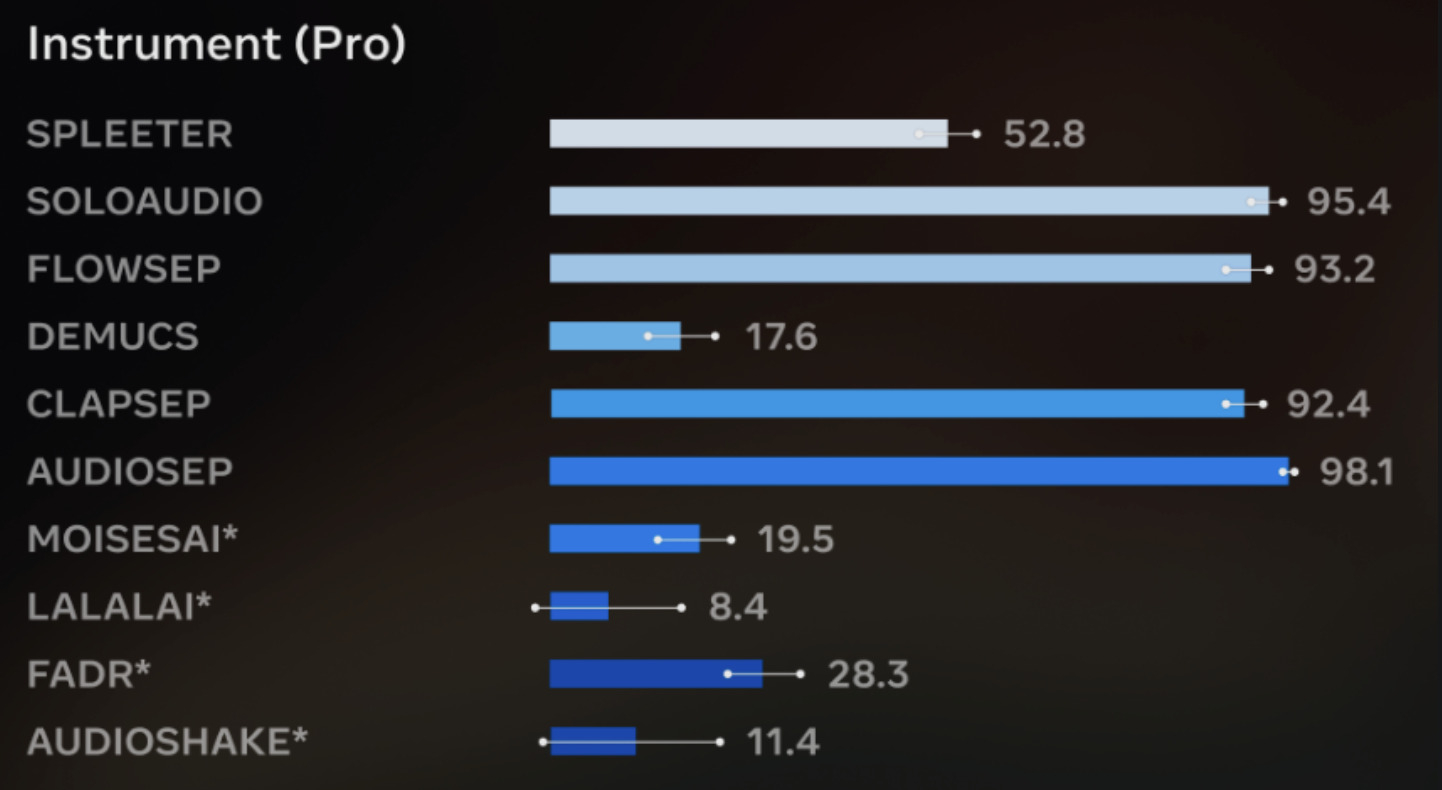
In Meta’s published evaluation, LALAL.AI was included as one of the commercial reference solutions alongside services such as Moises, AudioShake, and FADR. The benchmark compared SAM Audio’s output with that of existing music separation tools across several categories.
SAM Audio achieved the highest overall scores in instrument separation, including vocals. Among commercial systems, LALAL.AI showed the smallest performance gap relative to the research model in professional instrument separation tasks, vocal isolation included.
“Being selected as a reference in Meta’s benchmark confirms that LALAL.AI continues to set the standard for high-quality, production-ready music stem separation,” said Nik Pogorski, LALAL.AI product owner and co-founder. “Among all commercial services evaluated, we achieved the smallest performance gap to the research-level SAM Audio, while offering fast, accessible, and reliable solutions for professional workflows.”
LALAL.AI’s approach relies on transformer-based architectures designed specifically for audio. Unlike generative diffusion models, these systems are discriminative rather than generative: they focus on separating existing sound rather than recreating or resynthesizing it. This design choice helps preserve stereo imaging, phase alignment, and subtle details such as reverb tails: factors that are critical for studio-quality vocal extraction.
As a leader in the Instruments (Pro) category among other commercial services and vocal removers, LALAL.AI is the cross-platform tool that is available to plenty of creators and businesses, from hobbyists and karaoke lovers to pro audio engineers and labels, on every device, in every scenario, and now, with the release of its VST plugin, in a direct integration with multiple DAWs.
To remove vocals from a song, an audio file, or even a video recording, creators just have to upload the recording to LALAL.AI (either on desktop, mobile, or web) and choose the Vocal & Instrumental stem.
Speed and Accessibility in Real Vocal Isolation Workflows
Benchmarks provide useful reference points, but they do not fully reflect how tools are used day to day. For most musicians and producers, the key questions are practical ones: how fast the separation runs, what hardware is required, how clean vocals are, and whether the output can be used immediately.
LALAL.AI is built to run on standard consumer and professional setups, including desktop applications, mobile apps, and a VST plugin that integrates into existing audio workstations, which contrasts with research systems like SAM Audio, which are designed to explore what is possible under laboratory conditions rather than to support routine production work.
Universal models may perform well on noisy recordings, speech-heavy content, or multimodal scenarios that combine audio and video. These use cases matter, but they differ from the controlled, high-quality source material typically used in music production.
What This Means Going Forward
Meta’s SAM Audio highlights how quickly audio research is progressing and how much attention sound separation is now receiving within the broader AI field. Its release does not replace existing vocal remover tools or professional stem separation services, but it does help clarify the boundaries between research exploration and production-ready software and showcases how the field is developing.
For creators searching for reliable vocal removal today, the distinction remains clear. Research models expand the range of what can be studied. Production tools define what can be used, at scale, without specialized infrastructure. Both approaches are likely to coexist and serve different needs, under different constraints, and for very different audiences.
About LALAL.AI
LALAL.AI is an AI-powered audio processing platform that helps users extract vocals, instruments, and other audio components from music and video files. Launched in 2020 in Switzerland, it quickly grew from a 2-stem splitter to the world’s first 10-stem solution. Over the years, LALAL.AI expanded across desktop, mobile, VST, and API, added noise reduction, echo removal, and voice modification features. The service is now used by over six million musicians, producers, audio engineers, content creators, and media professionals around the world. For more information, visit www.lalal.ai.
Media Contact
Klara Alexeeva
PR & Communications Manager, LALAL.AI
klara.alexeeva@lalal.ai